
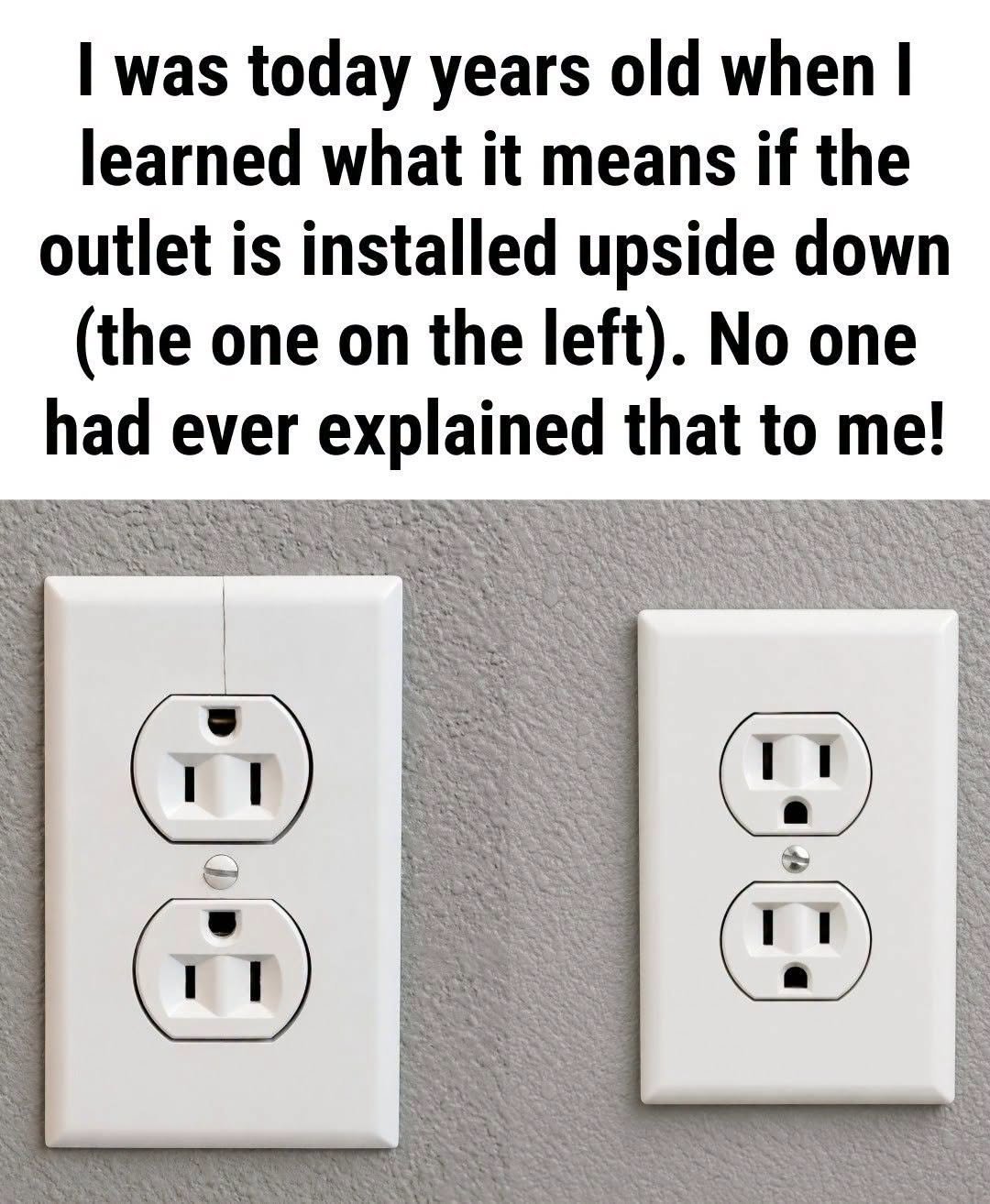
Have you ever walked into a room and noticed that one electrical outlet appears to be installed upside down?
At first glance, it may look like an installation mistake. After all, most residential wall outlets are installed with the grounding hole facing downward, so seeing one positioned the opposite way can immediately catch your attention.
But an upside-down outlet isn’t necessarily a mistake.
In many homes, an inverted receptacle can serve as a visual clue that the outlet is controlled by a nearby wall switch. This setup is especially common in bedrooms, living rooms, dens, and older homes where a room may not have originally included a ceiling light.
However, there’s an important detail to remember: an upside-down outlet does not automatically mean it is controlled by a switch.
Outlet orientation can vary according to local practices, electrician preference, the age of the home, or previous electrical work.
So what does that unusual orientation actually mean?
What Does an Upside-Down Outlet Usually Mean?
An electrical outlet installed with the grounding opening at the top may indicate that the receptacle is switch-controlled.
This type of setup was commonly used in rooms where a ceiling-mounted light fixture wasn’t installed. Instead of adding overhead lighting, an electrician could wire a wall switch to control a receptacle where a homeowner could plug in a table lamp or floor lamp.
With this arrangement, turning on the wall switch can provide room lighting without requiring a ceiling fixture.
In many installations, only one half of a duplex receptacle is switched.
That means one plug remains energized continuously, while the other is connected to the wall switch.
For example, you might plug a lamp into the switched portion and connect a clock or another device that needs continuous power to the always-on portion.
This arrangement can be particularly convenient because a single wall switch can effectively control a lamp without requiring additional wiring.
Why Would an Electrician Flip the Outlet?
The upside-down orientation can act as a quick visual indicator.
Imagine entering a room with several outlets. If one receptacle is installed in the opposite orientation from the others, an electrician or homeowner may immediately recognize that something about that outlet’s wiring could be different.
In some homes, this convention is used specifically to identify a switched receptacle.
However, it is not a universal rule.
An electrician may install every receptacle in the same orientation, regardless of whether it is switched. Another electrician may use an inverted orientation as a helpful visual distinction.
A previous homeowner could also have replaced an outlet and accidentally installed it in the opposite orientation.
Therefore, orientation alone should never be treated as proof of how an outlet is wired.
There Is No Universal Rule That Upside-Down Means Switched
This is one of the most important points to understand.
There isn’t a universal residential rule requiring every switch-controlled receptacle to be installed upside down.
Electrical installation requirements can vary depending on the applicable electrical code, local jurisdiction, and installation circumstances. The physical orientation of a standard receptacle is not, by itself, a reliable way to determine what a wall switch controls.
That’s why you shouldn’t assume that an upside-down outlet is switched—or that a normally oriented outlet isn’t.
Instead, the outlet should be tested safely.
How to Tell Whether an Outlet Is Controlled by a Wall Switch
How to Tell Whether an Outlet Is Controlled by a Wall Switch
You don’t need to remove the receptacle or touch any electrical wiring to check whether a nearby switch controls it.
A simple lamp can often help.
Plug the lamp into one portion of the outlet and turn the lamp on. Then operate nearby wall switches one at a time.
If the lamp responds to a particular switch, you’ve likely identified a switch-controlled receptacle.
If nothing happens, try the other portion of the duplex outlet.
Remember that many older installations have only one switched half, while the other remains powered continuously.
If neither side responds, the wall switch may control a different outlet, a ceiling fixture, or another light in the room.
Look at the Room’s Lighting Layout
The location of the outlet can also provide a useful clue.
Switch-controlled receptacles are often positioned where a homeowner might naturally place a lamp.
You may find one near a sofa, beside a bed, along a wall where a table normally sits, or in a corner suitable for a floor lamp.
This makes sense from a practical standpoint: the electrician was providing a convenient way to turn on room lighting from the wall without requiring an overhead fixture.
Why Are Some Outlets Installed With the Grounding Hole on Top?
There is another reason you might see an outlet installed upside down that has nothing to do with a wall switch.
Some electricians prefer installing receptacles with the grounding connection at the top.
One argument for this orientation involves the possibility of a metal object coming into contact with a partially inserted or loose plug. With the grounding opening positioned above the energized slots, the grounding contact may be encountered first in certain circumstances.
Ground-up receptacles are also encountered in some commercial, industrial, and specialized environments.
However, neither orientation automatically makes a properly installed receptacle unsafe.
The important factors include correct wiring, grounding, appropriate protection, secure connections, and compliance with the electrical requirements applicable to the installation.
An Upside-Down Outlet Isn’t Automatically Dangerous
Seeing an inverted wall outlet can make homeowners nervous, especially if every other receptacle in the house faces the opposite direction.
But orientation by itself doesn’t tell you whether an outlet is safe or unsafe.
Electrical safety depends on the condition and configuration of the entire installation.
Warning signs deserve much more attention than whether the grounding opening is facing upward or downward.
For example, stop using an outlet and have it inspected by a qualified electrician if you notice:
- Burning or scorching marks
- A receptacle that becomes unusually hot
- Buzzing, crackling, or unusual electrical sounds
- A loose plug that repeatedly falls out
- Visible damage to the receptacle
- Sparks or signs of overheating
- Repeated tripping of a circuit breaker
These problems can indicate an electrical issue that requires professional attention.
Don’t Assume a Nonworking Outlet Is Broken
One of the easiest mistakes homeowners make is assuming an outlet is defective simply because a device doesn’t receive power.
Before concluding that a receptacle has failed, check nearby wall switches.
This is particularly useful in bedrooms, living rooms, and older homes where switched outlets may have been used as an alternative to ceiling lighting.
A homeowner who moves into an older property may discover a wall switch that appears to do nothing. In reality, that switch could be controlling an outlet somewhere else in the room.
Once you identify the correct receptacle, the purpose of the switch suddenly becomes clear.
Be Careful About What You Plug Into a Switched Outlet
If you discover that one half of a receptacle is controlled by a wall switch, think about what you connect to it.
A lamp is an obvious choice because you may want to turn it on and off from the wall.
Devices that need uninterrupted power should generally be connected to an always-on receptacle instead. Depending on the setup, this might include certain clocks, networking equipment, or other electronics for which unexpected power interruption would be inconvenient.
Most importantly, don’t overload the circuit.
A switched outlet is still part of an electrical circuit with a specific capacity. Avoid connecting high-wattage equipment unless you know that the circuit and receptacle are appropriate for the load.
Should You Turn an Outlet Around Yourself?
If you simply prefer the appearance of an outlet facing the opposite direction, it might seem like an easy DIY project.
But changing the orientation requires opening the electrical box and handling electrical connections.
Turning off a wall switch is not enough to make the work safe. Power must be disconnected at the appropriate circuit breaker, and the circuit should be properly tested before any wiring is handled.
There can also be additional complications involving split receptacles, GFCI protection, multi-wire branch circuits, older wiring, or other components connected to the same circuit.
For anyone who isn’t trained and experienced in residential electrical work, having a licensed electrician inspect or modify the receptacle is the safer choice.
Renters should also check with their landlord or property manager before making electrical modifications.
The Interesting Clue Hidden in Your Walls
An upside-down outlet may look like a simple installation mistake, but sometimes it tells you something about how a home was designed.
It may indicate a switch-controlled receptacle, particularly in a room that doesn’t have a ceiling light. It can also reflect an electrician’s preferred installation method, a previous repair, or simply the orientation chosen when the outlet was installed.
That’s why the best approach is to treat the unusual orientation as a clue, not a guarantee.
If you’re curious about an upside-down outlet in your home, safely test it with a lamp and check the nearby switches rather than assuming what the wiring does.
And if an outlet shows signs of overheating, damage, unusual sounds, or other electrical problems, don’t experiment with it—have a qualified professional inspect it.
Sometimes, that seemingly strange outlet isn’t a mistake at all. It may simply be a small reminder of the way your home’s electrical system was designed.