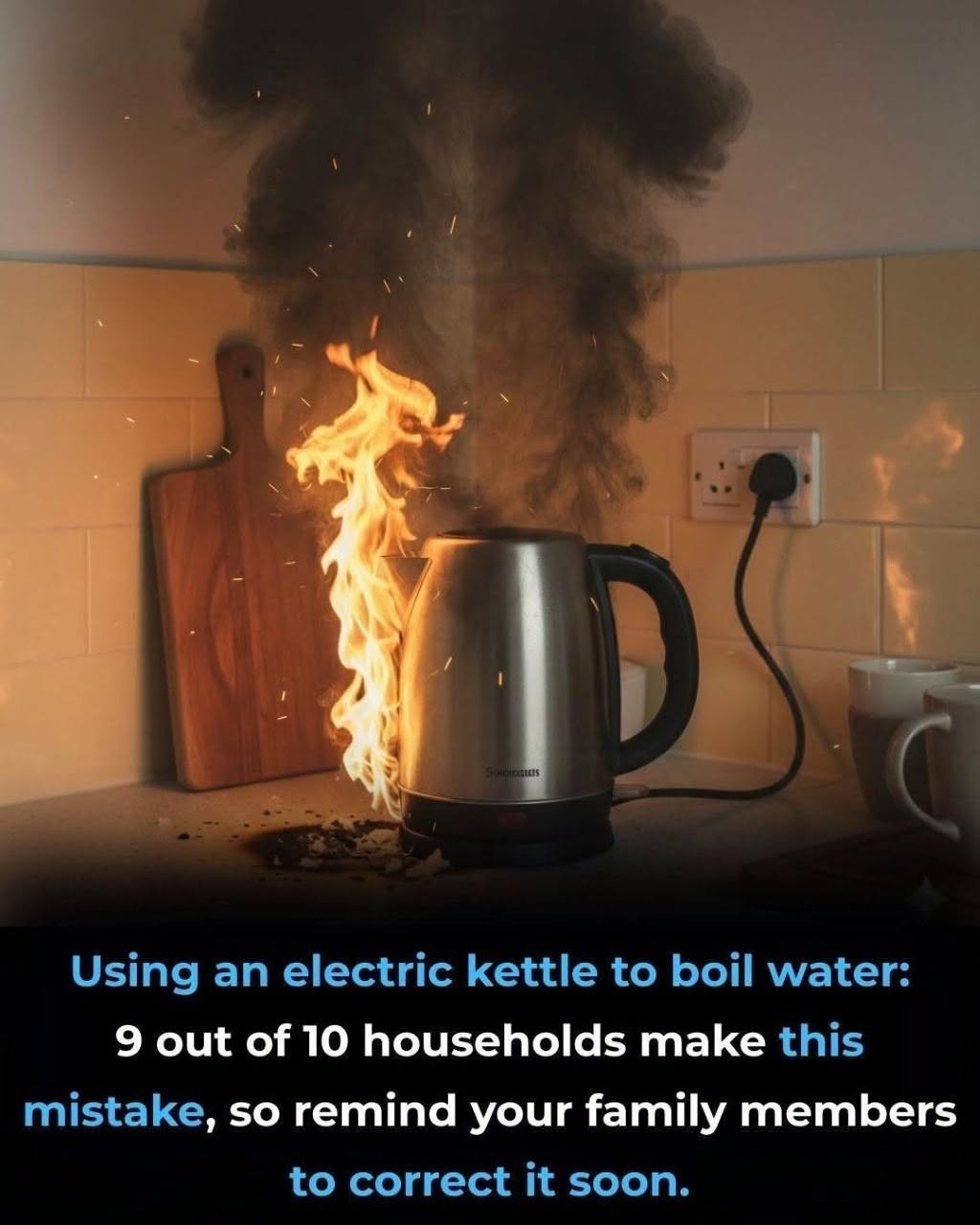
An electric kettle seems almost impossible to use incorrectly.
Add water. Press the button. Wait a few minutes. Done.
But because kettles are so simple, many people stop paying attention to how they use them.
A kettle can be used safely for years, but small habits can create unnecessary problems. Filling it above the maximum line can cause boiling water to spill, while running it with too little or no water can trigger its dry-boil protection or potentially damage the appliance. Mineral buildup can also interfere with performance over time.
The good news is that most of these mistakes are very easy to fix.


1. Filling the Kettle Above the Maximum Line
This is one of the easiest mistakes to make.
You need several cups of hot water, so you fill the kettle almost to the top. It seems efficient because you won’t have to boil another batch.
The problem is that electric kettles have a maximum fill line for a reason.
When water boils, it needs room to move and produce steam. If the kettle is overfilled, boiling water can spill or spit from the spout or lid area. Manufacturers specifically warn that overfilling can lead to hot water spilling out and causing burns.
So don’t treat the MAX line as a suggestion.
Treat it as a limit.
Before switching the kettle on, take one second to check the water level.
And if you’re only making one cup of tea, there’s usually no reason to fill a large kettle with several cups of water.


2. Turning It On With Too Little or No Water
This is another habit worth taking seriously.
Someone empties the kettle, puts it back on its base, and later switches it on without checking whether there is enough water inside.
The heating element can become extremely hot very quickly.
Many modern kettles have a safety feature called boil-dry protection. It is designed to shut the kettle off if there isn’t enough water.
That’s helpful, but it shouldn’t be treated as permission to operate the kettle empty.
Manufacturers advise users to make sure there is sufficient water before switching the kettle on. Some models specify a minimum water level because the heating element needs to be properly covered.
A simple routine prevents the problem:
Water first. Kettle on the base second. Power third.
If your kettle accidentally runs dry, turn it off, unplug it, and allow it to cool before using it again. Follow the instructions for your particular model if it has a specific reset procedure.


3. Getting Water on the Electrical Base
This mistake is less obvious because the kettle itself is designed to handle water.
The electrical base is different.
When filling your kettle, it’s best to remove it from the base first. After filling, check around the outside and bottom before placing it back.
If water has spilled onto the base or electrical connector, dry it before operating the kettle.
Manufacturer safety instructions specifically warn against getting water into electrical components and advise keeping the power base, plug, and electrical connections away from water.
This is especially important if someone fills the kettle directly over the sink.
A little water on the outside isn’t a reason to panic.
Just don’t connect or operate the appliance while the electrical parts are wet.
And never immerse the kettle’s electrical base in water while cleaning it.


4. Ignoring the Chalky Buildup Inside
Open the lid of an electric kettle that has been used regularly for months and you may see something you weren’t expecting.
White or gray deposits.
That’s usually limescale, caused by minerals naturally present in water.
It tends to become more noticeable in areas with harder water.
Limescale isn’t a sign that the kettle is necessarily dirty in the ordinary sense. It’s a mineral deposit that develops as water is repeatedly heated.
But heavy buildup can affect how efficiently the kettle heats water and can contribute to problems such as switching off before boiling. Manufacturers commonly recommend regular descaling, particularly in hard-water areas.


How Often Should You Descale It?
There isn’t one perfect schedule for every household.
It depends on:
- How often you use the kettle
- How hard your water is
- Your kettle model
- The manufacturer’s recommendations
Some manufacturers recommend descaling about monthly in hard-water areas, while others recommend intervals around every one to three months depending on use and water conditions.
The best approach is to look inside the kettle regularly.
If you can clearly see mineral buildup, it’s time to clean it.
Use the Manufacturer’s Cleaning Instructions
This part is important.
Don’t assume every kettle can be cleaned exactly the same way.
Some manufacturers recommend a commercial descaling product. Others allow white vinegar or citric acid according to specific instructions.
Follow the instructions for your model, and rinse the kettle thoroughly afterward.
For example, some manufacturer instructions specifically say to boil and rinse several times after descaling to remove any remaining cleaning solution.
Never use abrasive tools to scrape the heating surface, and never immerse an electric kettle or its electrical base in water.
5. Assuming Every Kettle Can Be Used the Same Way
Two electric kettles may look almost identical but have different operating instructions.
One might have a minimum fill level.
Another might have temperature controls.
Another may have a removable filter.
Some models have concealed heating elements, while others have different cleaning requirements.
That’s why the instruction manual matters.
You should especially check it when:
- Cleaning the kettle
- Descaling it
- Troubleshooting an unusual problem
- Resetting boil-dry protection
- Using special temperature settings
- Replacing filters
The manufacturer’s instructions take priority over generic cleaning tricks found online.


One Habit You Should Change: Don’t Keep Reheating More Water Than You Need
There’s another simple improvement that doesn’t get enough attention.
If you’re making one cup of tea, don’t automatically fill the entire kettle.
Heating more water than necessary uses more energy because you’re raising the temperature of a larger volume of water.
A better approach is to measure roughly what you need while staying above your kettle’s minimum fill level.
Some manufacturer guidance specifically recommends boiling only as much water as needed, both to reduce unnecessary energy use and to reduce the amount of water left sitting in the kettle.
It also means the kettle usually reaches boiling temperature faster.
So instead of:
Fill → boil → pour one cup
try:
Measure → boil → use
It’s a tiny change, but it’s an easy one to make.
Should You Leave Water Sitting in the Kettle?
This is where online advice can get confusing.
Some viral articles claim that you should always leave a little water inside after boiling because emptying the kettle completely can damage the heating element or thermostat.
I would not treat that as a universal rule.
Manufacturer guidance commonly recommends emptying unused water after use, particularly to reduce mineral buildup and staining. Tefal, for example, recommends emptying excess water and descaling regularly.
So rather than following a viral “one rule fits all” tip, follow your kettle’s instructions.
If your manufacturer recommends emptying the kettle after use, do that.
Don’t Use an Electric Kettle for Things It Wasn’t Designed to Heat
A standard electric kettle is designed for water.
That sounds obvious, but people sometimes try to heat milk, soup, sauces, or other liquids in them.
Unless your particular appliance explicitly says otherwise, don’t.
Manufacturers such as Tefal state that their kettles should be used for water and warn that heating other liquids can result in leakage, spillage, or damage.
Milk and other liquids can also foam or leave residue that is much harder to remove than ordinary mineral deposits.
If you need to heat another liquid, use an appliance designed for that purpose.
Know When Your Kettle Should Be Replaced
Cleaning can solve mineral buildup.
It can’t fix every problem.
Stop using an electric kettle if you notice things such as:
- A damaged power cord
- Cracks in the kettle body
- Persistent leaking
- A loose or damaged handle
- Electrical problems
- Burning smells
- An automatic shutoff that no longer works properly
- Damage around the electrical connector
Don’t try to defeat a safety mechanism because the kettle is “still working.”
And don’t attempt electrical repairs unless you are properly qualified and the manufacturer specifically provides a safe service procedure.
A replacement kettle is far cheaper than dealing with a preventable electrical or scalding accident.


A Simple Electric Kettle Routine
You don’t need a complicated maintenance schedule.
Before boiling:
1. Check the water level.
Stay between the minimum and maximum marks.
2. Check the base.
Make sure electrical connections are dry.
3. Close the lid properly.
Follow your model’s instructions.
4. Switch it on.
Don’t operate an empty kettle.
After boiling:
5. Pour carefully.
The water and steam can cause serious burns.
6. Empty or store the remaining water according to your manufacturer’s instructions.
7. Check the inside occasionally.
Look for mineral buildup.
Every so often:
8. Descale it according to the manufacturer’s directions.
That’s really all most households need.
The Bottom Line
Electric kettles are simple appliances, but simple doesn’t mean they are impossible to misuse.
The biggest habits to correct are straightforward:
Don’t overfill the kettle.
Don’t operate it without enough water.
Keep water away from the electrical base.
Don’t ignore heavy limescale buildup.
Follow the instructions for your specific model.
And don’t believe every dramatic claim circulating online. The “9 out of 10 households” figure behind this topic isn’t something I could verify from a reliable survey, so it shouldn’t be presented as established fact.
What is well supported is that manufacturers warn against overfilling, dry operation, wet electrical components, and poor maintenance.
A few seconds of attention before pressing that little switch can make your kettle safer, cleaner, and more reliable for years.