
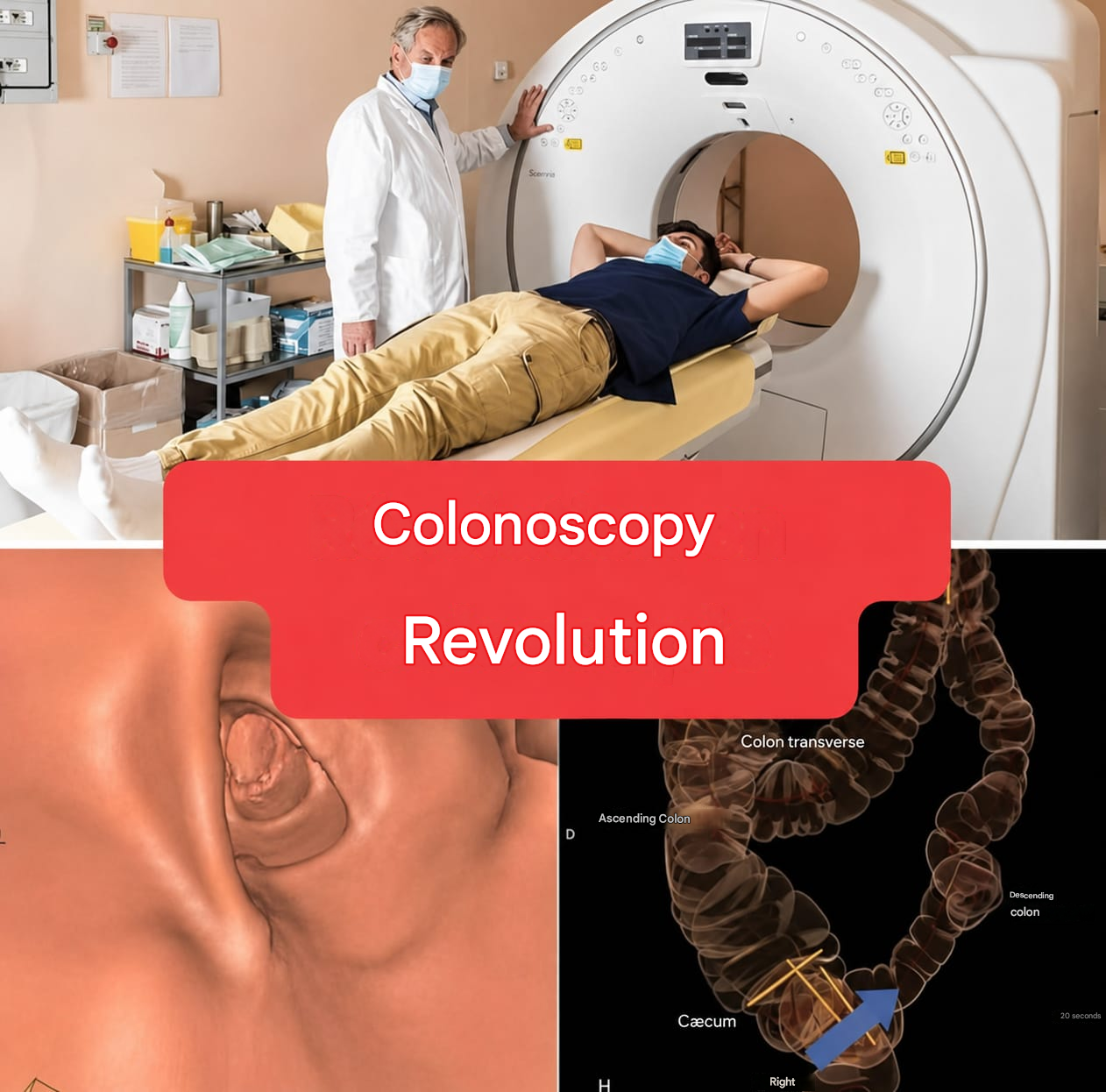
For many people, the word colonoscopy immediately brings to mind an uncomfortable preparation, sedation, and a flexible camera being inserted into the colon.
So the idea of a new method that could make colon examinations less invasive sounds like a major breakthrough.
And there are newer technologies that can make examination of the colon easier for some people.
But there is an important distinction: colonoscopy itself has not suddenly become noninvasive, and newer tests have not completely replaced traditional colonoscopy. Instead, doctors now have several different ways to screen or examine the colon, including CT “virtual colonoscopy,” stool-based tests, and capsule-based technology.


The Traditional Colonoscopy Is Still an Important Test
A conventional colonoscopy uses a thin, flexible tube with a camera that is passed through the rectum and into the colon.
The doctor can directly examine the lining of the colon and look for:
- Polyps
- Precancerous growths
- Colorectal cancer
- Bleeding
- Other abnormalities
One major advantage is that the doctor can often remove a polyp or take a tissue sample during the same procedure.
That’s something most noninvasive screening tests cannot do.
So despite the development of newer technologies, traditional colonoscopy remains an important diagnostic and treatment procedure.
So What Is the “New” Method?
There isn’t just one new technology.
Several alternatives have been developed or improved, and they work in very different ways.
One of the most established is called CT colonography, commonly known as a virtual colonoscopy.
Another technology attracting attention is colon capsule endoscopy, in which a person swallows a small capsule containing cameras.
There are also stool-based tests that can be completed at home.
Each has advantages—and limitations.


Virtual Colonoscopy Doesn’t Require a Colonoscope
CT colonography uses X-rays and computer technology to create detailed images of the colon and rectum.
Instead of inserting a long camera through the entire colon, the radiologist examines computer-generated images from the CT scan.
This is why it is often called a virtual colonoscopy.
One advantage is that sedation or anesthesia is generally not needed.
The procedure also takes less time than a traditional colonoscopy.
For someone who is worried about sedation or simply cannot tolerate conventional colonoscopy well, this can be an attractive alternative.
But there is an important catch.
You still need bowel preparation
Virtual colonoscopy is not simply a matter of walking into a scanner and having your colon examined.
The colon generally needs to be cleaned beforehand, which means bowel preparation is still part of the process. A small tube is also inserted into the rectum so the colon can be expanded with air or carbon dioxide for imaging.
So it is less invasive, but it isn’t completely preparation-free.
What Happens If the CT Scan Finds a Polyp?
This is one of the most important differences.
A CT colonography can identify suspicious polyps or other abnormalities, but the doctor cannot simply reach through the CT scanner and remove them.
If an important abnormality is discovered, you may still need a traditional colonoscopy for removal or biopsy.
In other words:
Virtual colonoscopy can help find a problem, but conventional colonoscopy may still be needed to treat it.
That distinction is easy to miss in sensational headlines.


What About Swallowing a Tiny Camera?
This is perhaps the technology that sounds most like science fiction.
With colon capsule endoscopy, the patient swallows a capsule containing tiny cameras.
As it travels through the digestive tract, the capsule takes pictures. The images are transmitted to a recorder worn by the patient and can later be reviewed by a doctor. The capsule eventually passes naturally through the digestive system.
There is no long flexible colonoscope passing through the colon.
That makes the technology particularly interesting for people who are uncomfortable with conventional colonoscopy.
But Capsule Colonoscopy Isn’t Perfect Yet
The phrase “just swallow a camera” makes the process sound incredibly simple.
In reality, there are still limitations.
The colon must generally be cleaned thoroughly before the test so that the camera can see the bowel lining.
And if the capsule detects something suspicious, another procedure may still be required.
Current NCI information says capsule colonoscopy continues to be explored and is not currently a general stand-alone screening test for average-risk people in the United States. It has particular uses, including situations involving incomplete colonoscopy and certain patients with evidence of lower gastrointestinal bleeding.
Research is continuing, however.
A 2026 multicenter study evaluated a newer colon capsule system and reflects the ongoing effort to make capsule examination more accurate and practical.


Another Option: A Test You Can Do at Home
Some people may not realize that colorectal cancer screening doesn’t always require a procedure.
One option is the fecal immunochemical test, commonly called FIT.
It looks for hidden blood in a stool sample and can be completed at home.
Another option is a stool DNA-FIT test, which looks for blood as well as certain genetic changes associated with colorectal cancer.
These tests are much less invasive than colonoscopy.
But there is another important limitation:
A positive stool test usually means you still need a colonoscopy.
The stool test can signal that something may be wrong, but it doesn’t allow a doctor to directly inspect or remove a suspicious growth.
Which Test Is Best?
There isn’t one answer for everyone.
For average-risk adults in the United States, current colorectal cancer screening recommendations include several options.
According to the National Cancer Institute’s current recommendations, screening strategies include:
- FIT every year
- Stool DNA-FIT every 1 to 3 years
- CT colonography every 5 years
- Colonoscopy every 10 years
- Certain other screening strategies in appropriate patients
The right choice depends on your age, medical history, previous screening results, family history, personal preferences, and whether you’re experiencing symptoms.


Why Colonoscopy Still Has an Important Advantage
There is a reason conventional colonoscopy hasn’t simply disappeared.
Imagine a doctor finds a suspicious polyp.
With a conventional colonoscopy, the doctor can often:
- See the polyp
- Examine it closely
- Remove it
- Send tissue for laboratory analysis
That combination of detection and treatment in one procedure is a major advantage.
With CT colonography, a stool test, or capsule examination, finding an abnormality may lead to another procedure.
That’s why calling these newer technologies a complete “replacement” for colonoscopy would be misleading.
The Future May Be Less Invasive
That doesn’t mean the future isn’t exciting.
Researchers continue working on technologies that could make colorectal cancer screening easier, more comfortable, and more accessible.
Capsule endoscopy is one area of active research, and researchers are also investigating new blood-based and other noninvasive approaches.
The goal is straightforward:
Find colorectal cancer and precancerous polyps earlier while making screening easier for people to accept.
That matters because a screening test only helps if people are actually willing to take it.


Don’t Wait for Symptoms to Think About Screening
One of the biggest mistakes is assuming that you only need colorectal cancer screening if something feels wrong.
Screening is intended to detect disease before symptoms appear.
Colorectal cancer can develop from polyps, and finding and removing certain precancerous polyps can help prevent cancer from developing.
For average-risk adults, U.S. recommendations generally begin screening at age 45. Adults ages 76 to 85 should discuss whether screening is appropriate based on their overall health, previous screening history, and preferences.
If you have symptoms such as rectal bleeding, unexplained weight loss, persistent changes in bowel habits, or unexplained anemia, that’s a different situation. You should discuss those symptoms with a healthcare professional rather than simply choosing an at-home screening test on your own.
The Bottom Line
The headline “colonoscopy will no longer be an invasive examination” gets ahead of the science.
There are already less-invasive ways to examine or screen the colon.
Virtual colonoscopy uses CT imaging rather than a conventional colonoscope.
Capsule endoscopy allows a small camera to travel through the digestive tract.
FIT and stool DNA tests can be completed without a procedure.
But these options don’t completely replace conventional colonoscopy.
If an abnormality is discovered, a traditional colonoscopy may still be necessary to remove a polyp or take a biopsy.
So the real breakthrough isn’t that colonoscopy has disappeared.
It’s that patients now have more screening options than ever before, and research is continuing to make colorectal cancer detection less invasive and more convenient.
If you’ve been putting off colorectal cancer screening because you’re afraid of a traditional colonoscopy, it’s worth talking with your doctor about which screening options are appropriate for you.







