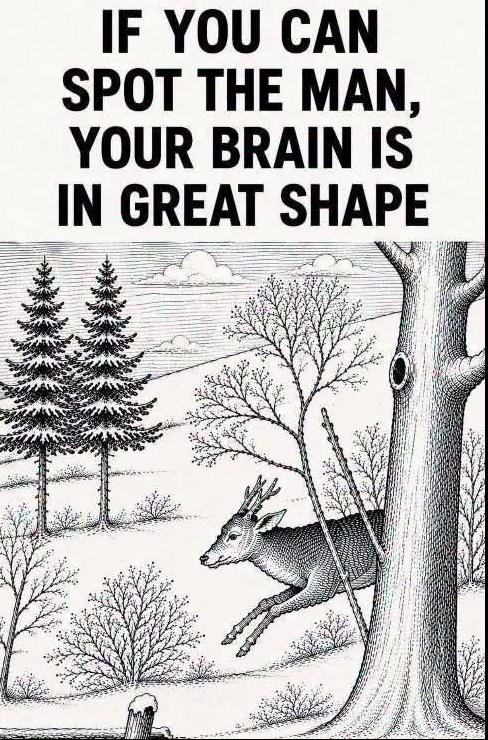
At first glance, there doesn’t seem to be much to solve.
You see a peaceful winter forest, snow covering the ground and a deer standing among the trees. The animal is so easy to recognize that your eyes probably go straight to it.
But don’t stop there.
There is another figure hidden in the scene, and it is much easier to miss because it isn’t sitting in the picture like an ordinary object. Instead, the surrounding trees, branches, shadows and snowy spaces come together to suggest a human face.
And once you finally see it, you may wonder how you managed to overlook it.
Before You Read Any Further, Take Another Look
Give the picture another few seconds.
This time, try not to study the deer.
Let your eyes move around the entire winter landscape. Look at the tree trunks. Follow the branches. Notice where darker areas meet the lighter snow.
Most importantly, don’t assume that the empty-looking spaces are unimportant.
The hidden figure depends on the way several parts of the scene work together. You aren’t necessarily looking for a single object that looks like a face.
You’re looking for a face that appears when separate shapes are viewed together.
That’s a much harder challenge.
Why the Deer Gets Your Attention First
The deer is almost too obvious.
Its body has a recognizable shape, its head is easy to identify, and it stands out against the snowy surroundings. Your brain can understand what it is almost instantly.
Once that happens, you’ve already made a decision about the photograph.
It’s a winter scene with a deer.
The trees become background.
The snow becomes background.
The shadows become background.
And that is exactly where the hidden puzzle gets clever.
The face is suggested by some of those very details you’ve already decided are merely scenery.
Here’s Your First Hint
Move your attention away from the animal.
Instead of asking, “Where is the face?” try asking a different question:
Which parts of the forest could form a shape other than what they appear to be?
Look for unusual curves.
Look at places where branches cross.
Examine the darker areas between the trees.
Then look at the lighter areas surrounding them.
Sometimes a hidden image becomes easier to recognize when you stop searching for an individual feature and start looking for the relationship between several features.
A branch by itself is simply a branch.
A shadow by itself is simply a shadow.
But put several shapes together, and your brain may begin to see something completely different.
Still Can’t Find It? Try This
Here’s another approach.
Instead of staring harder at the picture, change the way you’re viewing it.
Move a little farther away from your screen.
You can also look at a smaller version of the image if possible.
Why might that help?
When you’re close to a detailed photograph, your eyes naturally notice individual textures. You see separate branches, patches of snow and little variations in light and shadow.
Those details can actually get in the way.
From farther away, small elements begin to blend together. The overall arrangement becomes easier to see.
The puzzle isn’t changing.
Your perspective is.
One More Hint Before the Reveal
Think about the difference between seeing an object and recognizing a pattern.
If you see a tree, your brain doesn’t have to study every branch before deciding what it is.
The same thing happens with the deer.
But a hidden face works differently.
You may need to stop treating each tree and shadow as a separate object and instead consider how they fit together.
So take one final look.
Forget the deer for a moment.
Scan the forest.
Look for the suggestion of facial features rather than expecting to find a perfectly outlined portrait.
Now you’re getting closer.
The Hidden Figure Is a Face
The mystery isn’t another animal hiding behind the deer.
The secondary image is a human face suggested by the landscape.
It blends into the winter setting rather than appearing as a separate figure standing among the trees.
That is why the puzzle can be so frustrating at first.
You’re looking for something that isn’t presented in the usual way.
There is no obvious person waving from behind a tree.
Instead, the face emerges from the arrangement of natural shapes, with branches, shadows and areas of snow contributing to the impression.
Once your brain recognizes that pattern, the entire picture can suddenly look different.
The forest hasn’t changed.
Your interpretation has.
Why Hidden Images Can Fool Us
This kind of puzzle takes advantage of a very ordinary feature of human vision.
We don’t give equal attention to every detail in front of us.
Our brains constantly organize complicated scenes into recognizable objects and backgrounds. That is extremely useful in everyday life. Imagine having to consciously analyze every tree branch, shadow, person, car and building every time you walked down a street.
You’d never get anywhere.
Instead, your brain quickly decides what matters.
A deer is a deer.
A tree is a tree.
Snow is snow.
But hidden-picture puzzles take advantage of that efficiency.
They arrange familiar shapes so that they can be interpreted in two different ways.
At first, your brain chooses the obvious interpretation.
Then, if you find the hidden pattern, it suddenly discovers another one.
Why Faces Are Especially Easy to Recognize
There is another reason a hidden human face can be so effective.
People are remarkably sensitive to face-like patterns. We can sometimes recognize a suggestion of a face even when the image is far from a realistic portrait.
That’s why people occasionally see faces in clouds, wood grain, rock formations or other random patterns.
The brain is constantly looking for meaningful arrangements.
In this winter puzzle, that tendency works in reverse.
Instead of finding a face where you don’t expect one, you’re being challenged to discover one that has been deliberately suggested by the surrounding landscape.
The Deer Was Never the Whole Story
The most obvious subject in a photograph isn’t always the most important one.
That’s the little lesson hidden inside this puzzle.
The deer grabs your attention because it is recognizable. Once you’ve identified it, you may feel that you’ve already understood the picture.
But the hidden face asks you to reconsider everything around it.
Suddenly, the background isn’t just background.
The shadows matter.
The spaces between objects matter.
The branches matter.
Even areas that initially seem empty can become part of the larger pattern.
That’s what makes the eventual discovery so satisfying.
Did You Spot It?
If you found the face quickly, you probably managed to resist the pull of the deer and examine the larger composition.
If it took you several tries, don’t feel bad.
That’s exactly what makes this kind of visual puzzle entertaining.
The challenge isn’t necessarily about having extraordinary eyesight or being exceptionally clever. It can simply come down to where your attention lands first and whether you are willing to reconsider your initial interpretation.
And once someone points out a hidden image, something interesting often happens.
You can no longer see the picture quite the same way.
The shapes that looked random suddenly seem connected.
The face that wasn’t there a moment ago now seems almost obvious.
That is the fun of a good hidden-picture puzzle: the answer was in front of you the whole time.
So, be honest.
Did you spot the hidden face before reading the hints, or did the deer keep your attention for too long?