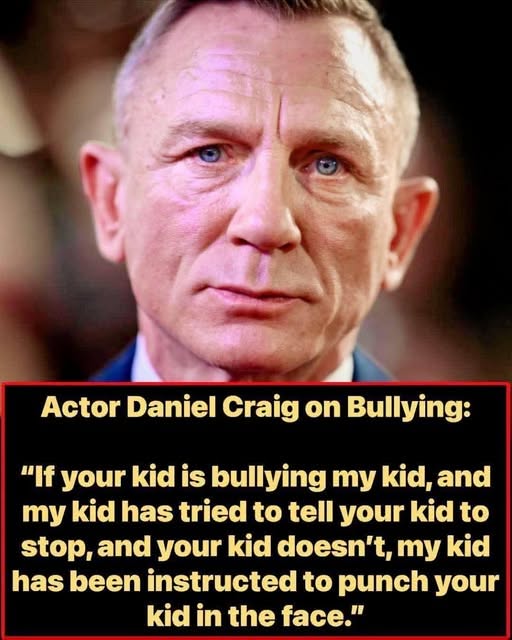
A few words can sometimes start a much bigger conversation than anyone expects. A statement circulating online and attributed to British actor Daniel Craig has recently attracted attention by raising an important question for parents: How should children respond when someone repeatedly bullies them?
The viral image features Craig alongside a message encouraging children not to accept repeated mistreatment. It suggests that when a child continues bullying another child despite being told to stop, the victim should be prepared to defend themselves.
The message has sparked different reactions among parents and social media users. Some agree that children should learn to stand up for themselves and never feel powerless when someone mistreats them. Others worry that encouraging physical retaliation could make an already difficult situation more dangerous.
However, there is an important detail to consider: The exact wording in the circulating image has not been independently verified as an authentic Daniel Craig quotation. It is therefore better to treat it as an online message attributed to the actor rather than a confirmed statement from him.
Still, the discussion raises a genuine issue that deserves attention: How can parents teach children to be confident, establish boundaries, and stay safe when dealing with bullying?
Why the Viral Message Has Attracted So Much Attention
Bullying remains a concern for families, schools, and communities around the world. It can happen in classrooms, playgrounds, neighborhoods, sports activities, and online spaces.
For parents, learning that their child is being targeted can be particularly upsetting. They want their children to feel confident, respected, and safe wherever they go.
The message attributed to Daniel Craig reflects a parenting philosophy centered on self-respect and personal boundaries. Supporters believe children should understand that they do not have to accept repeated intimidation or mistreatment.
However, there is a difference between teaching a child to stand up for themselves and encouraging them to respond aggressively.
Children need to know that they deserve protection, but they also need guidance on how to handle difficult situations without unnecessarily increasing the risk of harm.
That balance is at the heart of the debate.
Understanding the Difference Between Self-Defense and Retaliation
One of the most important lessons parents can teach is that protecting yourself is different from seeking revenge.
A child who is being bullied should understand that they have the right to feel safe and that nobody has the right to threaten, intimidate, or deliberately hurt them.
However, responding to every conflict with physical aggression can make a situation worse. It may lead to further confrontation, injuries, disciplinary consequences, or additional problems at school.
Children should instead learn several important principles:
- They are allowed to say no when someone treats them disrespectfully.
- They should not feel responsible for another person’s bullying behavior.
- They can walk away from an unsafe confrontation whenever possible.
- They should seek help from a trusted adult when bullying continues.
- If they face immediate physical danger, their priority should be getting to safety and receiving help.
Self-defense should be understood as protecting oneself from immediate danger, not punishing another person or getting even.
Why School Bullying Can Have a Serious Impact on Children
School should be a place where children can learn, develop friendships, discover their interests, and build confidence.
Unfortunately, repeated bullying can interfere with these experiences.
Some children become reluctant to attend school, participate in activities, or spend time with classmates because they are worried about being targeted.
Bullying does not always involve physical aggression. It can take several different forms.
Physical Bullying
This includes behaviors such as hitting, pushing, kicking, or deliberately damaging another child’s belongings.
Verbal Bullying
Repeated insults, name-calling, threats, and humiliating comments can make children feel uncomfortable and isolated.
Social Bullying
Some children experience deliberate exclusion, public embarrassment, or rumors intended to damage their friendships and relationships.
Cyberbullying
Bullying can also continue outside school through social media, messaging applications, online games, and other digital platforms.
Hurtful messages, threatening comments, embarrassing photographs, and repeated online harassment can make it difficult for children to feel that they have a safe space.
Recognizing these different forms of bullying helps parents understand that the problem is not always immediately visible.
How Parents Can Help Children Deal With Bullies
Parents play an important role in helping children develop confidence and learn how to respond to difficult social situations.
The goal should not be to teach children to fight, but to give them the communication skills, emotional support, and practical guidance they need to stay safe.
1. Encourage Children to Speak Openly
One of the most important things parents can do is create an environment where children feel comfortable discussing their experiences.
Instead of immediately criticizing, questioning, or blaming them, parents should listen carefully and take their concerns seriously.
Simple questions such as “What happened today?” or “How did that make you feel?” can help children explain situations they might otherwise keep to themselves.
Children should understand that asking for help is not a sign of weakness.
2. Teach Them to Establish Clear Boundaries
Children can benefit from learning simple, confident ways to communicate when someone’s behavior is unacceptable.
For example, they can practice saying:
- “Stop. I don’t like that.”
- “That’s not okay.”
- “Please leave me alone.”
These statements should be delivered calmly and confidently when it is safe to do so.
However, children should never be expected to confront someone who is threatening them or putting them in immediate danger.
3. Explain When to Walk Away
Walking away from an aggressive situation is not the same as surrendering.
Sometimes the safest and most sensible decision is to leave the area, move toward other people, and find a trusted adult.
Children should understand that their safety matters more than winning an argument or proving they are brave.
4. Teach Them to Ask Adults for Help
Parents should encourage children to speak with teachers, school counselors, coaches, or other responsible adults when bullying happens.
If the behavior continues, families can contact the school and request a clear plan to address the problem.
Repeated incidents should be documented, including when and where they occurred, what happened, and who witnessed them.
This information can help schools understand the situation and take appropriate action.
5. Build Confidence Through Positive Activities
Healthy friendships and supportive activities can help children develop confidence and a stronger sense of belonging.
Sports, creative activities, music, and group hobbies can provide opportunities to build social skills and discover personal strengths.
The goal is not to make children more intimidating than their classmates. It is to help them recognize their own value and feel comfortable being themselves.
What Should Parents Do If Their Child Is Being Bullied?
When bullying becomes a repeated problem, parents should avoid dismissing it as ordinary childhood disagreement.
The first step is to understand what happened and determine whether the child is facing an ongoing pattern of intimidation or aggression.
Parents can then take practical steps:
- Listen to the child without blaming or embarrassing them.
- Write down details of repeated incidents.
- Contact the teacher or appropriate school administrator.
- Ask what steps will be taken to protect the child.
- Follow up to determine whether the behavior has stopped.
- Seek additional support if the child is experiencing significant emotional distress.
If there is an immediate threat or physical danger, parents should prioritize safety and contact the appropriate local emergency services.
Schools also have an important responsibility. Preventing bullying requires clear rules, consistent responses, adult supervision, and an environment where students feel comfortable reporting problems.
How Can Parents Teach Children to Be Strong Without Encouraging Violence?
Children need more than simple instructions about how to respond when someone mistreats them.
They need to understand that confidence does not mean aggression, and kindness does not mean accepting unacceptable behavior.
Parents can teach several important lessons through everyday conversations:
Respect yourself and others. Every child deserves to be treated with dignity, regardless of appearance, background, personality, or abilities.
Speak up when something is wrong. Children should know that they can express discomfort and ask for support.
Avoid unnecessary confrontation. Walking away from a dangerous situation can be a smart decision.
Never confuse revenge with protection. Hurting someone because they previously hurt you does not necessarily solve the underlying problem.
Support others who are being bullied. Children can help classmates by refusing to participate in teasing, offering friendship, and reporting serious incidents to responsible adults.
These lessons help children develop emotional maturity while understanding the importance of personal safety.
What About Bullying on Social Media?
Cyberbullying has created additional challenges for modern families.
Unlike traditional bullying, online harassment can follow children beyond the classroom and reach them through phones, computers, and social media accounts.
Parents should encourage healthy digital habits and make sure children know they can discuss uncomfortable online experiences without automatically losing access to their devices.
If cyberbullying occurs, families can save relevant messages, block or report the accounts involved, and contact the school or platform when appropriate.
Children should also be reminded not to respond with threats, insults, or embarrassing posts of their own. Escalating an online argument can make the situation more complicated.
The Bigger Lesson Behind the Viral Daniel Craig Message
The debate surrounding the message attributed to Daniel Craig goes beyond one celebrity quotation or social media image.
At its heart, it reflects a question that many parents face: How do we raise children who are confident enough to stand up for themselves while also understanding the importance of kindness, responsibility, and self-control?
Children should never be taught that accepting bullying is part of growing up. They deserve to feel safe at school, at home, and in their communities.
But teaching confidence does not require teaching aggression. Children can learn to establish boundaries, seek help, avoid dangerous situations, and protect themselves without being encouraged to retaliate.
Ultimately, the strongest lesson parents can give their children is that they deserve respect, they are never alone when facing bullying, and asking for help is always an acceptable choice.
The conversation sparked by the viral image may continue online, but the real priority should remain the same: creating safer environments where every child can grow, learn, and feel respected.