

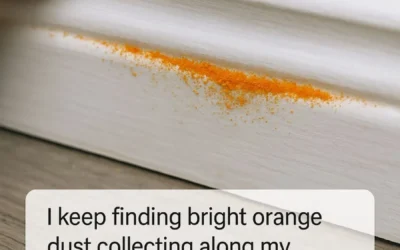
You wipe it away, walk back into the room a few days later—and there it is again: a strange line of bright orange dust collecting along the baseboard.
At first, it can look like ordinary dirt.
Then you notice the color.
And that’s when the questions start: Is it rust? Mold? Insects? Something coming from inside the wall?
The truth is that orange-colored residue can have several different causes. The color alone isn’t enough to identify it, but where it appears, how it feels, and whether it keeps coming back can give you some useful clues.


1. It Could Be Debris From Wood Damage
If your home has wooden baseboards, flooring, framing, or furniture nearby, deteriorating wood can produce fine particles that collect along edges.
The color isn’t always plain beige. Depending on the wood, finish, and surrounding material, the debris can look brown, reddish, or orange.
Wood-boring insects can make this more concerning because they may leave behind frass—a mixture of wood particles and insect waste.
Look closely at the area.
Are there tiny holes?
Does the wood feel unusually soft?
Does the orange material keep appearing after you’ve cleaned it?
Those clues are more significant than the color by itself.
2. Tiny Pellets Could Point to Insect Activity
Not all “dust” is actually dust.
If the material consists of many small particles that look surprisingly uniform, almost like tiny grains or pellets, insect activity becomes something worth investigating.
Termite frass, for example, can collect near wooden structures.
Carpenter ants can also excavate wood and leave behind sawdust-like material.


This doesn’t mean every orange pile is termites.
But if you’re seeing repeated piles in exactly the same location, combined with holes, damaged wood, or insects, it’s worth getting the area inspected rather than repeatedly sweeping it away.
3. Rust Can Turn Into Orange Powder
Rust is another straightforward possibility.
Metal nails, screws, brackets, or other hardware inside or around a wall can corrode when exposed to moisture.
As corrosion develops, flakes and particles can break away and settle below the affected area.
That’s why orange residue can sometimes appear around baseboards, door frames, window areas, bathrooms, kitchens, basements, or other places where humidity is higher.
Look for something simple:
Is there an orange or reddish stain immediately above the dust?
If you can see exposed metal nearby, rust becomes a much more plausible explanation.
4. Your House Could Be Producing the Dust
Sometimes there’s no pest problem at all.
Paint, stain, drywall compounds, brick, tile, grout, or concrete can deteriorate and produce fine particles.
Humidity, temperature changes, aging materials, and physical wear can all contribute to surface deterioration.
Check the wall and baseboard carefully.
Look for:
- Peeling paint
- Cracks
- Chipping
- Powdery surfaces
- Damaged grout
- Crumbling material
- A visible gap between the wall and baseboard
If the residue is concentrated directly below damaged material, you may have found the source.
5. Recent Renovation Can Leave Behind Colored Dust
Have you recently had construction, painting, drilling, flooring work, or repairs done?
If so, don’t overlook that possibility.
Brick, tile, wood, drywall, plaster, and other building materials can produce surprisingly fine dust during construction or renovation.
Orange-colored dust can even come from brick or other masonry materials. A home-improvement example shows that drilling into brick can produce distinctly orange dust.
And because fine particles can settle in cracks and along baseboards, you may continue discovering them long after the original work appears finished.
6. Outdoor Dust May Be Getting Inside
Sometimes the explanation is much less dramatic.
Soil, pollen, road dust, and other outdoor particles can enter through doors, windows, ventilation openings, or gaps around the structure.
Some outdoor dust can have reddish or orange tones because of iron-rich minerals.
If the residue is especially noticeable near entrances or poorly sealed areas, check what’s happening outside before assuming there’s a hidden problem inside the wall.
A good doormat, regular vacuuming, and properly sealed gaps can reduce the amount of outdoor material that makes its way indoors.
7. Moisture Can Make the Situation More Complicated
If the orange material appears in a bathroom, basement, kitchen, or another humid area, don’t ignore the possibility of a moisture problem.
Damp conditions can contribute to corrosion, deterioration of building materials, and microbial growth.
Some fungi and other growths can produce unusual colors, including rust-like shades.
That doesn’t mean orange dust automatically equals mold.
It doesn’t.
But if you also notice:
- Musty smells
- Damp walls
- Water stains
- Peeling paint
- Condensation
- Soft wood
- Recurring moisture
then finding and fixing the moisture source should become a priority.
8. The Most Useful Clue Is Whether It Comes Back
Here’s a simple test that can tell you more than staring at the color.
Clean the area carefully.
Take a photo of the spot.
Then check it again after a few days.
If nothing comes back, it may simply have been accumulated household or outdoor dust.
But if the same orange material reappears in exactly the same location, pay attention.
Recurring debris suggests that something is continuously producing or depositing the material.
That could be an active insect issue, corrosion, deteriorating material, moisture-related damage, or simply a persistent source of outdoor dust.
The pattern matters.
What Should You Do First?
Don’t immediately start spraying insecticide or strong chemicals.
First, try to identify the source.
Look above the orange dust
Check the wall, baseboard, trim, window frame, and nearby furniture.
Look for holes
Tiny holes in wood combined with recurring debris deserve closer attention.
Check for moisture
Look for dampness, stains, condensation, or peeling paint.
Check nearby metal
Rusting nails, screws, brackets, and other hardware may leave orange residue.
Check outside
If the area is close to a door or window, outdoor soil and dust could be entering.


Don’t Forget to Protect Yourself While Investigating
If you’re dealing with an unknown powder, avoid deliberately stirring it into the air.
Don’t sniff it closely or blow it around to see what happens.
For routine cleaning, use appropriate gloves and clean gently rather than aggressively brushing an unknown substance into the air.
If you suspect significant mold, an active pest infestation, or deteriorating building material, professional assessment is safer than repeatedly disturbing the material yourself.
When Should You Call a Professional?
A little orange dust isn’t automatically an emergency.
But professional help becomes much more reasonable when the residue:
- Keeps returning
- Appears in several locations
- Is accompanied by damaged wood
- Comes with visible insects
- Appears alongside moisture damage
- Is accompanied by a strong musty odor
- Seems to come from inside the wall
- Is associated with crumbling or deteriorating building materials
The important thing is not to focus exclusively on the color.
Find the source.
The Bottom Line
Bright orange dust along a baseboard can look alarming, but there isn’t one universal explanation.
It could be wood debris, insect frass, rust, deteriorating paint or building material, renovation dust, outdoor particles, or a moisture-related problem.
The best clue is what happens around it.
Does it come back?
Is the wood damaged?
Are there tiny holes or insects?
Is there moisture nearby?
Is there rust or deteriorating material above it?
Answer those questions first, and you’ll be much closer to figuring out what you’re actually dealing with.
And if the orange dust keeps returning despite cleaning, don’t just keep wiping it away and hoping it stops. Find out what’s producing it.