
For nearly two years, Margaret had slept wherever she could find a safe place.
Sometimes it was a borrowed room. Sometimes it was the back seat of an old van. And on the coldest nights, it was the corner of a church basement where nobody asked too many questions.
Then one Saturday morning, a man she’d barely spoken to pulled up beside her with an old travel trailer.
“It’s yours,” he said.
Margaret stared at him.
She thought he was joking.
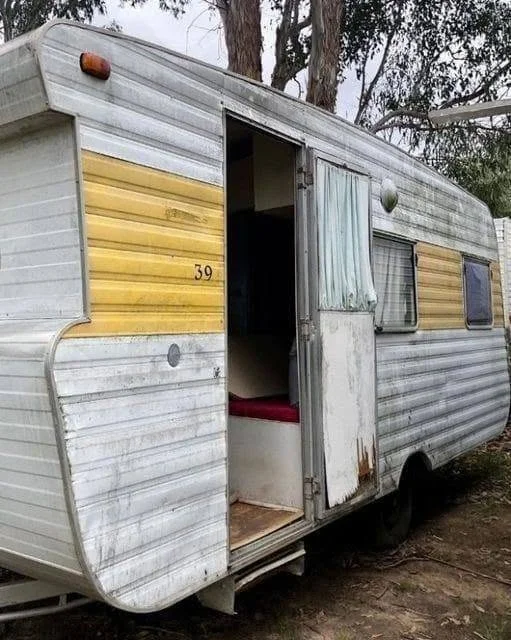
The trailer was faded, dented, and covered in years of dirt. One window was cracked. The tires were worn. The inside smelled like dust and old wood.
But Margaret saw something nobody else seemed to see.
She saw a home.
She just didn’t know yet that, within a few months, the little trailer would become something far more beautiful than anyone in town expected.


Part One — The Woman Nobody Thought Could Start Over
Margaret was sixty-three when her life changed completely.
For most of her adult life, she had lived in the same small town in northern Oregon. She had worked as a school cafeteria assistant, raised two children, and spent nearly twenty-five years in the same modest apartment.
She wasn’t wealthy.
She had never been.
But she had always managed.
Then her husband died.
The medical bills came first.
After that came the rent increase.
Then the car broke down.
Within a year, Margaret was making choices she never imagined she’d have to make at her age.
Do I pay for medicine or groceries?
Do I repair the car or keep the electricity on?
Do I find somewhere safe to sleep or try to keep the last few dollars in my bank account?
Eventually, she lost her apartment.
Her daughter lived several states away and was struggling with a family of her own. Margaret refused to ask her for money.
“I’ve spent my whole life taking care of other people,” she once told a friend. “I just don’t want my children worrying about taking care of me.”
So Margaret adapted.
She found temporary work.
She stayed with acquaintances.
She spent several nights in a small van that barely ran.
And whenever she had nowhere else to go, she parked near a quiet patch of woodland outside town.
She wasn’t looking for pity.
She was looking for peace.
That’s where she met Daniel.
Daniel owned a small landscaping company and frequently worked near the forest.
One morning, he noticed Margaret sitting outside her van with a cup of coffee.
“You live out here?” he asked.
“For now,” she answered.
Daniel didn’t ask any more questions.
But he remembered her.
A few weeks later, he drove up in an old pickup truck.
Behind it was the trailer.
Margaret immediately shook her head.
“No.”
“You haven’t even seen inside.”
“I can’t afford it.”
“I’m not selling it.”
She stared at him.
Daniel pointed toward the trailer.
“It’s been sitting behind my brother’s property for years. Nobody wants it. I figured you might.”
Margaret laughed nervously.
“You want to give me a trailer?”
“I want to give you a chance.”


Margaret walked around it slowly.
The paint was peeling.
The door squeaked.
One side had a long dent.
Inside, the cushions were stained and the cabinets were covered in grime.
It was, in every possible sense, a mess.
But Margaret smiled.
“She’s beautiful.”
Daniel laughed.
“You’re the first person who’s ever said that.”
“I didn’t say she was beautiful yet.”
He raised an eyebrow.
“I said she could be.”
And that was enough.
Part Two — The Trailer Everyone Else Wanted to Throw Away
The first week was not glamorous.
Margaret spent hours scrubbing.
She removed old curtains.
She washed the walls.
She pulled out broken shelves.
She threw away cracked dishes and damaged furniture.
The trailer slowly began to smell less like an abandoned storage shed and more like a place someone actually lived.
Two friends, Jamie and Kevin, joined her.
Jamie brought paint.
Kevin brought tools.
Daniel brought lumber.
Nobody charged Margaret anything.
They simply showed up.
One Saturday, Margaret walked inside carrying a small wooden table she’d found at a thrift store.
Kevin looked at it.
“Where are you going to put that?”
“Right here.”
“There’s barely enough room.”
“Then we’ll make room.”
That became Margaret’s philosophy.
Don’t complain about what you don’t have.
Work with what you have.
The trailer was tiny, so she stopped trying to make it feel bigger than it was.
Instead, she made every inch useful.
She installed narrow shelves along the walls.
She used baskets instead of bulky cabinets.
She added hooks beside the door.
She found an old rocking chair and repaired it herself.
Then came the color.
Margaret chose warm cream walls with soft green accents.
The faded cabinets were painted a gentle white.
The old floor was covered with inexpensive vinyl planks that looked like weathered wood.
Nothing was expensive.
Nothing matched perfectly.
And somehow, that made it beautiful.


But Margaret wasn’t finished.
She wanted the trailer to feel like more than a place to sleep.
She wanted it to feel like home.
So she placed a small lamp beside the rocking chair.
She hung family photographs above the table.
She added soft blankets.
A secondhand rug covered the floor.
And in the corner, she placed a tiny bookshelf.
Most of the books were old.
Some had been hers for decades.
One belonged to her late husband.
That book never left her side.
“I know it’s just a trailer,” Margaret told Jamie one afternoon.
Jamie looked around.
“No.”
Margaret smiled.
“It’s home.”
By the end of the second month, people who hadn’t understood Daniel’s decision began stopping by.
They expected to see a shabby trailer.
Instead, they found a tiny cottage.
But the biggest surprise was waiting outside.
Margaret had started building a garden.
Part Three — She Turned the Forest Into Her Backyard
The land surrounding the trailer wasn’t particularly impressive.
There were tall trees, uneven ground, patches of moss, and plenty of weeds.
Margaret saw possibilities.
She planted herbs beside the steps.
Then tomatoes.
Then lettuce.
She added flowers along the walkway.
Soon, there were pots everywhere.
Old buckets became planters.
A broken wooden crate became a herb box.
An old metal tub became a flower bed.
Nothing was wasted.
One afternoon, Daniel arrived with another load of lumber.
“What are you building now?”
Margaret pointed toward the trees.
“A porch.”
Daniel looked at the small trailer.
“You’re putting a porch on that?”
“Why not?”
He laughed.
“Fair enough.”
The porch took three weekends.
It wasn’t large.
Just enough room for two chairs and a little table.
But from that porch, Margaret could watch the sun come through the trees every morning.
She began drinking coffee outside.
Then she started eating breakfast there.
Eventually, neighbors began visiting.
Someone brought blueberry muffins.
Someone else brought a bird feeder.
A retired couple donated two Adirondack chairs.
A woman from town brought a box of seedlings.
The trailer had become a community project without anyone officially planning it.


Then something unexpected happened.
Margaret started helping other people.
A young mother who had recently lost her job began visiting the garden.
Margaret taught her how to grow herbs.
An elderly neighbor who lived alone started coming over for coffee.
A teenager from town helped Margaret repair a fence.
People came for different reasons.
But they kept coming back.
Margaret had started with almost nothing.
Now she had something money couldn’t easily buy.
A community.
One evening, Jamie sat on the porch beside her.
“You know what I keep thinking?”
“What?”
“When Daniel gave you this trailer, everybody thought he was giving you a place to live.”
Margaret looked toward the garden.
“He did.”
“No. I mean, everybody thought that was the end of the story.”
Margaret smiled.
“And?”
“You turned it into the beginning.”
For a moment, Margaret said nothing.
Then she looked at the little house behind them.
“I didn’t build this because I wanted people to admire it.”
“I know.”
“I built it because I needed somewhere to belong.”
Jamie reached for her hand.
“You belong here.”
Part Four — The Day the Whole Town Saw What She Had Built
Almost a year after Margaret received the trailer, Daniel organized a small community gathering.
He wanted people to see what their combined efforts had created.
Margaret didn’t want a celebration.
She kept saying it was “just a trailer.”
Daniel disagreed.
“People need to see what kindness can become.”
So on a sunny Saturday afternoon, neighbors gathered near the forest.
There were folding chairs.
Homemade desserts.
Coffee.
Fresh vegetables from Margaret’s garden.
Children ran between the trees.
Someone brought a guitar.
Margaret stood on her porch and looked at everyone.
She suddenly became emotional.
A year earlier, she had been sleeping in a van.
Now dozens of people were standing in her yard.
People who had once been strangers.
Daniel stepped forward.
“I didn’t give Margaret a perfect home,” he said. “I gave her something old that nobody wanted.”
Everyone laughed.
Daniel continued.
“She did the rest.”
Margaret shook her head.
“We all did.”


Then Margaret did something nobody expected.
She walked inside and returned with a small wooden box.
She opened it.
Inside were dozens of handwritten notes.
Every note came from someone who had helped her.
A bag of groceries.
A few hours of labor.
A box of paint.
A bag of seeds.
A repaired window.
A warm blanket.
A simple cup of coffee.
Margaret had written down every act of kindness.
“I wanted to remember,” she said.
The crowd became quiet.
“Because when you’re struggling, sometimes the smallest kindness feels enormous.”
She looked at Daniel.
“You gave me a trailer.”
Then she looked around at everyone else.
“But all of you gave me something bigger.”
“What?”
“A reason to believe I wasn’t forgotten.”
Nobody spoke for several seconds.
Then someone started clapping.
Others joined.
Margaret wiped her eyes.
She had spent months transforming an old trailer.
But the truth was that the trailer had transformed her too.
It gave her independence.
It gave her purpose.
And most importantly, it gave her a place where people knew her name.
Today, the little trailer still sits among the trees.
Flowers grow along the steps.
Her vegetable garden gets bigger every year.
The porch has two chairs.
One is Margaret’s.
The other is usually reserved for whoever happens to stop by.
And there’s one rule in her little forest home.
Nobody leaves hungry.
Margaret says she remembers what it feels like to have almost nothing.
So whenever someone comes through her door, she makes coffee.
She cuts a piece of bread.
She offers vegetables from the garden.
And she listens.
Because she learned something during the hardest chapter of her life:
A home isn’t always the biggest house.
Sometimes it’s a tiny trailer surrounded by trees.
Sometimes it’s a porch with two chairs.
Sometimes it’s a garden grown from almost nothing.
And sometimes, home is simply the place where someone finally looks at you and says:
“You can stay.”







