

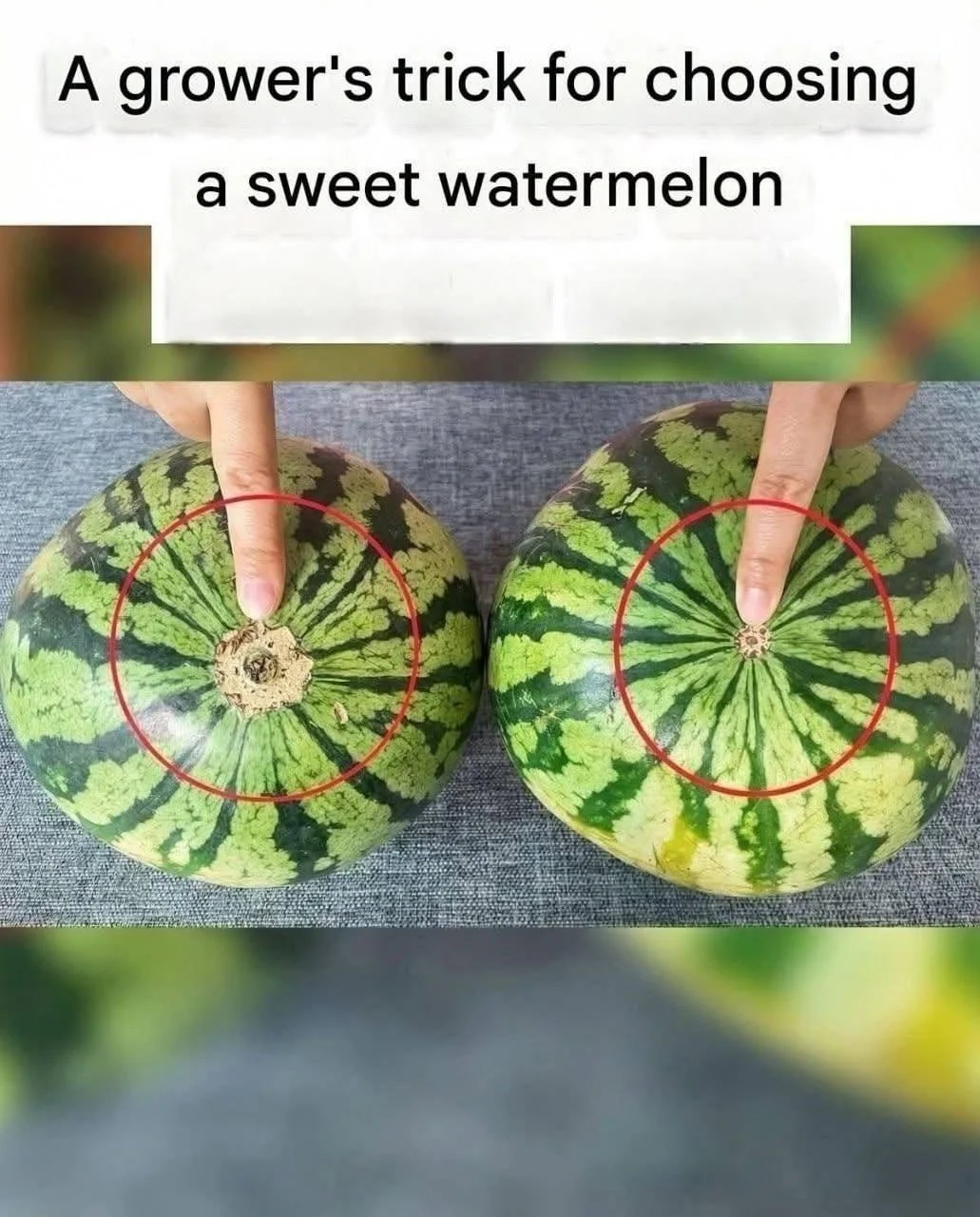
You can pick the biggest, prettiest watermelon in the store and still end up cutting into a pale, disappointing melon.
The frustrating part is that you usually don’t know what’s inside until you’ve already paid for it. But you can get better at choosing one before you leave the produce aisle.
The trick isn’t to look for one magical mark. Instead, check a few clues on the outside—especially the spot where the watermelon rested on the ground, how heavy it feels, and whether it shows signs of having reached maturity.
And there’s one fact worth knowing before anything else: watermelon doesn’t keep getting sweeter after it’s picked. Unlike bananas or peaches, it doesn’t continue normal ripening once harvested.
So if you’re standing in front of a pile of watermelons right now, here’s what to look for.


1. Turn It Over and Find the Yellow Field Spot
This is one of the first things I’d check.
Look at the underside of the watermelon—the side that rested against the soil while the fruit was growing. You’ll usually see a lighter-colored patch there, often called the field spot or ground spot.
A mature watermelon generally develops a more noticeable yellow or creamy-yellow field spot. A very white or greenish-white spot can be a sign that the fruit was harvested before reaching full maturity.
The important word here is clue.
The field spot isn’t a guarantee that the inside will be exceptionally sweet. Varieties can differ, and USDA guidance notes that no single outside characteristic can definitively establish maturity.
Still, when you’re comparing several melons, a good-looking yellow field spot is one of the most useful signs to consider.
What you’re looking for
- Creamy yellow
- Yellow or buttery tones
- A noticeable ground spot
Be more cautious with
- Very white patches
- Greenish-white areas
- A barely developed spot
Don’t reject a watermelon simply because its spot isn’t perfectly golden. Use it together with the other signs below.
2. Pick Up Two or Three and Compare the Weight
Here’s an easy test that takes only a few seconds.
Pick up two watermelons that are roughly the same size.
Then compare them.
The one that feels heavier for its size is usually the better candidate if you’re looking for a juicy melon. Watermelon is mostly water, and research on external maturity indicators has found that fruit weight can be associated with internal maturity characteristics.
You’re not necessarily looking for the largest watermelon in the pile.
A smaller melon that feels dense and heavy can be a better choice than a much larger one that feels surprisingly light.
Think:
Same size + noticeably heavier = worth a closer look.


3. Check the Stem or Tendril If You Can See It
This clue is more useful when you’re buying directly from a farm or getting a watermelon with some of the plant still attached.
The small curly tendril nearest the fruit can change from green to brown and dry as the watermelon approaches maturity. Extension guidance from both Minnesota and Oklahoma identifies this change as a maturity clue.
A dry stem can also provide supporting evidence.
But don’t panic if the watermelon at your supermarket has no visible stem or tendril. Most commercially sold melons won’t give you a perfect view of this feature.
And don’t treat a green stem as proof that the watermelon is bad. It’s simply one clue among several.
4. Look at the Rind—But Don’t Get Obsessed With Shine
You’ve probably heard that a dull watermelon is ripe and a shiny one is underripe.
There’s some reasoning behind that idea: rind sheen can change as the fruit matures.
But there’s an important catch.
The appearance varies by variety.
Minnesota Extension specifically notes that the change in rind sheen depends on the type of watermelon.
So don’t stand in the produce aisle trying to find the least shiny watermelon.
Instead, look for a melon that appears:
- Firm
- Healthy
- Free from major damage
- Normally colored for its variety
- Mature-looking rather than unusually pale
Use rind appearance as supporting evidence—not your deciding factor.
5. Choose a Firm, Well-Formed Melon
Your watermelon doesn’t have to be perfectly round.
Some varieties are naturally long or oval, and that doesn’t make them inferior.
What matters more is that the fruit looks reasonably well developed and doesn’t have obvious physical problems.
Pass on watermelons with:
- Deep cracks
- Large bruises
- Soft or sunken areas
- Signs of decay
- Serious cuts or damaged areas
USDA grading standards specifically recognize issues such as immaturity, decay and serious physical damage as defects.
A few ordinary scratches or harmless surface marks aren’t necessarily a reason to reject a good melon.
6. Don’t Assume Brown “Webbing” Means More Sugar
This is one of those watermelon tips that gets repeated so often that it starts sounding like a rule.
You’ve probably heard that brown web-like markings mean the watermelon is packed with sugar.
I wouldn’t use that as your deciding factor.
Those markings can occur as the fruit develops, but they aren’t a dependable way to measure the amount of sugar inside the melon.
If two watermelons are sitting beside each other, I’d pay much more attention to the field spot, weight, overall condition and maturity clues than to how much webbing appears on the rind.
That’s a good general rule with produce:
A popular trick isn’t necessarily a reliable test.
7. Try the Knock Test—But Don’t Let It Decide Everything
Yes, you can tap it.
A mature watermelon may produce a deeper, more hollow or dull sound, while an immature melon can sound more metallic. Extension resources recognize sound as one traditional maturity clue.
But there’s a reason I put this near the end of the list.
It takes practice.
And even experienced shoppers can’t use a knock to measure the exact sugar level of a watermelon.
USDA research has also cautioned that the traditional thumping method isn’t foolproof because a dull sound can occur in an overripe melon as well.
So tap it if you like.
Just don’t let one mysterious thump outweigh several stronger clues.


The 30-Second Watermelon Test I Would Actually Use
Continue Reading For More Helpful Tips →
Continue Reading →
Continue Reading For More Helpful Tips →
Continue Reading →