
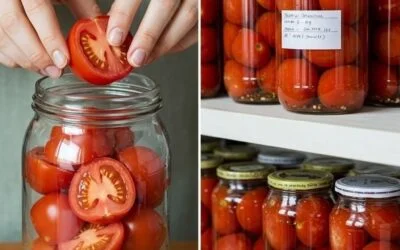
The idea of opening a jar of summer tomatoes in the middle of winter sounds wonderful—but tomato canning is one place where a “foolproof” shortcut can become a food-safety problem. Tomatoes are acidic, but their acidity can vary, and modern tomato varieties are not automatically acidic enough for every home-canning method. The good news is that you do not need vinegar to safely can tomatoes: tested home-canning guidance uses bottled lemon juice or citric acid instead.
So if you have a garden overflowing with ripe tomatoes, here’s how to preserve them while keeping both quality and safety in mind.


First, One Important Correction About the “2-Year” Claim
The source article promises tomatoes that remain fresh for two years without vinegar.
That’s not a claim I’d recommend repeating as a food-safety instruction.
For home-canned foods, USDA guidance says they should generally be used within one year. Commercially canned high-acid foods such as tomatoes can maintain best quality for longer, but that isn’t the same thing as recommending two-year storage for homemade jars.
Think of one year as the practical target for your home-canned tomatoes.
Why Tomato Canning Requires Extra Care
Tomatoes have traditionally been treated as an acidic food suitable for boiling-water canning.
But acidity varies among:
- Tomato varieties
- Growing conditions
- Ripeness
- Fruit condition
The National Center for Home Food Preservation notes that some tomatoes can have a pH above the safe threshold for boiling-water canning. That’s why tested guidance calls for acidification even when you’re using a pressure canner for tomato recipes where acidification is specified.
This isn’t a step to skip just because your tomatoes taste tart.
You Don’t Need Vinegar
If you dislike the flavor vinegar can add to canned tomatoes, there’s good news.
The tested options include:
- Bottled lemon juice
- Citric acid
- 5% acidity vinegar
For tomatoes, the National Center for Home Food Preservation recommends:
Per pint:
- 1 tablespoon bottled lemon juice, or
- ¼ teaspoon citric acid
Per quart:
- 2 tablespoons bottled lemon juice, or
- ½ teaspoon citric acid
Vinegar can also be used at the specified concentration, but it may noticeably change the flavor.


Why Bottled Lemon Juice Is Recommended
Don’t simply squeeze a random amount of fresh lemon juice into your jars.
For tested canning procedures, bottled lemon juice is preferred because its acidity is standardized.
That consistency matters when the acidity of the finished food is part of the safety process.
You can add the required acid directly to each jar before filling it. The National Center for Home Food Preservation specifically recommends doing this so the appropriate amount ends up in every jar.
Choose Good Tomatoes
Start with tomatoes that are:
- Firm
- Ripe
- Free from disease
- Free from significant bruising
- Preferably vine-ripened
Don’t use tomatoes from dead or frost-killed vines for canning.
If a tomato has a damaged or questionable area, don’t assume cooking will make the problem disappear. Trim away appropriate minor defects according to the tested recipe, and discard seriously spoiled produce.
A Simple Tested Style: Whole or Halved Tomatoes
For a straightforward pantry staple, whole or halved tomatoes are one option.
The National Center for Home Food Preservation’s tested procedure calls for peeling the tomatoes, removing the cores, leaving them whole or halving them, adding the required acid to the jars, filling the jars while leaving the specified headspace, and then processing them using the recommended canning schedule.
What You’ll Need
- Fresh, firm tomatoes
- Bottled lemon juice or citric acid
- Canning salt, optional
- Proper canning jars
- New canning lids appropriate for your jars
- Screw bands
- A boiling-water canner or pressure canner
- Jar lifter
The exact processing time depends on the recipe, jar size, canning method, and elevation, so don’t use one generic processing time for every tomato preparation.
Step 1: Wash the Tomatoes
Rinse the tomatoes thoroughly under clean running water.
Remove dirt and obvious debris.
Don’t soak them in a sink of dirty water.
Step 2: Loosen the Skins
For many whole or halved tomato canning procedures, tomatoes are dipped in boiling water for about 30–60 seconds, until the skins split.
They’re then transferred to cold water so the skins can be slipped off more easily.


Step 3: Remove the Cores
Remove the cores and any bruised or discolored portions.
You can leave the tomatoes whole or cut them in half, depending on the tested recipe you’re following.
Step 4: Add the Acid to Each Jar
Before filling your jars, add the appropriate amount of bottled lemon juice or citric acid.
For the standard tomato acidification guidance:
| Jar size | Bottled lemon juice | Citric acid |
|---|---|---|
| Pint | 1 tablespoon | ¼ teaspoon |
| Quart | 2 tablespoons | ½ teaspoon |
Do not reduce the acid because you prefer a sweeter tomato flavor.
If the finished tomatoes taste more acidic than you’d like, you can balance the flavor when you cook with them later.
Step 5: Fill the Jars
Pack the prepared tomatoes into the jars according to the tested recipe.
For the NCHFP whole-or-halved tomato procedure, the recommended headspace is ½ inch.
Don’t fill jars randomly to the top.
Headspace is part of the tested canning process and helps accommodate expansion during processing.
Step 6: Remove Air Bubbles
Run a nonmetallic bubble-removing tool around the inside of the jar.
Add more tomato if necessary to restore the correct headspace.
Wipe the jar rim clean.
Then apply the lid and screw band according to the manufacturer’s instructions.
Step 7: Process the Jars Properly
This is where you should not improvise.
The correct processing time changes with:
- Jar size
- Tomato preparation
- Canning method
- Elevation
For example, the NCHFP tested procedure for crushed tomatoes uses different boiling-water processing times at different elevations, and its pressure-canning options also have specific pressure requirements.
So don’t take a time from a recipe for crushed tomatoes and apply it to whole tomatoes—or vice versa.
What About Pressure Canning?
A pressure canner can be used for certain tested tomato procedures.
But here’s an important point:
Pressure canning does not automatically mean you can skip acidification.
The National Center for Home Food Preservation explicitly states that when its tested tomato procedures call for acidification, that acidification remains part of the procedure even when pressure canning is used.
That’s an easy detail to miss.
Can You Can Tomatoes Without Any Added Acid?
For ordinary home tomato canning, don’t treat “no vinegar” as “no acid.”
If you’re following a tested tomato-canning recipe that calls for acidification, use the specified amount of bottled lemon juice or citric acid.
Skipping it because your tomatoes taste acidic isn’t a safe substitution.


How to Tell Whether a Jar Should Be Discarded
Never taste questionable canned food to see whether it’s safe.
USDA warns against using jars that show signs such as:
- Leaking
- Bulging
- Cracked jars
- Loose or bulging lids
- Foul odors
- Liquid spurting when opened
Potential botulinum toxin cannot be reliably detected by smell or taste, so when in doubt, throw it out.
How to Store Home-Canned Tomatoes
Store sealed jars in a:
- Cool location
- Dry location
- Dark or relatively dark pantry
- Place away from temperature extremes
Avoid storing them above the stove or somewhere that gets hot.
USDA recommends using home-canned foods within one year for best practice.
Label each jar with:
What it is + date canned
That simple habit makes older jars much easier to manage.
What About the “Two-Year” Promise?
This is one place where it’s worth separating quality advice from a catchy headline.
A properly sealed jar may still look fine after a long time, but that doesn’t make “two years” an appropriate blanket recommendation for home-canned tomatoes.
USDA’s practical guidance is to use home-canned foods within one year.
So instead of promising two years, a better goal is:
Can safely, label carefully, store properly, and use within the recommended period.
That’s a much more useful promise to make to readers.
Common Tomato-Canning Mistakes
Skipping the Acid
Problem: Assuming naturally acidic tomatoes don’t need additional acid.
Better: Follow the tested acidification amount for the tomato product you’re canning.
Using Fresh Lemon Juice Instead of Bottled
Problem: Fresh lemons vary in acidity.
Better: Use bottled lemon juice when the tested recipe specifies it.
Guessing the Processing Time
Problem: Using the same time for every tomato preparation.
Better: Follow a tested recipe that matches your product, jar size, method, and elevation.
Canning Damaged Tomatoes
Problem: Trying to rescue heavily spoiled produce.
Better: Start with sound, disease-free tomatoes.
Treating a Good Seal as Proof of Safety
Problem: Assuming a sealed lid means every possible safety requirement was met.
Better: Safe canning depends on the entire process—not just whether the lid eventually seals.
Frequently Asked Questions
Can I preserve tomatoes without vinegar?
Yes. Vinegar isn’t the only acidification option. Tested guidance allows bottled lemon juice or citric acid for tomato canning.
Can I use fresh lemon juice?
For tested home-canning directions, bottled lemon juice is the recommended choice because its acidity is standardized.
Can I leave out the lemon juice if my tomatoes are very sour?
No. Don’t judge the safety of the canning process by taste. Use the specified amount of acid in the tested recipe.
Can I pressure-can tomatoes instead?
Some tested tomato procedures offer pressure-canning options, but you still need to follow the complete procedure, including acidification where specified.
How long should home-canned tomatoes last?
USDA recommends using home-canned foods within one year.
Can I use tomatoes that fell from a frost-killed plant?
The National Center for Home Food Preservation specifically says not to can tomatoes from dead or frost-killed vines.
The Bottom Line
Preserving a summer tomato harvest is absolutely worth doing—but safe canning is more important than finding a shortcut.
You don’t need vinegar if you don’t like its flavor. For tested tomato-canning procedures, bottled lemon juice or citric acid can provide the required acidification, followed by the correct processing method for the specific tomato preparation.
And rather than promising that homemade tomatoes will stay “fresh for two years,” aim for something better: properly prepared, properly processed, clearly labeled jars that you use within the recommended storage period.
That way, when winter arrives and you open a jar of tomatoes from your summer garden, the good memory comes with peace of mind—not a food-safety gamble.







