
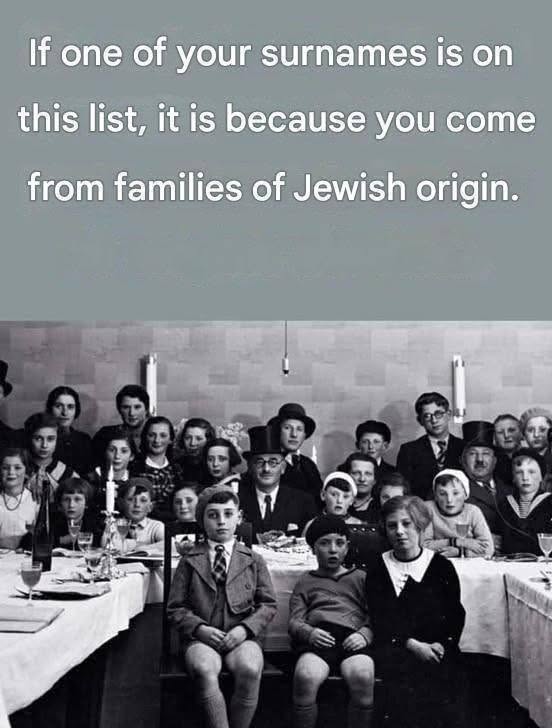
That is why lists of surnames said to be connected to Jewish ancestry attract so much attention. People see a familiar family name and naturally wonder whether it reveals something about their own history.
But there is an important distinction: a surname may be associated with Jewish communities without proving that everyone who carries it has Jewish ancestry. Names have moved across borders, changed spelling, and been shared by people from different backgrounds over many generations.
Why Jewish surnames can be difficult to identify
Jewish communities have lived in many parts of the world, and their naming traditions developed differently depending on the region and historical period.
For example, Ashkenazi Jewish communities were historically concentrated in Central and Eastern Europe. Sephardic Jewish communities have roots in Spain and Portugal, with families later settling across North Africa, the Mediterranean, the Middle East, and other regions.
These different histories influenced family names. Some surnames came from places of origin, while others were based on occupations, personal characteristics, parents’ names, or religious and cultural traditions.
The timing also matters. Many Ashkenazi Jewish families adopted permanent hereditary surnames between the late 18th and mid-19th centuries, often following government regulations. Some Sephardic families had established surnames much earlier.
Posen Library+1
As a result, there is no single pattern that identifies every Jewish family name.
Surnames that may offer historical clues
Some family names are strongly associated with particular Jewish communities. Names such as Cohen, Levi, and Katz, for example, have historical connections to Jewish religious traditions.
Other surnames may reflect geography, language, or family history. Names associated with Spanish, Portuguese, German, Hebrew, Arabic, or Eastern European languages can sometimes appear in Jewish family histories.
However, the same name may also belong to families with no Jewish connection. A surname can develop independently in different places, and people from different backgrounds may share it.
Jewish genealogy researchers therefore warn against treating a name as definitive evidence. Even a surname commonly associated with Jewish history is only one possible clue.
JewishGen+1
Why a surname alone cannot confirm your ancestry
Imagine discovering that your family name appears on a list of surnames associated with Jewish communities. It is understandable to feel curious, especially if your family has never discussed its earlier history.
But several things could explain the connection:
Your ancestors may have belonged to a Jewish community.
Your surname may have originated in a region where Jewish and non-Jewish families lived alongside one another.
Your family may share a name with an unrelated Jewish family.
The spelling or pronunciation may have changed after migration.
The name may have developed independently in more than one country.
Migration, language differences, government registration, and changes in spelling can make family history complicated. Two people with the same surname are not necessarily related, and a family name does not automatically reveal someone’s religion or ancestry.
JewishGen+1
How to investigate your family history
If you genuinely want to know whether your family has Jewish roots, there are more reliable ways to investigate than checking a surname list.
1. Start with older relatives.
Ask parents, grandparents, aunts, and uncles what they know about earlier generations. Family stories may include details about migration, languages, places of birth, religious traditions, or previous family names.
2. Find out where your ancestors lived.
A surname becomes more meaningful when you know the towns, regions, and countries connected to your family. Historical records from a particular location can provide much stronger clues than a name considered on its own.
3. Look for official family records.
Birth certificates, marriage records, death certificates, immigration documents, census records, and old family documents can help establish connections between generations. Religious and community records may also be useful when available.
4. Check different spellings of the surname.
Names sometimes change when families move between countries or when officials record them in another language. Searching only the modern spelling may cause you to miss important documents.
5. Consider a DNA ancestry test carefully.
DNA testing can provide information about genetic ancestry and possible connections with distant relatives. However, results depend on the company’s reference databases and cannot independently establish a person’s religious identity or prove every detail of a family story.
The most convincing family history usually comes from combining several kinds of evidence rather than relying on one result.
Jewish ancestry is more diverse than many people realize
Jewish history includes communities from Europe, North Africa, the Middle East, and many other regions. Their family names reflect centuries of movement, cultural exchange, and changing local traditions.
That is also why a surname that sounds Spanish, Arabic, German, or Eastern European may appear in Jewish genealogical records. Jewish families did not all use the same naming conventions, and many adopted names that were also common among their neighbors.
Research into Jewish family names has documented surnames connected to places such as Fez, Toledo, and other historic communities. Some names reflect migration, while others describe occupations or family relationships.
DOI+1
A family name can therefore open an interesting door into the past, but it cannot tell the whole story.
The real answer may be in your family’s records
Seeing your surname on a list connected to Jewish ancestry can be an interesting starting point. It may encourage you to ask questions that nobody in your family has thought to investigate for years.
Still, the important question is not simply whether your surname appears on a particular list. It is whether historical documents, family stories, and other reliable evidence support a connection.
Your ancestors’ lives may have included unexpected journeys, different languages, and cultural traditions that were never passed down clearly to later generations. Exploring those details can reveal far more than a surname alone.
Ultimately, your last name may offer a clue about your family’s past, but discovering your real ancestry takes research, historical context, and evidence.
Sources consulted: Center for Jewish History, JewishGen, Posen Library, and Board for Certification of Genealogists.