
A non-stick pan can look perfectly usable while its coating is already beginning to wear down. And once that coating is scratched or damaged, something much smaller than a visible flake may be released during cooking: tiny particles of the non-stick material itself.
That doesn’t mean every non-stick pan is dangerous, or that one scratch automatically makes your food unsafe. But research has found that damaged PTFE-coated cookware can release microplastics and nanoplastics, including in surprisingly large numbers.


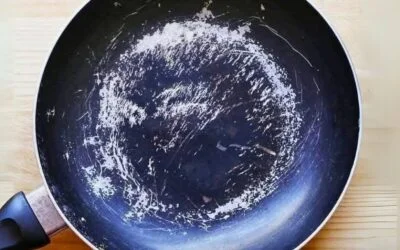
So if your favorite frying pan has started looking like the one pictured above, it may be worth taking a closer look before using it again.
What’s Actually Happening to a Non-Stick Pan?
Many traditional non-stick pans use a coating made with polytetrafluoroethylene, commonly known as PTFE. Teflon is a well-known brand associated with this type of coating.
When the coating is intact and the pan is used properly, regulators such as the U.S. Food and Drug Administration consider approved non-stick coatings suitable for their intended food-contact use. The FDA says the polymerized coating has negligible amounts of PFAS capable of migrating into food.
The concern is different when the surface becomes scratched, cracked, or heavily worn.
Mechanical damage can break pieces away from the coating. Researchers have specifically investigated this problem using Raman imaging to identify PTFE particles released from damaged non-stick cookware.
How Many Particles Can a Damaged Pan Release?
This is where the headline about “millions” comes from.
A 2022 study found that a damaged non-stick coating could potentially release very large numbers of PTFE microplastics and nanoplastics. The researchers estimated that a broken coating could release up to about 2.3 million particles, while a surface crack could produce roughly 9,100 particles under the study’s experimental conditions.
Those numbers sound alarming, but they need context.
They came from laboratory testing designed to examine particle release from damaged cookware. They do not mean that every meal cooked in every non-stick pan contains millions of particles.
That distinction matters.
Scratches Are One of the Biggest Things to Watch
A small scratch might seem like nothing, especially if the pan still cooks normally.
But scratches can create points where the coating becomes mechanically damaged. Using metal spatulas, forks, knives, or other hard utensils can make this worse.
Repeated scrubbing with abrasive materials can also contribute to wear.


This doesn’t mean you need to throw away a pan because of the tiniest cosmetic mark. The important question is whether the coating is visibly deteriorating.
Look for:
- Deep or spreading scratches
- Areas where the coating is peeling
- Flaking or chipped sections
- Large patches where the original surface has disappeared
- A surface that has become unusually rough
- Damage caused by repeated use or abrasive cleaning
When the coating is clearly breaking down, replacing the pan is a sensible precaution.
What About Microplastics in the Food?
Research has demonstrated that particles from damaged PTFE cookware can be released. Another study published in 2024 also found PTFE and other plastic particles in food simulants prepared using plastic cookware. However, the researchers emphasized that the health implications of ingesting these particles remain unclear.
That’s an important point.
It would be inaccurate to say that these particles have been proven to cause a specific disease simply because they were detected.
Scientists are still studying how microplastics and nanoplastics behave in the human body, how much exposure people receive, and what long-term effects different types and amounts might have.
So the evidence supports being careful with badly damaged cookware, but it does not justify claiming that every non-stick pan is toxic.
Heat Matters Too
Scratches aren’t the only reason to treat non-stick cookware carefully.
PTFE coatings should not be deliberately overheated. Excessive temperatures can cause the coating to break down and release fumes, which is a separate issue from the physical release of microplastic particles.
A simple habit can help: don’t leave an empty non-stick pan heating unattended at very high temperatures.
Using moderate heat and following the manufacturer’s instructions is a much better approach.
How to Make Your Non-Stick Pan Last Longer
You don’t necessarily have to give up non-stick cookware.
A few simple habits can reduce unnecessary wear:
Use Softer Utensils
Choose silicone, wood, or other utensils recommended for non-stick surfaces rather than sharp metal tools.
Avoid Abrasive Cleaning
A soft sponge and appropriate dish soap are generally preferable to aggressive scouring pads that can scratch the coating.
Don’t Stack Pans Carelessly
If you store several pans together, the bottom of one pan can rub against the cooking surface of another. Using a protective layer between them can help prevent unnecessary scratches.
Avoid Extreme Heat
Non-stick cookware is generally intended for controlled cooking temperatures. Avoid heating an empty pan for long periods, especially over high heat.
Inspect the Surface Regularly
You don’t need a microscope to know when a pan has reached the end of its useful life. Peeling, extensive scratching, or obvious coating loss are good reasons to replace it.
Should You Throw Away Every Scratched Non-Stick Pan?
Not necessarily because of one tiny mark.
The research shows that damaged PTFE coatings can release particles, but it doesn’t establish that every visible scratch produces the same amount of material or that using a slightly scratched pan will automatically cause harm.
The more practical approach is to look at the overall condition of the coating.
If the surface is heavily scratched, peeling, flaking, or visibly deteriorating, replacing the pan is a reasonable choice. If it’s simply showing a minor cosmetic mark, the situation is different.
The Bigger Takeaway
The surprising part of the research isn’t that every non-stick pan is secretly dangerous. It’s that a coating that looks like a smooth, solid surface can produce microscopic particles when it becomes sufficiently damaged.


For most people, the practical lesson is simple: take care of the coating, avoid unnecessary scratching and overheating, and replace cookware when the surface is clearly breaking down.
And one final detail is worth remembering: the phrase “millions of particles” comes from controlled experimental research on damaged cookware. It should not be interpreted as proof that every non-stick pan releases millions of particles every time you cook.
The science is more nuanced than the headline — and that’s exactly why checking the condition of the pan you use every day is worth your attention.