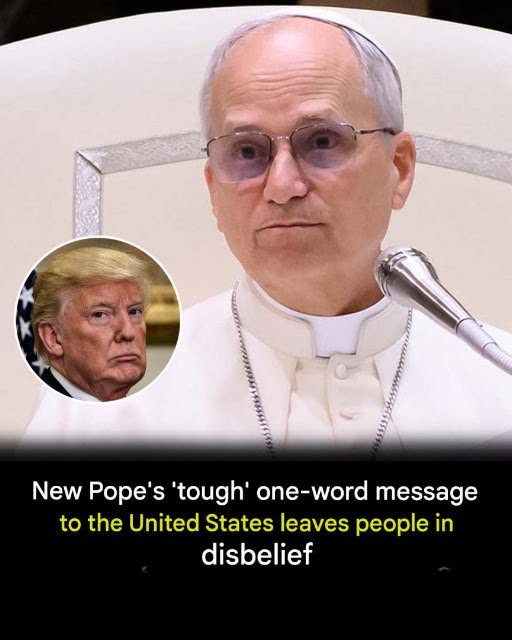
Sometimes, a brief response can attract more attention than a lengthy speech. That was the case when Pope Leo XIV, the first American-born pope in the history of the Catholic Church, gave a surprisingly short answer to a reporter asking whether he had a message for the United States.
The exchange took place at the Vatican on May 12, 2025, just days after his election as pontiff. When NewsNation correspondent Robert Sherman asked, “Any message for the United States?” Pope Leo XIV smiled and responded with a single word: “Many.”
He then added, “God bless you all.”
Although the conversation lasted only a few moments, the video quickly circulated across social media, attracting attention from people interested in the new pope and his relationship with his home country.
A Brief Exchange That Captured Public Attention
The moment happened as Pope Leo XIV interacted with journalists gathered at the Vatican.
Following his historic election on May 8, 2025, the new pontiff was meeting representatives of the international press. During the gathering, reporters had an opportunity to ask questions and hear his thoughts about his new responsibilities.
Among the questions was one about the United States, the country where he was born.
His response, “Many,” was brief but unexpected. Rather than offering a detailed statement, he followed it with a simple blessing before continuing through the crowd.
The short exchange soon became a widely shared online moment, with viewers discussing what the pope might have meant.
Why Did His One-Word Response Attract So Much Attention?
Part of the public interest came from the simplicity of the answer.
The word “Many” did not provide a specific explanation, leaving room for different interpretations. Some viewers wondered whether he was referring to the challenges facing the United States, while others believed he might have been suggesting that he had several thoughts he would share at another time.
Others viewed the response as a lighthearted and spontaneous moment rather than a carefully prepared political statement.
Importantly, Pope Leo XIV did not explain what he intended to communicate through that particular word. As a result, interpretations circulating online should not be mistaken for a confirmed explanation of his intentions.
Pope Leo XIV’s Message About Responsible Communication
The brief exchange took place on the same day as a larger address to journalists from around the world.
During his remarks, Pope Leo XIV emphasized the importance of responsible communication, freedom of the press, and the need for meaningful dialogue.
He encouraged journalists to approach their work with professionalism and to give attention to people whose voices are often overlooked.
He also spoke about the dangers of communication driven by prejudice, resentment, fanaticism, and hatred.
One of the central ideas in his address was that society needs communication based on listening rather than aggressive rhetoric.
These themes attracted attention because they addressed issues that extend beyond journalism, including public debate, social divisions, and the responsibilities of people who influence public opinion.
His American Background Adds Another Dimension
Pope Leo XIV, born Robert Francis Prevost in Chicago, Illinois, made history when he was elected leader of the Catholic Church.
His American background naturally attracted interest, particularly because he became the first pope born in the United States.
However, his life and religious career have extended far beyond his birthplace. Before becoming pope, he spent many years serving the Church internationally, including significant work in Peru.
This international experience has shaped his public identity and gives him a perspective that reaches beyond any single country.
For many Americans, his election represented a historic moment. It also raised questions about how he might approach issues affecting the United States while carrying responsibilities that extend to Catholics around the world.
Social Media Reactions and Different Interpretations
As the video spread online, reactions varied considerably.
Some viewers appreciated the pope’s calm delivery and found the short response memorable. Others focused on the possible meaning behind his choice of words.
His previous public positions on certain social and immigration issues also became part of online discussions about the exchange.
However, it is important to separate documented statements from personal interpretations. A brief answer does not necessarily reveal a complete political position or establish that a particular person or government was being criticized.
The response became interesting partly because it left so much room for discussion.
What Does the Moment Tell Us About His Leadership Style?
It would be premature to draw broad conclusions about Pope Leo XIV’s leadership approach from a single interaction.
Nevertheless, his May 12 address to journalists offered a clearer indication of the communication principles he wanted to emphasize.
His remarks highlighted listening, respect, freedom of expression, and the importance of avoiding language that encourages division.
These are themes that can apply to political leaders, journalists, religious communities, and ordinary conversations alike.
As he continues his responsibilities as pope, his public statements and actions will provide a much fuller picture of his priorities.
Final Thoughts
Pope Leo XIV’s brief response to a reporter asking about the United States became one of the memorable moments surrounding the beginning of his papacy.
His single-word answer, “Many,” followed by “God bless you all,” sparked curiosity and encouraged different interpretations across social media.
Yet the most meaningful context came from his broader address to journalists, where he emphasized responsible communication, listening, and respect for different voices.
Whether people viewed the exchange as humorous, thoughtful, or simply spontaneous, it demonstrated how even a short public interaction can generate widespread interest.
For now, the pope’s exact meaning remains open to interpretation, while his wider message about dialogue and responsible communication provides a clearer understanding of the themes he chose to emphasize.