
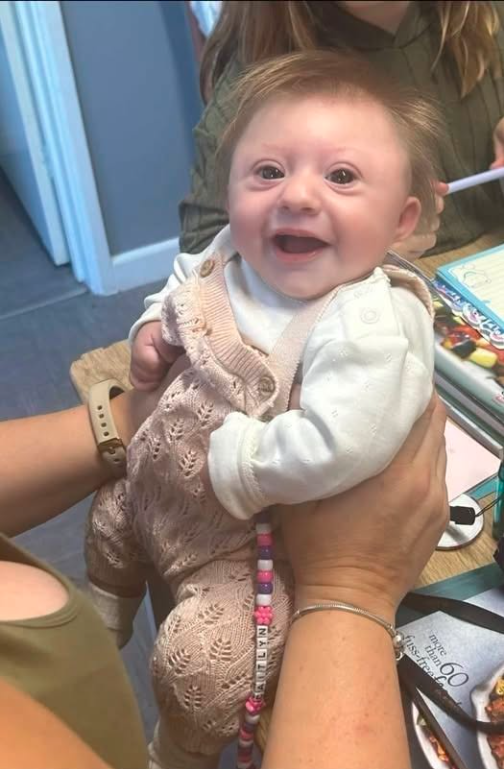
It began with something that sounds so ordinary: a tired father holding his two-month-old baby.
The child was asleep, and the father reportedly settled down with him during the early morning hours. Then, according to the account given to police, the father fell asleep too.
What happened next turned a quiet moment at home into a heartbreaking tragedy and left investigators with difficult questions about exactly how the infant died.
The case took place in Anápolis, in the Brazilian state of Goiás, and dates back to July 2018. Yet the story has resurfaced online years later, often beneath an incomplete headline that gives readers only a few words before asking them to click for the rest.
Behind that sensational presentation is a much sadder and more complicated story.
A Baby Was Being Held by His Father
According to reports from the time, the incident happened in the Jardim das Américas 2ª Etapa neighborhood of Anápolis during the early hours of July 2, 2018.
The baby was only two months old.
His father told authorities that he had been holding the infant while resting and had eventually fallen asleep. According to that account, the baby slipped from his father’s arms.
Emergency medical personnel from SAMU, Brazil’s Mobile Emergency Care Service, were called to the home. The infant could not be saved.
For the family, there was no preparation for what followed.
An ordinary moment of caring for a baby had suddenly become a devastating loss.
But there was another question that authorities had to answer.
Was the father’s account consistent with what the physical evidence showed?
Police Had to Reconstruct What Happened
Whenever a very young child dies unexpectedly, investigators have to establish the circumstances carefully.
In this case, police did not simply have one explanation and immediately treat it as the final answer.
The father’s account was one piece of the investigation.
Authorities also needed forensic evidence, statements from people who might have information about the events and other details that could help reconstruct what happened inside the home.
Reports from the time indicated that the case was being investigated as a possible death involving negligence or lack of intent, while investigators continued working to establish the circumstances.
That distinction matters.
An initial police classification is not the same thing as a final legal conclusion.
And in a tragedy involving an infant, assumptions can be especially dangerous.
The Father’s Story Was Only the Beginning
The father reportedly went to police and explained what had happened.
He said he had been with his son and had fallen asleep while holding him.
From his perspective, the incident was a terrible accident that happened during a moment of exhaustion.
But investigators still had to determine whether the physical evidence supported that account.
That is why forensic examination was so important.
A death investigation cannot rely solely on what someone remembers, particularly when the person providing the account was also present when the incident occurred.
The goal was to establish what happened, not simply to accept or reject a story based on emotion.
The Tragedy Also Highlights the Danger of Exhaustion
There is a painful lesson buried inside this case that many parents and grandparents will recognize.
Caring for an infant can mean interrupted sleep night after night.
A baby may need feeding, comforting or attention at almost any hour. A parent who has been awake repeatedly can become profoundly tired, sometimes without fully realizing how close they are to falling asleep.
That is why infant-sleep guidance generally recommends putting a baby on a firm, flat, separate sleep surface rather than sleeping with the baby on a couch, armchair or other adult sleeping surface.
The American Academy of Pediatrics specifically advises against routine sleep on couches and armchairs because these environments can create serious risks for infants.
That general safety advice should not be treated as a conclusion about the specific Brazilian case.
It is simply an important reminder of how quickly exhaustion can become a safety issue when an adult is caring for a very young child.
Why the Headline Can Be Misleading
The original headline circulating online is deliberately incomplete:
“Rest in peace: Died after father took his…”
Then comes the familiar invitation to “See more.”
That format creates an immediate information gap.
Who died?
What happened?
Why was the father involved?
Was this an accident?
Was anyone charged?
Those unanswered questions can make readers click before they know that the underlying case is from 2018, not a new tragedy occurring in 2026.
That date is one of the most important details to understand.
The story may look like breaking news when it appears in a recent social-media post, but the reported incident happened years ago.
An Old Tragedy Has Been Repackaged Online
This is something readers increasingly encounter on social media and smaller websites.
A tragic event from years ago can suddenly begin circulating again.
Sometimes the wording changes.
Sometimes the photograph changes.
Sometimes the original date disappears completely.
And sometimes an incomplete headline makes the story appear even more mysterious than it originally was.
That seems to be what has happened here.
The tragedy itself is real, but the presentation can make it difficult to understand when it happened and what investigators actually knew at the time.
For readers, that is a good reason to pause before sharing a dramatic post.
Look for the date.
Look for the original reporting.
And pay attention to whether a statement describes something that was reported, suspected, under investigation, or established as fact.
Those words can make a tremendous difference.
The Hardest Part May Have Come After the Investigation Began
For the family, an investigation could never change the most painful fact.
Their baby was gone.
No police report, forensic examination or eventual classification could restore the future they had imagined.
A two-month-old child represents a lifetime of possibilities that parents naturally expect to see unfold.
First smiles.
First steps.
First words.
Birthdays.
School.
Graduation.
All of those ordinary milestones were suddenly gone.
That is why stories like this deserve more than a sensational headline.
There are real people behind the clicks.
What Was Known About the Investigation?
Contemporary reporting said authorities were collecting testimony and relying on forensic work to establish the circumstances surrounding the death. The father’s explanation was being examined alongside the available evidence.
Reports also used legal terminology relating to a possible unintentional death.
That does not mean the father was found guilty of intentionally harming his child.
In fact, the available reporting emphasized that investigators still needed to establish what had happened.
That is an important distinction that can disappear when an old case is turned into a short social-media headline.
A careful account should preserve the uncertainty that existed during the investigation rather than turning it into a stronger accusation years later.
There Is a Bigger Lesson for Parents
The tragedy also illustrates why infant-safety recommendations are so specific about sleep.
An adult may think, “I’ll just rest here for a minute.”
A baby may already be asleep.
The situation can feel harmless.
But exhaustion can make it difficult to predict what will happen next.
The safest option is to place an infant in an appropriate sleep space before the caregiver falls asleep.
That advice is not about blaming exhausted parents. Quite the opposite.
Parents of newborns are often operating on very little sleep, and recognizing that vulnerability is part of keeping babies safe.
Sometimes the most important safety precautions are the ones designed for the moment when someone is simply too tired to think clearly.
Why This Story Still Gets Attention
The story has all the elements that tend to draw people online: a baby, a parent, an unexplained death, a dramatic headline and unanswered questions.
But the real story does not need extra drama.
It is heartbreaking enough on its own.
A father reportedly fell asleep while holding his two-month-old son.
The infant fell.
Emergency responders arrived and confirmed that the baby had died.
Police and forensic authorities then had to determine exactly what had happened.
Those facts are already devastating.
There is no need to invent motives, assign blame that was not established, or turn an old investigation into breaking news.
A Reminder to Slow Down Before Sharing
When an emotional headline appears in your feed, especially one that ends with “See more,” it can be tempting to click, react and share immediately.
This story is a good reminder to take another moment.
Ask when the event happened.
Ask where the information came from.
And ask whether the headline tells you what investigators actually determined or simply gives you enough information to make you curious.
In this case, the tragedy occurred in Anápolis in 2018, not during the current news cycle.
That one detail changes the entire context.
A Family Was Left With an Unthinkable Loss
The most important part of this story is not the viral headline.
It is the tiny life that ended far too soon.
A two-month-old baby died after reportedly falling from his father’s arms while the father was asleep. Authorities investigated the circumstances, while the family was left to cope with a loss that no parent ever expects.
Years later, the story continues to circulate online.
But beneath the dramatic wording is a reminder that some stories should be approached with compassion rather than curiosity alone.
The facts are painful enough.
And for the family involved, this was never simply a headline.
It was the loss of a child.







