
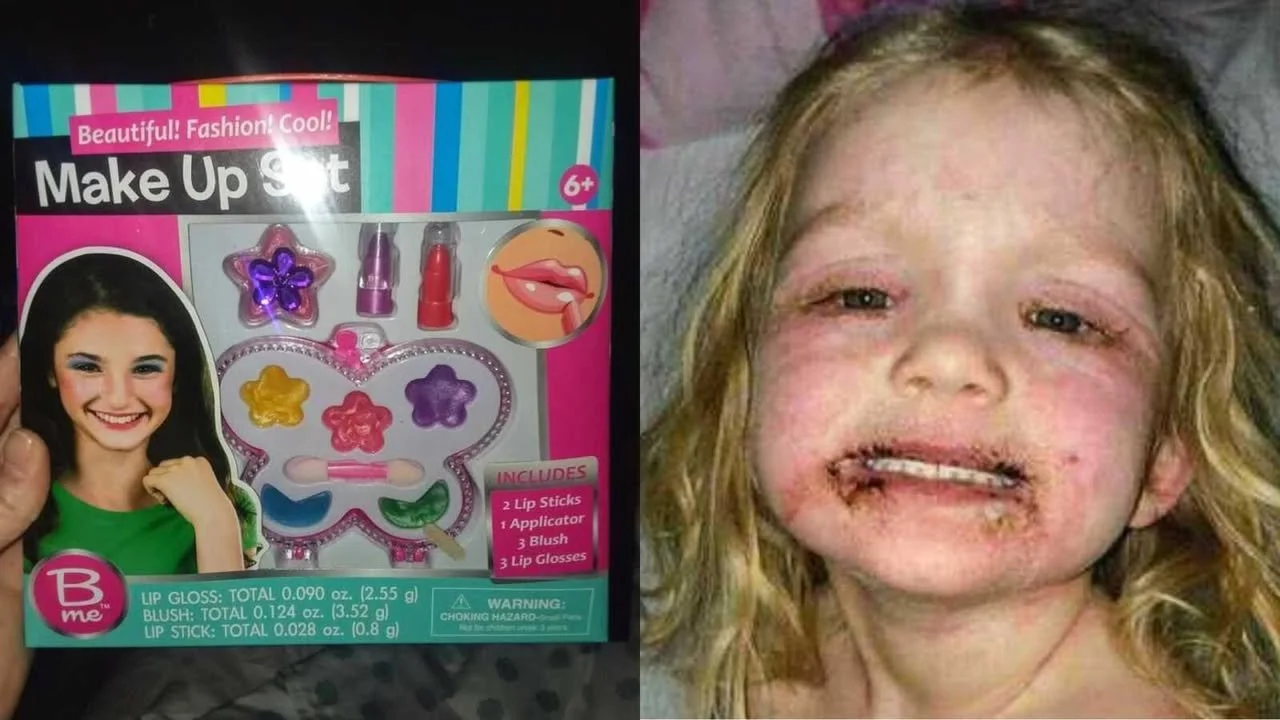
PART 1
The first thing I noticed was that Emma stopped smiling.
She had been standing in front of the bathroom mirror for almost an hour, carefully putting on the little makeup set we’d bought her for her eighth birthday.
Pink eyeshadow.
Purple lipstick.
A tiny bottle of glitter.
A plastic brush that was probably worth less than a dollar.
She was so proud of herself.
“Mom, look!”
She turned around and grinned.
I laughed.
“You look beautiful, sweetheart.”
She ran back to the mirror.
“I look like you!”
I remember that sentence because, later that night, I would replay it in my head hundreds of times.
Because twelve hours later, my daughter wouldn’t even be able to open her eyes.


6
At the time, there was nothing that seemed dangerous.
The makeup had been marketed for children.
The packaging was colorful.
It had little cartoon stars all over it.
And Emma had used similar products before.
So when she asked if she could spend the afternoon pretending to be a grown-up, I didn’t think twice.
She put glitter on her cheeks.
Pink color around her eyes.
A little lipstick.
Then she ran downstairs to show her father.
“Look at me, Daddy!”
Mark looked up from his laptop and smiled.
“Wow.”
He pretended to be shocked.
“Who’s this fancy lady?”
Emma giggled.
For the next few hours, everything was normal.
We ate lunch.
We watched a movie.
Emma played with her dolls.
She even begged me to take pictures because she wanted to show her grandmother.
Then, around six o’clock, she rubbed her eyes.
“Mom?”
“Yeah?”
“My eyes itch.”
I looked at her.
There was a little redness around her eyelids.
Nothing dramatic.
I assumed she’d gotten some makeup in her eyes.
“Let’s wash your face.”
I took her upstairs and carefully removed everything.
The glitter.
The eyeshadow.
The lipstick.
I washed her face with water and tucked her into bed.
“Better?”
She nodded.
But she didn’t look at me.
Her eyes were already beginning to swell.
I kissed her forehead.
“Get some sleep.”
At 10:30, I checked on her.
Her face looked different.
The skin around her eyes was red and puffy.
I woke Mark.
“Something’s wrong.”
He sat up immediately.
We turned on the bedroom light.
Emma was scratching her arms.
“Mommy…”
Her voice was tiny.
“My skin hurts.”
I pulled back the blanket.
There were red patches spreading across her neck and chest.
My stomach dropped.
We rushed her to urgent care.
The doctor examined her and asked what she had been exposed to.
I told him about the makeup.
He looked at Mark.
Then at me.
“She may be having an allergic reaction.”
“To the makeup?”
“It’s possible.”
Possible.
That word gave me hope.
Until Emma suddenly started crying.
“Mommy, I can’t see.”
My heart stopped.
Her eyelids had swollen almost completely shut.
The doctor immediately told us to take her to the emergency department.
We raced through the night.
And as I sat in the back seat holding my daughter’s hand, I kept thinking about the little pink box sitting in our bathroom.
The harmless little toy I’d bought her.
The thing that had made her so happy that morning.
I didn’t know yet that it might have triggered the worst night of our lives.
PART 2
By the time we reached the hospital, Emma’s face was almost unrecognizable.
Her eyes were swollen shut.
Her lips were cracked and inflamed.
Red patches covered her cheeks, neck, arms, and stomach.
She kept crying.
Not loudly.
That somehow made it worse.
“Mommy, make it stop.”
I held her hand.
“I will.”
But I had no idea how.
A nurse rushed her into a treatment room.
Doctors began asking questions.
“What did she eat?”
“Anything new?”
“Any medication?”
“Any insect bites?”
I answered everything.
Then one doctor asked:
“Any cosmetics?”
I froze.
“The makeup.”
He looked at the nurse.
“Get the box.”
Mark ran home.
Twenty minutes later, he returned with the little pink kit inside a plastic bag.
The doctor photographed the packaging.
Then he started reading the ingredient list.
His expression became serious.
“We need to be careful here.”
My heart sank.
“Is she going to be okay?”
“We’re treating the reaction now.”
“But?”
He paused.
“She appears to be having a severe skin reaction. We need to monitor her closely, especially because the reaction involves her eyes.”
I looked through the glass at my daughter.
She was lying completely still.
A cold cloth covered her forehead.
She looked so small.
So helpless.
Just that morning she’d been laughing at herself in the mirror.
Now she couldn’t even open her eyes.


5
Then Emma whispered something.
“Mommy?”
I leaned closer.
“Yes, baby?”
“Did I do something bad?”
My heart broke.
“No.”
“Then why does it hurt?”
I couldn’t answer.
I kissed her hand instead.
Hours passed.
Medication.
Cold compresses.
Doctors checking her eyes.
Nurses monitoring her breathing.
Every few minutes, I asked the same question.
“Is she getting better?”
Finally, just before sunrise, the doctor came back.
“She’s responding to treatment.”
I nearly collapsed with relief.
“But we’re not sending her home yet.”
“Why?”
“Her skin is still reacting, and we want to make sure the swelling continues to come down.”
I nodded.
Anything.
We would do anything.
I sat beside Emma’s bed until morning.
Mark sat on the other side.
Neither of us spoke.
Then his phone buzzed.
He looked at the screen.
It was a message from his sister.
Is Emma okay?
He typed:
She’s in the hospital. Severe reaction.
Three dots appeared.
Then disappeared.
Then appeared again.
Finally, another message came through.
What makeup did she use?
I looked at Mark.
“Why would she ask that?”
He didn’t know.
I reached into my purse and pulled out a photograph I’d taken earlier that afternoon.
Emma smiling.
Holding the makeup kit.
I zoomed in.
And suddenly noticed something I’d completely missed.
There was a tiny sticker on the bottom of the box.
A second brand name.
One I didn’t recognize.
I searched for it on my phone.
My stomach tightened.
The same product had been mentioned in several parent forums.
Parents complaining about rashes.
Burning skin.
Swollen eyes.
But there was something stranger.
One of the posts had been deleted.
Another had disappeared.
And a third parent had written:
“My daughter had the exact same reaction. I tried contacting the company, but they told me there was nothing wrong with the product.”
I stared at the screen.
Then another notification appeared.
A private message.
From a woman I’d never met.
Please don’t throw that makeup away.
I froze.
Another message arrived seconds later.
I know what happened to your daughter.
Then a final message:
And I know why the company doesn’t want parents asking questions.
I looked across the hospital room at Emma.
Her eyes were still swollen shut.
And suddenly, this didn’t feel like an accident anymore.
PART 3
The message stayed on my screen for almost a minute.
I know why the company doesn’t want parents asking questions.
I typed back.
Who are you?
The reply came almost immediately.
My name is Rachel. My daughter was hospitalized six months ago. Same product. Same reaction.
I looked at Emma.
Her breathing was steady now, but her face was still swollen.
I wrote:
What happened to your daughter?
This time, the response took longer.
She recovered. But we were told it was an unexplained allergic reaction.
Then another message appeared.
It wasn’t unexplained.
My hands went cold.
Rachel sent me a photograph.
It showed a different little girl sitting in a hospital bed.
Her eyes were swollen shut.
Red, blistered skin covered her cheeks.
It looked almost identical to Emma.
I showed Mark.
“That’s not possible.”
“I know.”
Another message arrived.
Check the batch number on Emma’s makeup.
I pulled the box from my purse.
There it was.
A tiny series of numbers printed underneath the packaging.
I sent Rachel a photograph.
She didn’t respond for several minutes.
Then:
That’s the same batch.
My stomach dropped.
“Mark…”
He stared at the screen.
“What?”
“The same batch made her daughter sick.”
Before we could say anything else, the hospital room door opened.
A woman in a dark blazer stepped inside.
“Are you Emma Carter’s parents?”
I immediately stood.
“Who are you?”
“My name is Laura Bennett. I’m with the manufacturer.”
Mark stepped forward.
“How did you know she was here?”
Laura looked uncomfortable.
“We received a report from the hospital.”
“That doesn’t answer my question.”
She glanced at the makeup kit on the table.
Then at me.
“We’d like to take the product for testing.”
“No.”
Her expression changed.
“Excuse me?”
“I’m not giving you anything.”
“Mrs. Carter, we need to determine whether the product was contaminated.”
“Then test it here.”
She hesitated.
That hesitation told me everything.
Mark noticed it too.
“You knew about this.”
Laura shook her head.
“No.”
“Then why did you come here so quickly?”
She didn’t answer.
A nurse suddenly entered.
“Mrs. Carter?”
I turned.
“The doctor wants to speak with you.”
I followed her into the hallway.
The doctor was waiting with a folder.
His expression was serious.
“We’ve run additional tests.”
My heart began pounding.
“What did you find?”
“We can’t say with certainty what caused the reaction yet.”
I looked at him.
“But?”
“There are signs that this may be more than a simple cosmetic allergy.”
“What does that mean?”
He lowered his voice.
“We found evidence of a chemical irritation that isn’t typical for ordinary children’s makeup.”
I felt the floor disappear beneath me.
“Chemical?”
He nodded.
“We’re sending samples for further analysis.”
I looked through the glass at my daughter.
Then something caught my eye.
The little pink makeup bag was still sitting on the hospital table.
I walked back inside.
Laura was gone.
But the bag wasn’t where I’d left it.
Someone had opened it.
I grabbed it.
The makeup kit was missing.
“Where is it?”
Mark looked confused.
“What?”
“The makeup.”
His face changed.
He understood immediately.
We searched the room.
Nothing.
Then my phone buzzed.
Rachel.
Did the company take the makeup?
I typed:
Yes.
Her response came instantly.
Don’t let them.
Then:
They took my daughter’s kit too.
I stared at the message.
Another one followed.
And three days later, my daughter disappeared from the hospital records.
My blood ran cold.
“What do you mean disappeared?”
Rachel didn’t answer.
Instead, she sent me a photograph.
A document.
At the bottom was a signature.
Laura Bennett.
The same woman who had just walked into my daughter’s hospital room.
I looked toward the hallway.
She was gone.
And suddenly, I realized something terrifying.
She hadn’t come to help Emma.
She had come to collect evidence.
PART 4
I ran.
I pushed through the hospital doors and found Laura near the elevators.
“Stop!”
She turned.
For one second, fear flashed across her face.
Then she smiled.
“You shouldn’t be following me.”
“Where is my daughter’s makeup?”
“I don’t know what you’re talking about.”
“You took it.”
“I didn’t.”
I held up my phone.
“I have proof.”
Her expression hardened.
“You have no idea what you’re getting yourself into.”
“Then tell me.”
The elevator doors opened.
She stepped inside.
I blocked them with my hand.
“How many children?”
She stared at me.
“What?”
“How many children got sick?”
Silence.
Then she whispered:
“More than you think.”
My heart stopped.
“Why?”
She looked around before speaking.
“Because the company knew.”
Mark had reached us.
“What did they know?”
Laura swallowed.
“The product was reformulated last year.”
“Why?”
“To reduce costs.”
“And?”
“They received complaints.”
“How many?”
“Enough.”
I felt sick.
“Then why was it still being sold?”
Laura looked down.
“Because the company decided the reactions were isolated.”
I shook my head.
“Isolated?”
“My daughter nearly lost her eyesight.”
“I know.”
Those two words broke something inside me.
“You knew?”
Laura’s eyes filled with tears.
“My niece was one of the first.”
The hallway went silent.
“What happened?”
“Her eyes were damaged.”
I covered my mouth.
“She’s eight.”
Laura nodded.
“She’s been in treatment for months.”
“Then why are you protecting them?”
“I’m not.”
She reached into her bag.
Pulled out a small flash drive.
“I’ve been collecting the internal emails.”
She handed it to me.
“The company knew about the reactions.”
I stared at the drive.
“Why give this to me?”
“Because your daughter is still one of the lucky ones.”
I froze.
“What does that mean?”
Laura looked toward the pediatric ward.
“Some children didn’t recover as quickly.”


4
That night, Emma’s swelling finally began to go down.
For the first time since the nightmare started, she opened her eyes.
Just a little.
“Mom?”
I rushed to her bedside.
“I’m here.”
“Can I see?”
I smiled through tears.
“Yes, sweetheart.”
Her eyes opened another fraction.
She looked at me.
Then whispered:
“I don’t want makeup anymore.”
I kissed her forehead.
“You never have to wear it again.”
Weeks later, Emma recovered.
Her skin healed.
Her eyes returned to normal.
But we didn’t forget.
The flash drive Laura gave us became part of an investigation.
Parents came forward.
More hospital records appeared.
More families told the same story.
Eventually, the company recalled the affected products.
The story made national news.
But the moment that stayed with me happened months later.
Emma was standing in front of the bathroom mirror again.
For a second, my heart jumped.
Then I realized she wasn’t putting on makeup.
She was brushing her hair.
She looked at herself in the mirror.
Then turned to me.
“Mom?”
“Yeah?”
“Do I look pretty?”
I walked over and hugged her.
“You look like Emma.”
She smiled.
“Good.”
And that was enough.
Because I had learned something I wish I’d known before that little pink box ever entered our home:
A product being made for children doesn’t automatically make it safe for children.
And sometimes, the most dangerous thing in your house isn’t the thing you were warned about.
It’s the thing you were told was harmless.







