
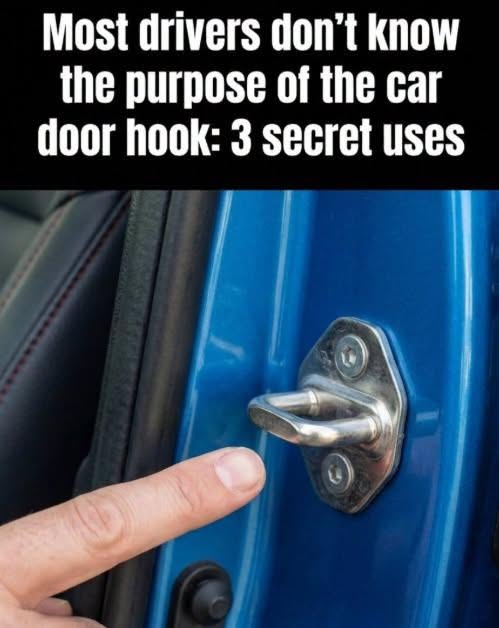
Have you ever noticed the small metal loop attached to the frame of your car door? It is easy to overlook. You probably see it every time you get into your vehicle, yet you may never have wondered why it is there.
At first glance, it looks like an ordinary metal hook. Some drivers assume it is simply part of the door’s locking mechanism, while others have no idea what it does.
But this little piece of metal plays an important role in your everyday driving experience. It helps keep your car door securely closed, contributes to a quieter ride, and is connected to an important part of your vehicle’s safety system.
And there is another interesting detail: some drivers have discovered additional ways to use it, although there are a few precautions worth knowing before trying them.
The Small Metal Loop Has an Official Name
The component is called a door striker, sometimes referred to as a latch striker.
You will generally find it mounted on the vehicle’s body frame, where the door meets the car when closed.
Although it may look like a simple metal loop, it is designed to work together with the locking mechanism inside your car door.
When you close the door, the latch catches onto the striker. That familiar clicking sound tells you that the two components have engaged.
This connection is what keeps the door in its closed position while you drive.
Without it, your vehicle’s door would not remain securely attached to the body in the way it was designed to.
It Does More Than Simply Keep the Door Closed
Most people think about the door striker only when they close their car door.
However, its role becomes especially important when considering vehicle safety.
The striker helps maintain the connection between the door and the vehicle body. During a collision, this connection is part of the system designed to help prevent the door from opening unintentionally.
Keeping the door properly secured also helps preserve the passenger compartment’s integrity.
This is particularly important because an unexpectedly opening door during an accident can create additional danger for the people inside the vehicle.
Of course, the striker is only one component of a much larger safety system that includes the door latch, hinges, reinforced door structure, and other parts.
Still, it is remarkable how much responsibility rests on such a small and easily overlooked piece of hardware.
That Little Part Also Helps Keep Your Ride Quiet
Here is something you may not have considered.
The door striker also contributes to your comfort while driving.
When the door closes correctly, it sits firmly against the vehicle’s frame. This helps the weather seals maintain proper contact with the surrounding surfaces.
Those seals help keep unwanted elements outside your car, including:
- Wind entering around the door.
- Rainwater getting into the passenger compartment.
- Dust and road debris.
- Unwanted outside noise.
A properly adjusted door also helps reduce unwanted movement and rattling while driving over uneven roads.
If you have ever driven an older vehicle with a door that rattles over every bump, you understand how annoying that sound can become.
Sometimes, problems with the door’s alignment or locking mechanism can contribute to that experience.
The small striker is one of the components involved in keeping everything properly positioned.
Some Drivers Have Found Another Interesting Use for It
Beyond its original purpose, the sturdy metal striker has attracted attention from drivers looking for practical accessories.
One example is the portable folding car step.
These accessories are designed to provide an additional foothold when someone needs to reach a roof rack or cargo box.
Another product mentioned in the original article is a mobility grab handle.
For older adults or people who have difficulty getting into or out of a vehicle, a properly designed support handle may make the movement easier.
Some accessories are designed to attach to the door striker, providing a convenient place to hold while entering or exiting the vehicle.
There are also lightweight organizers and cargo accessories that use suitable attachment points to help prevent smaller items from moving around.
However, there is an important distinction here.
Just because the metal striker looks strong does not mean every accessory can safely be attached to it.
Its original purpose is to engage with the door latch, not necessarily to support a person’s body weight or heavy cargo.
Before Attaching Anything, Check This First
This is particularly important if you are considering a grab handle or folding step.
Different vehicles have different door designs, striker arrangements, and manufacturer specifications.
An accessory that works with one vehicle may not be suitable for another.
Before purchasing or installing anything, consider these precautions:
1. Check your owner’s manual.
Your vehicle manufacturer’s instructions should be your first reference. Look for information about the door latch, striker, and approved accessories.
2. Choose accessories designed for your vehicle.
Avoid improvised attachments or products that do not clearly explain how they connect and what they are designed to support.
3. Never assume the striker can support your body weight.
This is especially important when using mobility handles or portable steps. Only use products approved for the specific attachment point and application.
4. Stop if the door does not close normally.
An accessory should never interfere with the latch, prevent the door from closing properly, or affect its locking mechanism.
5. Ask a qualified mechanic if you are unsure.
A professional can help determine whether a particular accessory is appropriate for your vehicle.
A little caution can prevent unnecessary damage to an important safety component.
Does This Small Metal Part Need Maintenance?
Yes, it deserves occasional attention.
Because the striker is exposed to everyday conditions, dirt, dust, moisture, and grime can accumulate around it.
Over time, corrosion or excessive wear may affect the way the latch engages.
You do not need an elaborate maintenance routine, but checking the area occasionally is a sensible habit.
Look for visible rust, unusual wear, loose mounting hardware, or signs that the door is no longer closing as smoothly as it once did.
If you notice that the door requires extra force to close, makes unusual noises, or feels loose, do not simply ignore the problem.
The issue could involve the striker, latch, hinges, or door alignment.
A qualified mechanic can inspect the mechanism and determine whether adjustment or repair is needed.
Avoid bending, filing, or repositioning the striker yourself. Its position is important to the proper operation of the door.
Two Common Misunderstandings About the Door Striker
Because this component is rarely discussed, it is easy to misunderstand its purpose.
One common misconception is that the metal loop is intended for hanging shopping bags, coats, or other belongings.
That is not its primary function. Vehicles generally have separate hooks and storage features designed for those purposes.
Another misunderstanding is that the striker never needs attention because it is made of metal.
Although it is built to withstand repeated use, that does not mean it is immune to corrosion, wear, or mechanical problems.
Like other parts of your vehicle, it benefits from occasional inspection.
A Small Detail That Deserves More Attention
The next time you open your car door, take a moment to look at the small metal loop on the frame.
It may not look particularly impressive, and it certainly isn’t one of the features manufacturers use to advertise a new vehicle.
Yet it performs an important job every time you get behind the wheel.
It helps the door stay securely closed, contributes to a comfortable cabin, and works alongside other components designed to protect passengers.
It is also a reminder that many of the most important parts of a car are the ones we rarely think about.
Sometimes, the smallest details make a surprisingly big difference.
Have you ever noticed this metal loop on your car before, or did you always assume it was just part of the door’s locking mechanism?
Important Safety Disclaimer
This article is intended for general educational purposes and is not a substitute for your vehicle manufacturer’s instructions or professional automotive advice. Door striker designs and weight limitations can vary between vehicles. Never use a door striker as a support point for your body weight, a mobility handle, a step, or heavy cargo unless the vehicle manufacturer and the accessory manufacturer specifically approve that application. If you notice rust, damage, unusual door movement, or difficulty closing the door, consult a qualified automotive technician before attempting repairs or modifications.