
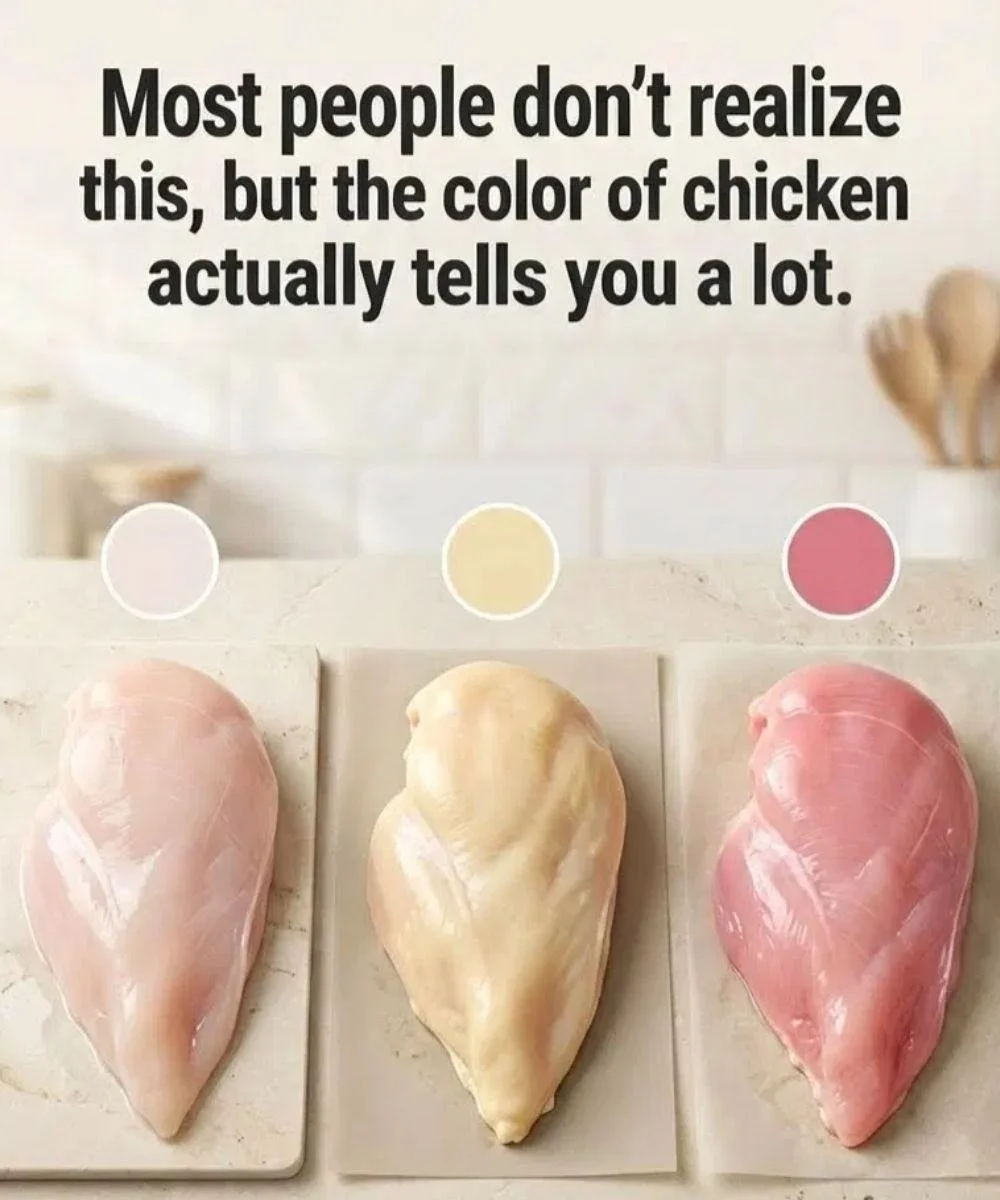
You’re standing in the grocery store looking at two packages of chicken. One breast looks pale pink, another has a slightly yellowish tone, and a third looks almost bluish-white.
Which one is better?
The answer may be less obvious than you think. Chicken can naturally come in several different colors, and color alone doesn’t tell you whether it is fresher, healthier, or safer.


Table of Contents
- Why Raw Chicken Can Look Different
- Does Yellow Chicken Mean Better Quality?
- What About Pink Chicken?
- Color Alone Doesn’t Tell You If Chicken Is Spoiled
- The Biggest Mistake: Judging Cooked Chicken by Color
- The Thermometer Matters More Than Your Eyes
- What About White Stripes on Chicken Breast?
- What Should You Actually Look For When Buying Chicken?
- So, Which Color of Chicken Is Best?
- The Bottom Line
Why Raw Chicken Can Look Different
Raw poultry can naturally range from bluish-white to yellow.
According to the USDA, these differences can be influenced by factors including the bird’s breed, age, activity, and diet. Younger poultry, for example, can have a bluish appearance because it has less fat beneath the skin. Yellow skin can also be related to what the bird was fed.
So if one chicken breast looks pinker and another looks paler, that doesn’t automatically mean one is better.
The same applies to chicken skin.
Does Yellow Chicken Mean Better Quality?
Not necessarily.
Yellowish chicken skin is sometimes presented online as a sign that the chicken is more nutritious, richer, or higher quality. But the USDA specifically notes that chicken skin color is influenced by feed and is not a measure of nutritional value, flavor, tenderness, or fat content.
That means you shouldn’t choose chicken simply because the skin looks more golden.
Color can tell you something about the bird and how it was raised, but it doesn’t give you a complete quality assessment.
What About Pink Chicken?
Pink is also a normal color for raw poultry.
The color of chicken meat is influenced in part by myoglobin, a protein in muscle tissue. Muscles that are used more can contain more myoglobin and therefore appear darker. Age and other biological factors can also influence meat color.
This is why different parts of the same chicken don’t necessarily look identical.
A darker-looking piece isn’t automatically spoiled, and a very pale piece isn’t automatically fresher.
Color Alone Doesn’t Tell You If Chicken Is Spoiled
This is one of the most important points.
A change in color by itself doesn’t necessarily mean that raw chicken has spoiled. USDA explains that normal color changes can happen during storage.
Instead, look for other warning signs, such as an off odor, a sticky or tacky surface, or a slimy texture.
That gives you a much better basis for judging whether something is wrong than simply asking, “Is this chicken pink enough?”


The Biggest Mistake: Judging Cooked Chicken by Color
Here’s where color becomes especially misleading.
Many people were taught that chicken is unsafe whenever the center remains pink after cooking.
But that’s not necessarily true.
USDA says safely cooked poultry can range from white to pink to tan. Chemical changes during cooking can leave chicken with a pinkish appearance even after it has reached a safe temperature.
So don’t automatically put cooked chicken back in the oven just because you see a little pink.
There is a much better way to check.
The Thermometer Matters More Than Your Eyes
For poultry, USDA recommends a minimum internal temperature of 165°F (73.9°C) measured with a food thermometer.
That’s much more reliable than judging whether the meat “looks done.”
A thermometer is especially useful when you’re cooking thick chicken breasts, whole birds, or pieces with uneven thickness.
And remember: color isn’t a substitute for temperature.
What About White Stripes on Chicken Breast?
You may also notice white lines running along some chicken breasts.
This appearance is commonly referred to as white striping. Research involving USDA scientists describes it as a chicken breast muscle condition associated with meat-quality changes. It is generally considered a quality issue rather than a simple color-based safety test.
In other words, seeing white stripes doesn’t automatically mean the chicken is unsafe to eat.
It can, however, affect characteristics such as texture and overall eating quality.
What Should You Actually Look For When Buying Chicken?
Instead of focusing on one particular shade of pink or yellow, pay attention to the whole package.
Look for:
- Proper refrigeration
- Intact packaging
- No unusual slimy or sticky texture
- No strong unpleasant odor
- A product that has been handled and stored according to the package instructions
- A reasonable use-by or sell-by date, while remembering that dates aren’t the only factor in food safety
If the chicken has an unusual appearance plus an unpleasant smell or slimy texture, that’s much more concerning than color alone.
So, Which Color of Chicken Is Best?
There isn’t one magic color.
Pale, pinkish, bluish-white, or yellowish tones can all occur naturally in poultry. The color may reflect factors such as breed, age, diet, muscle activity, and fat distribution.
That’s why the idea that “this color means better chicken” is too simplistic.
The more useful question is: Does the chicken look and smell normal, has it been stored properly, and will you cook it safely?
Those things tell you far more than whether the meat looks pink, pale, or yellow.
The Bottom Line
The color of chicken can tell you something about its natural characteristics, but it doesn’t tell the whole story about quality or safety.
Yellow skin doesn’t automatically mean better chicken. Pink meat doesn’t automatically mean bad chicken. And cooked chicken doesn’t have to turn completely white to be safe.
When you’re buying chicken, consider its overall condition rather than chasing a particular color.
And when you’re cooking it, leave the guesswork behind: use a food thermometer and make sure the poultry reaches 165°F (73.9°C).
That small habit is far more useful than trying to judge safety with your eyes.