
PART 1
After suffering a miscarriage during my third pregnancy, I was terrified to try again.
We already had two healthy daughters, and we were grateful for them.
But three years later, I felt an overwhelming desire to have another baby.
My husband agreed.
Then, almost unbelievably, I discovered I was already pregnant.
Instead of simply enjoying the pregnancy, I was nervous the entire time.
If you’ve ever lost a baby, you know how quickly excitement can turn into fear.
I prayed every day.
I prayed that God would let me have this baby.
That he would be healthy.
That everything would go smoothly.
At 20 weeks, we found out we were having a boy.
Finally.
My boy.
I was overjoyed.
The rest of the pregnancy was completely normal.
No major complications.
No warning signs.
He made it to full term.
And then came delivery day.
I remember the excitement of finally knowing I was going to meet my son.
After two healthy deliveries, I thought I knew exactly what to expect.
Then it was time to push.
Five big pushes later…
my son was born.
They placed him on my chest.
And my heart sank.
I looked at him.
Something was different.
I remember asking:
“What’s wrong with him?”
Looking back, I hate that those were my first words.
Because there was nothing wrong with my son.
He was perfect.
But he had something I’d never seen before.
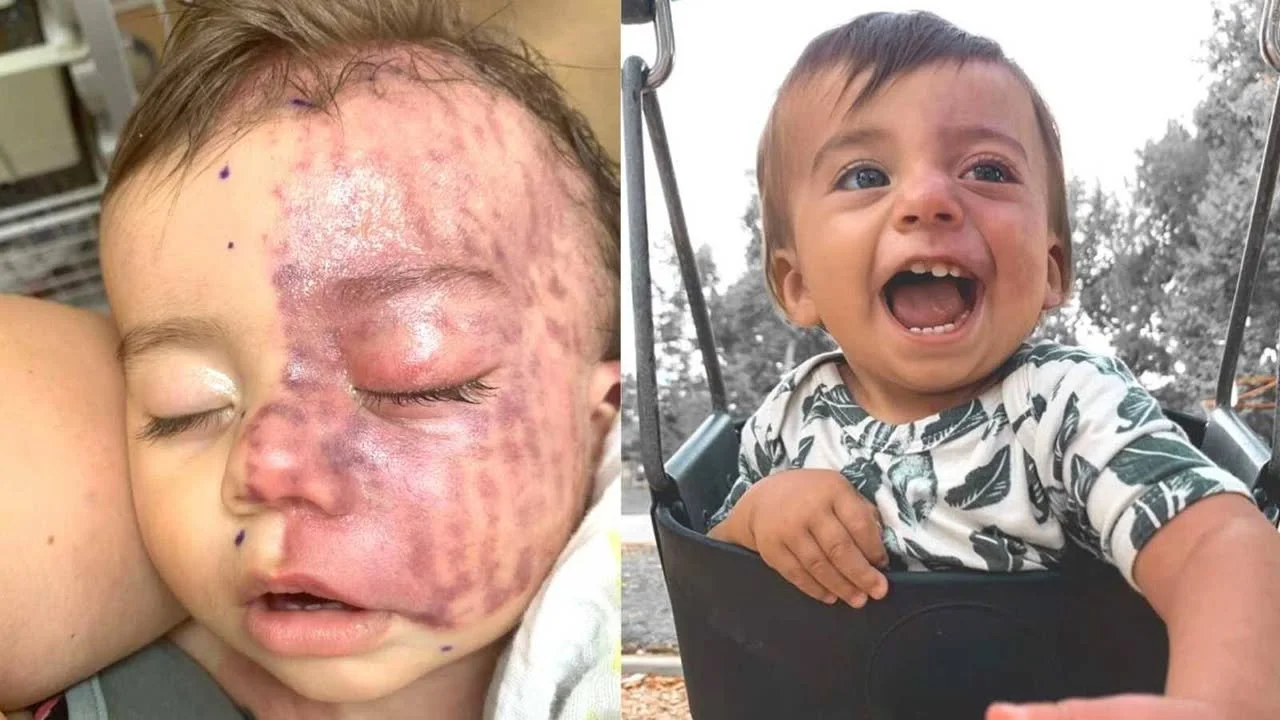
Large red birthmarks covered much of his body.
The most noticeable one covered almost the entire left side of his face and head.
They were called port-wine stains, caused by capillary malformations.
And I had no idea what they meant.


6
My mind immediately filled with questions.
Would people stare at him?
Would children make fun of him?
Would he struggle to accept himself?
Would his life be difficult?
I hadn’t even had time to process his birth.
And I certainly wasn’t prepared for what came next.
His left eye was extremely swollen.
When he began opening his eyes, I noticed something strange.
The affected eye looked cloudy.
The pediatrician examined him.
Then contacted a pediatric ophthalmologist.
The diagnosis came when my son was only one day old.
He had congenital glaucoma.
And because of the glaucoma and the location of his port-wine stain, doctors believed he most likely had a rare neurological condition:
Sturge-Weber syndrome.
Sturge-Weber syndrome can affect the brain and is often associated with seizures, glaucoma, and other neurological complications.
I felt like my entire world had collapsed.
I’d prayed for 40 weeks for a healthy baby.
I’d trusted God.
And now I was standing beside my newborn son wondering what his future would look like.
I was angry.
Terrified.
Heartbroken.
And completely unprepared.
PART 2
After the diagnosis, I became obsessed with researching Sturge-Weber syndrome.
I searched medical journals.
Articles.
Parent groups.
Anything I could find.
And unfortunately…
I focused on the worst possibilities.
I read about seizures.
Developmental problems.
Vision loss.
Neurological complications.
I couldn’t stop thinking about what could happen to my baby.
For months, I cried constantly.
I became depressed.
I was almost waiting for the first seizure to happen.
Every day I wondered:
“Is today going to be the day?”
But then…
months passed.
No seizures.
My son was eating well.
He was meeting his milestones.
And most importantly…
he was happy.
His smile was infectious.
He brought joy to everyone who met him.
Slowly, I started breathing again.
I realized that I had been so focused on what might happen that I had forgotten to enjoy what was actually happening.


5
We connected with other Sturge-Weber families online.
For the first time, I wasn’t alone.
Other parents understood the fear.
They understood the appointments.
The uncertainty.
The questions doctors couldn’t always answer.
We assembled a team of specialists.
Dermatologists.
Ophthalmologists.
Neurologists.
At only 17 days old, my son needed his first surgery to lower the pressure in his affected eye.
Watching my tiny baby being taken into an operating room was one of the hardest things I’d ever experienced.
Thankfully, the surgery was successful.
His eye became clearer, and we were able to control the pressure with medication.
But the appointments never seemed to end.
Because Sturge-Weber syndrome is rare, there weren’t always clear answers.
Doctors often told us:
“Every case is different.”
Sometimes they simply had to wait and see what would happen.
Eventually, we made an enormous decision.
At that time, we lived about three hours from the children’s hospital.
Every appointment meant a six-hour round trip with a newborn and our four-year-old.
My husband worked full time.
Our older daughter still had school.
The situation became exhausting and incredibly expensive.
So we sold our home.
We left the town where we’d grown up.
And we moved to California so our son could be closer to the specialists he needed.
After the move, he began receiving laser treatments for the port-wine stain on his face.
It was difficult to watch him go through another procedure.
But I knew we were doing everything we could for him.
Then…
our worst fear finally became reality.
My husband was away on a business trip.
My son woke up from a nap screaming.
Something was terribly wrong.
He couldn’t sit up.
His right arm and leg had suddenly become weak.
The right side of his face looked droopy.
He was drooling.
I called my sister.
We rushed toward the hospital.
But inside the car, his condition became worse.
I pulled over and called 911.
An ambulance arrived.
Then my baby was placed on a stretcher.
And suddenly…
we were being flown by helicopter to the hospital.


7
The helicopter ride lasted only 16 minutes.
But to me…
it felt like an eternity.
My son was having a full-blown seizure.
His little body was shaking uncontrollably.
I was strapped into my seat, unable to reach him.
Unable to stop it.
Unable to help my baby.
I was hysterical.
All I could do was pray.
“Please God, help him.”
When we finally landed, doctors rushed him inside.
They gave him medication to stop the seizure and performed tests to determine what had happened.
We would spend the next several days in the hospital.
And this was only the beginning of a battle that would test our family in ways we never imagined.
“God, Please Make It Stop.” Her Son’s Seizure Lasted 14 Minutes — And Then He Started Fighting Back
PART 3
After that first seizure, fear became part of our daily life.
Quinn was diagnosed with Todd’s paresis, which meant that after his seizures, the right side of his body could become extremely weak or almost paralyzed.
The first time it happened, it took three days for him to regain strength on that side.
We went home with new medications and even more questions.
I kept wondering when the next seizure would come.
And eventually…
it did.
Quinn began having clusters of seizures roughly once a month.
Sometimes there were two.
Sometimes three.
Sometimes four seizures back-to-back.
We made repeated trips to the hospital.
He had EEGs.
MRIs.
CT scans.
His medication doses were increased again and again because the seizures kept breaking through.
I was constantly waiting for the next emergency.


6
Then, one night in September 2019, everything became terrifying again.
Quinn started having seizures at home.
We took him to the children’s hospital.
The doctors managed to stop them, and after testing, we were sent home.
But only hours later…
it happened again.
This time, the seizure wouldn’t stop.
We didn’t have the emergency medication we’d been prescribed because no pharmacy nearby had it in stock.
Three minutes passed.
Then four.
Five.
Six.
Seven.
I was on the phone with 911, begging them to come.
My husband was beside Quinn, trying to comfort him.
I was trying desperately to stay calm for my son.
But inside, I was falling apart.
“God, please make it stop.”
I kept repeating those words.
“Please don’t take my baby from me.”


6
The paramedics finally arrived.
Quinn had been seizing for about 11 minutes.
They administered Ativan.
The seizure finally stopped.
My husband rode with him in the helicopter because I couldn’t bear to go through another helicopter ride.
I was completely overwhelmed.
At the hospital, Quinn underwent another MRI.
His medication was increased again.
We stayed for four more days.
When we were discharged, the seizure had stopped.
But the paralysis was still there.
We didn’t know how long it would last.
We didn’t know what his future would look like.
And after a seizure lasting around 14 minutes…
all we could do was wait.
And pray.
PART 4
Almost five months later, something incredible had happened.
Quinn hadn’t had another seizure.
For the first time in a long time, I felt like I could breathe.
I still lived with anxiety every single day.
I still worried whenever he acted differently.
I still knew another seizure could happen.
But my little boy was thriving.
He was receiving physical therapy.
Occupational therapy.
Vision therapy.
Six times a week.
And every day…
he was getting stronger.


10
His resilience amazed me.
This little boy had already endured more medical procedures and hospital visits than most people experience in a lifetime.
Yet he still smiled.
He still laughed.
He still brought happiness to everyone around him.
And something inside me had changed.
At the beginning, I had been angry with God.
I had asked:
“How could you let this happen to my baby?”
I had prayed every day for a healthy child.
Then, when Quinn was born with visible differences and a rare neurological condition, I felt like my prayers had failed.
But now…
I wasn’t angry anymore.
I thanked God for giving me Quinn exactly as he was.
Yes, people stared when we went out.
Sometimes strangers said things they shouldn’t.
But instead of letting those moments destroy me, I learned to respond with patience.
I learned that Quinn’s differences didn’t make him less valuable.
They gave us an opportunity to teach other people about kindness.
About acceptance.
About inclusion.


6
Quinn had taught me more in his first 17 months of life than I had learned in the 29 years before him.
He brought our entire family closer.
He changed the way we looked at the world.
And somehow…
he made my faith stronger.
I still don’t know exactly what his future will look like.
I don’t know how many challenges he’ll face.
But I no longer feel the same need to know.
I’ve learned to live in the moment.
To celebrate the good days.
To appreciate every smile.
Every laugh.
Every milestone.
And every ordinary day without a seizure.
Because ordinary days became precious to us.
Quinn isn’t someone who needs to be fixed.
He is my son.
He is a miracle.
And I am honored to be his mother.
I hope people learn to look beyond the birthmark.
Beyond the wheelchair or the medical diagnosis.
Beyond whatever makes someone look different.
Because behind every difference is a person who deserves the same thing we all do:
kindness.
Acceptance.
Love.
And when I look at my son now, I no longer see the frightening diagnosis that once consumed me.
I see a little boy who fought through every obstacle placed in front of him.
I see strength.
I see hope.
And I see a future that is still waiting to be written.
My son didn’t change the life I imagined.
He gave me a completely different life—one I wouldn’t trade for anything.







