
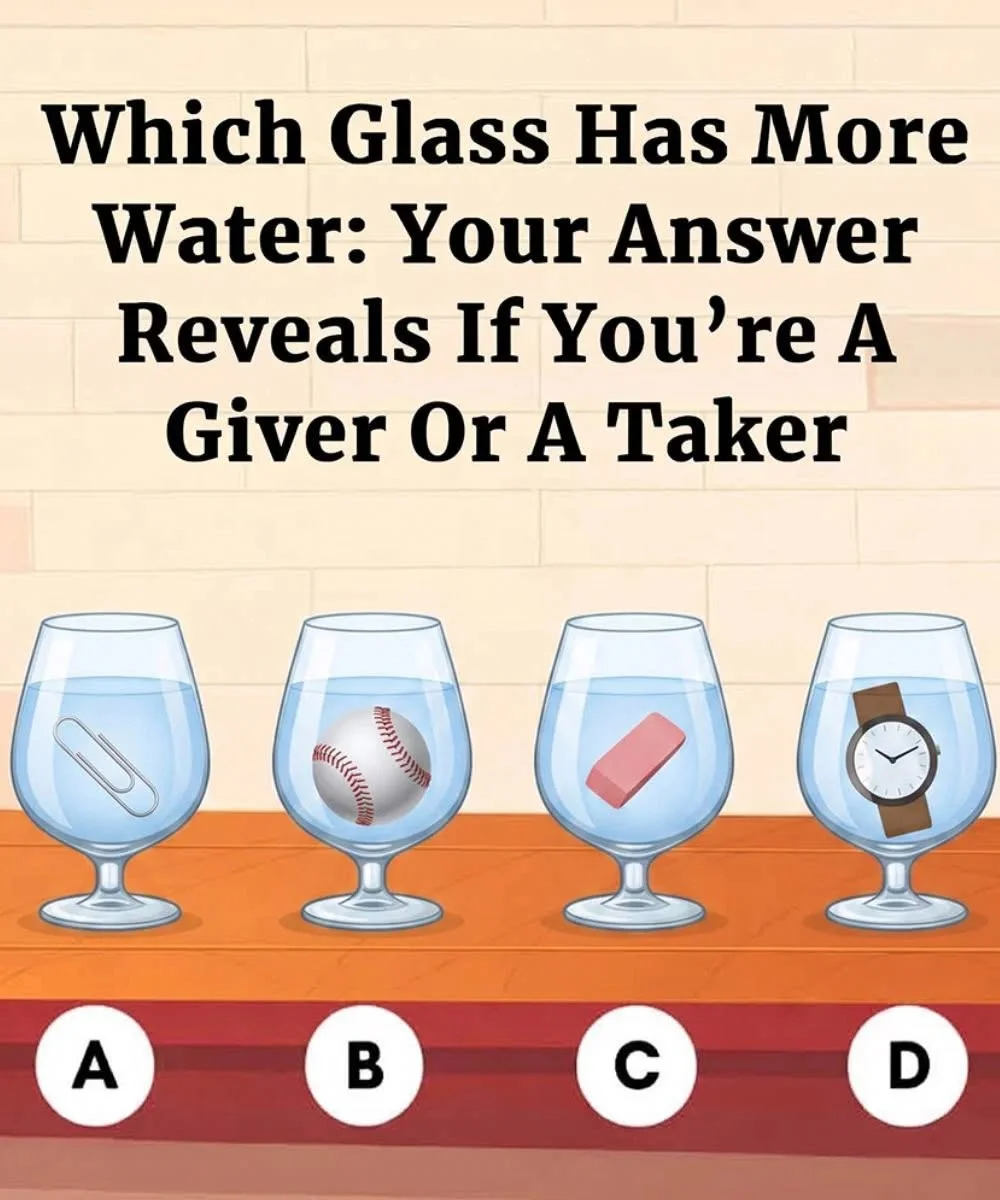
At first glance, this looks like a question with an obvious answer. Four glasses, four objects, and nearly identical water levels. But take a second look before choosing. The object inside each glass may matter more than the water line you notice first.
And there is another reason this little puzzle has become so popular: people often attach a personality meaning to the answer, suggesting that your choice can hint at whether you tend to be more of a giver or a taker.
So, which glass would you choose—A, B, C, or D?
The Answer Is Probably Glass A
If the glasses contain roughly the same amount of water up to the same visible level, Glass A is the most likely answer.
Why? Look at what is inside it.
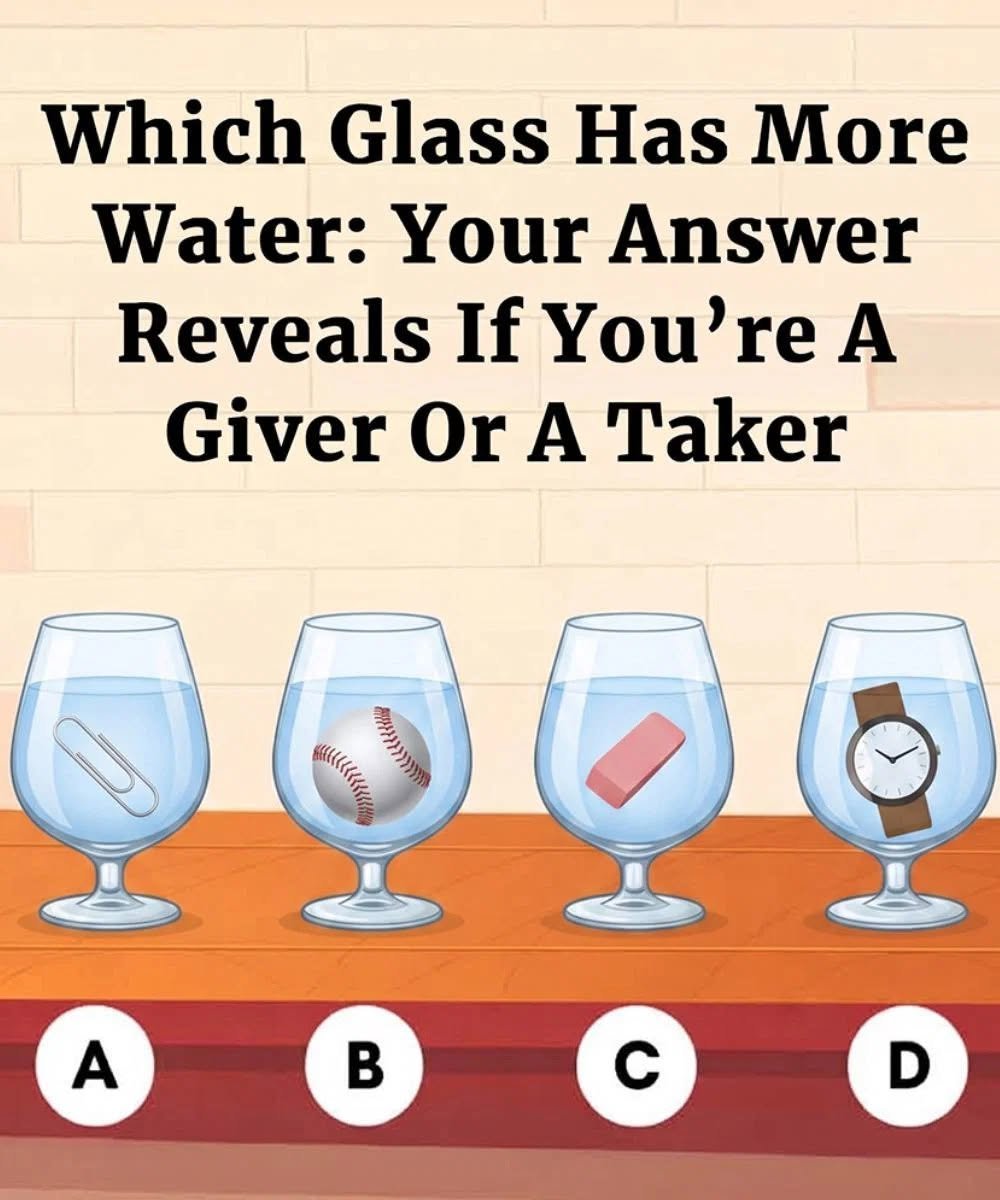
Glass A contains a small paperclip, while the other glasses contain objects that take up considerably more space. When an object is submerged, it occupies part of the space that could otherwise be filled with water.
That means the larger the submerged object, the less water is needed to reach the same level.
The paperclip takes up the least space, so Glass A can contain the greatest amount of actual water under the puzzle’s intended setup.
The important detail is easy to miss because our eyes naturally go to the water level first.
Why the Water Line Can Fool You
Imagine four identical glasses sitting side by side.
If you only look at the surface of the water, they appear to contain the same amount. But the objects underneath the surface are occupying space too.
Think of it this way:
- A small paperclip occupies very little space.
- A baseball occupies much more.
- An eraser occupies more than the paperclip.
- A watch also takes up considerably more room.
So even when the water reaches approximately the same height, the actual volume of water doesn’t have to be identical.
This is the basic idea behind water displacement: an object placed in water pushes liquid aside because it occupies physical space.
That’s why the puzzle is less about quickly spotting the “fullest” glass and more about noticing the detail hiding underneath the surface.
Why So Many People Pick the Wrong Glass
The puzzle plays on a very ordinary habit: making a quick judgment from what is most visually obvious.
The water surface is easy to see. The object underneath it is easier to overlook.
When you’re looking at the picture for only a few seconds, your brain may register:
“The water levels look the same.”
But the better question is:
“How much space is the object taking up?”
That small change in the question can completely change your answer.
It’s a useful reminder that the first thing we notice isn’t always the most important piece of information.
But Does Your Answer Really Reveal If You’re a Giver or a Taker?
This is where the puzzle becomes more interesting—and where it’s important to separate entertainment from science.
Social-media versions of these puzzles often attach personality descriptions to different answers. One choice may supposedly indicate generosity, another may suggest practical thinking, and another may be linked to emotional or intuitive decision-making.
Those descriptions can be fun to read, but there is no good reason to treat this single puzzle as a scientifically validated personality test.
Research from the University of Hertfordshire examining popular social-media claims about optical-illusion personality tests found little support for several of the personality connections being promoted online. The researchers noted that people can be especially receptive to descriptions that seem to fit them, even when the connection hasn’t been properly established.
So don’t worry if your answer supposedly makes you a “taker.” A glass puzzle can’t determine whether you’re generous, selfish, thoughtful, or caring.
Your everyday behavior tells us much more about that.
Still, Your Approach to the Puzzle Can Be Interesting
Even if the personality label isn’t scientifically reliable, the way you approach a puzzle can make for an interesting bit of self-reflection.
Did you answer immediately?
Or did you stop and inspect every object?
Maybe you noticed the paperclip right away. Maybe the baseball caught your attention because it was much larger. Or perhaps you assumed all four glasses contained the same amount of water until you looked more carefully.
None of those choices proves anything about your personality.
But they can highlight a useful habit: Do you tend to trust your first impression, or do you naturally look for the detail that might change the answer?
That’s a much more reasonable takeaway than declaring someone a “giver” or “taker” based on one picture.
The Smallest Detail Is the Real Trick
The clever part of this puzzle isn’t really the personality claim.
It’s the fact that the answer is hiding in plain sight.
Most people naturally focus on the water. The puzzle asks you to focus on the space occupied by the objects.
Once you notice that, the answer becomes much easier.
Glass A has the smallest object, so—assuming the illustration is intended to show comparable water levels and submerged objects—it is the logical choice for the greatest amount of water.
Try It Yourself With a Glass of Water
There’s an easy way to make the idea feel obvious.
Fill a clear glass with water and drop in a small object that can safely be submerged.
Watch the water level rise.
Then remove it and replace it with a larger object that fits safely in the glass.
The larger object will occupy more space and displace more water.
That’s essentially the principle this visual puzzle is playing with.
Just don’t use objects that can contaminate drinking water, damage the glass, or create a choking hazard around children or pets.
What If the Objects Are Floating?
There’s a small physical detail that the viral illustration doesn’t fully explain.
A completely submerged object displaces water according to the volume of the portion under the water. A floating object behaves differently because the amount of water it displaces is related to its weight.
So you shouldn’t treat every possible version of this image as a precise laboratory experiment.
For the intended puzzle, however, the simplest interpretation is that the objects are being compared by the amount of space they occupy, making the smallest-object glass the expected answer.
A Better Question to Ask Yourself
Instead of asking:
“Am I a giver or a taker?”
try asking:
“Did I look beyond the obvious before making my decision?”
That’s a question you can actually use in everyday life.
Sometimes the first answer is correct. Sometimes it isn’t. The useful habit is knowing when a situation deserves another look.
A quick decision can be perfectly reasonable when the facts are simple. But when something doesn’t quite add up, slowing down for a few seconds can reveal the detail you initially missed.
Frequently Asked Questions
Which glass has the most water?
Glass A is the intended answer in this version of the puzzle because the paperclip occupies the least space, assuming the water levels are comparable and the objects are being treated as submerged.
Why does the smallest object matter?
An object inside water occupies physical space and displaces some of the liquid. A smaller object generally displaces less water than a larger fully submerged object.
Is this actually a personality test?
No. The “giver or taker” interpretation is best treated as a fun social-media twist, not a validated psychological assessment.
Why do people get the puzzle wrong?
The visible water level is the easiest thing to notice. Many people don’t immediately consider how much space each object occupies.
What is water displacement?
Water displacement occurs when an object occupies space in a liquid and pushes some of that liquid aside.
The Takeaway
The answer may look simple once you see the trick: Glass A, because the paperclip takes up the least space.
But the more interesting lesson is what happens before you reach that answer.
A picture can make one detail look important while quietly hiding another. Taking an extra moment to look at the whole situation can sometimes change what seems obvious.
And as for whether your answer makes you a giver or a taker? Have fun with that part—but don’t take the personality label too seriously.