

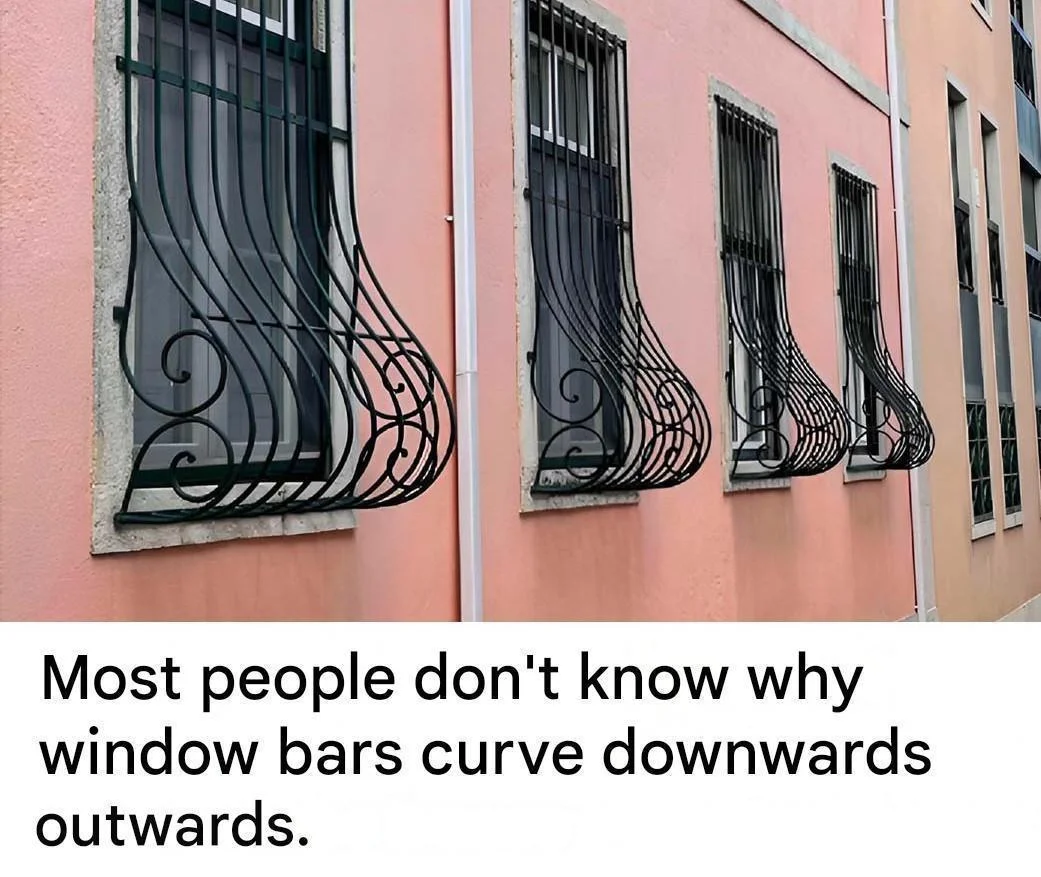
You’ve probably seen them on older buildings and narrow city streets: metal window bars that suddenly bow outward near the bottom instead of staying flat against the wall.
At first, the shape can look purely decorative. But that outward curve creates something surprisingly useful—a small amount of extra space outside the window without turning the opening into a full balcony.


So why were they made this way?
The Curve Creates Extra Space
The most practical explanation is simple: the curve gives the window a little more usable space while the metal grille continues to provide a barrier.
On a flat grille, anything placed outside the window would sit very close to the wall and could interfere with the bars. By bowing outward, the lower portion creates a small protected area.
That made the design useful for things such as flower pots and window boxes, particularly in places where homes had little or no outdoor space.
It essentially turned part of the window into a tiny outdoor space without requiring a conventional balcony.
A Small Garden Outside the Window
For homes in dense urban areas, even a few inches of extra space can be useful.
A curved grille can provide room for plants, flowers, or other small decorative items while keeping them behind the metal barrier.


This is one reason the design became associated with older Mediterranean and European architecture, where buildings could be close together and traditional balconies were not always practical.
However, it would be too strong to say that every curved window grille was designed specifically to hold flower boxes. These grilles appear in different architectural traditions, and their exact purpose can vary from building to building.
It Still Works as a Security Barrier
The original grille is still doing its most obvious job: creating a physical barrier over the window.
The curved section doesn’t automatically make a grille more secure than a straight one. Instead, it can provide extra space while maintaining the basic protective function of the bars.
That’s an important distinction because some explanations online claim that the curve was specifically engineered to make the bars impossible to cut or pry open. There isn’t good evidence for treating that as the universal reason for the design.
The safest conclusion is that these grilles combine security, usable space, and decoration.
Why Not Just Build a Balcony?
That’s another interesting part of the design.
A traditional balcony requires a structural platform that projects from the building. A curved window grille doesn’t. It provides only a small amount of exterior space while remaining attached directly around the window.
In other words, it’s a much simpler solution when the goal is to open a window, get more air and light, or add a little decorative space without constructing a full balcony.
Some related designs are even considered a type of Juliet balcony or balconette, although a true Juliet balcony is generally a guard or railing at a full-height opening rather than a small pot-bellied window grille.
The Shape Also Became Part of the Architecture
Function isn’t the whole story.
Wrought iron allowed blacksmiths to create elaborate curves, scrolls, and patterns. Over time, practical metalwork could become an important decorative feature of a building.
That explains why many examples look almost like miniature balconies or pieces of sculpture.


The curve gives the otherwise flat façade a three-dimensional shape, while decorative scrollwork can make the window stand out.
Not Every Curved Grille Has the Same Story
This is where the viral explanation needs a little caution.
You may see claims that these bars were invented for one specific purpose, such as holding flower pots, helping women in large dresses, improving security, or allowing people to lean farther outside.
Some of those uses may have occurred in particular places, but the shape itself doesn’t prove one universal historical explanation.
Architecture often develops through several needs at once: security, ventilation, available space, local craftsmanship, decoration, and changing styles.
So rather than saying “this curve has one secret purpose,” it’s more accurate to say that the outward bow creates useful space while preserving the protective grille—and that space could be used in different ways.
A Clever Solution Hidden in Plain Sight
The next time you see one of these windows, look at the curve differently.
What initially appears to be an ornamental flourish is actually a clever way of adding depth to an otherwise flat window. In many cases, that extra space could accommodate plants or other small items while the grille continued to protect the opening.
The exact history varies by place, but the basic idea is easy to appreciate: when you don’t have room for a balcony, sometimes you don’t need to build one—you can simply bend the metal outward.
And that’s what makes this little architectural detail so interesting.