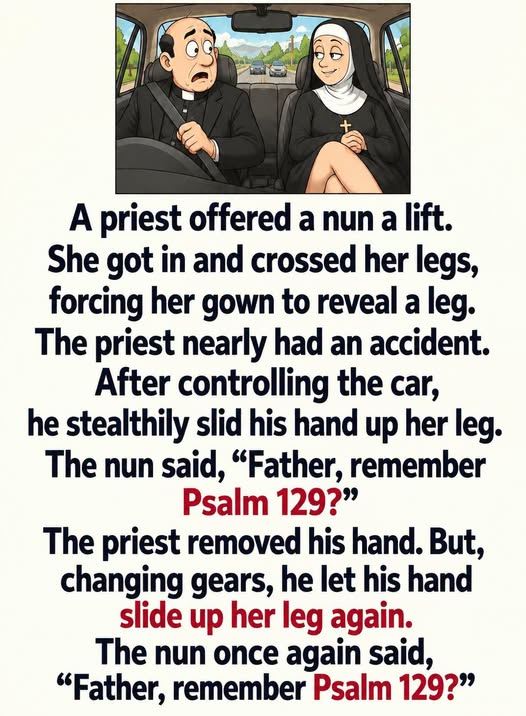
A priest was driving down the road when he noticed a nun waiting for a ride.
He stopped and offered to take her to the convent.
She thanked him, climbed into the passenger seat, and settled in.
Everything seemed perfectly ordinary.
Until she crossed her legs.
The movement caused her habit to shift slightly, and the priest suddenly became so distracted that he nearly lost control of the car.
He quickly focused on the road again.
But a few moments later, curiosity got the better of him.
His hand slowly moved toward the nun’s leg.
The nun noticed.
She calmly looked at him and said:
“Father, remember Psalm 129?”
The priest immediately pulled his hand back.
He suddenly seemed very interested in keeping both hands where they belonged.
For a few quiet moments, neither of them said anything.
The road continued ahead.
The priest tried to concentrate.
Then came the next gear change.
And somehow, his hand once again ended up drifting toward the same place.
The nun looked at him again.
“Father,” she said, “remember Psalm 129?”
Once again, the priest quickly moved his hand away.
“Of course, sister,” he replied.
But now there was a question bothering him.
What exactly was in Psalm 129?
He couldn’t remember.
And the nun seemed remarkably confident that whatever it said, he should know it.
So the rest of the drive became a strange little battle between temptation and curiosity.
The nun kept her composure.
The priest kept driving.
And eventually they arrived at the convent.
The nun thanked him, stepped out of the car, and walked inside without another word.
The priest continued on to the church.
But he couldn’t stop thinking about one thing.
What did Psalm 129 actually say?
As soon as he arrived, he went straight to his Bible.
He opened it to Psalm 129.
And that’s when he discovered the joke.
The line he was looking for did not say what he had apparently imagined.
The punchline of the old joke twists the passage into the supposed advice:
“Go forth and seek, further up you will find glory.”
Suddenly, the priest understood why the nun had repeated the verse.
Or at least, he thought he did.
And that was the joke’s final trick.
The humor isn’t really about Psalm 129 itself.
It’s about the priest hearing a mysterious biblical reference, assuming it must be a warning, and then discovering a completely different meaning in the punchline.
The Real Trick Behind the Joke
The story has been circulating for years in different versions.
Some versions end with the priest saying that “the flesh is weak,” while others use slightly different wording. The basic structure remains the same: the nun repeatedly mentions Psalm 129, the priest backs off, and his curiosity eventually sends him searching for the verse.
That is what makes the ending work.
The entire story sets up one question in the reader’s mind:
Why does the nun keep mentioning Psalm 129?
You expect the answer to be a warning.
Instead, the joke turns the biblical reference into the setup for the final punchline.
And once you see where the story is going, the ending becomes the part you remember.
But There’s One Small Detail
There’s also a funny detail that people often miss when this joke is shared online.
The punchline attributed to Psalm 129 is not actually a verse from Psalm 129.
The real Psalm 129 contains completely different wording. One commonly cited translation includes the line about plowmen plowing on the speaker’s back and making their furrows long.
So the joke deliberately invents a humorous “verse” for its ending.
And that’s exactly why the priest’s trip to his Bible makes the story work.
He went looking for serious spiritual guidance.
What he found instead was the punchline.
Sometimes an old joke doesn’t need a complicated ending.
It just needs the reader to wonder:
“Wait… what does Psalm 129 say?”
And that’s precisely what this one does.