At just 13 years old, Julian Vance made a decision that left his parents stunned and eventually brought an entire police department to tears. He sold his treasured guitar, his PlayStation, and every dollar he had saved to buy a new wheelchair for a classmate who desperately needed one.
What began as a heartbreaking discovery at home turned into an extraordinary story of kindness, friendship, and the lasting impact of a simple act of compassion.
A Knock at Seven in the Morning
At exactly seven o’clock on a cold October morning, Sarah Vance heard three loud knocks at her front door.
She was standing in the kitchen, wearing her bathrobe and pouring coffee into her husband’s travel mug. Her husband, Ben, had already left for work as an electric company lineman. Their 13-year-old son, Julian, was upstairs getting ready for school.
Nobody usually visited their home that early, especially on a Tuesday.
When Sarah opened the door, two police officers stood on the porch.
“Good morning, ma’am. Are you Sarah Vance?” one of them asked.
Her stomach immediately tightened.
She thought about her husband, who worked around dangerous electrical equipment, and her son, who was still upstairs.
“Yes,” she replied nervously. “Is everything all right?”
The officers introduced themselves and explained that they needed to speak with her and Julian about something that had happened the previous day.
Before Sarah could ask another question, Julian came down the stairs.
He was wearing pajama pants and an old T-shirt, his hair still wet from the shower. The moment he saw the officers, his face turned pale.
Sarah instinctively reached for his hand.
“Has he done something wrong?” she asked.
Officer Daniels looked at the boy before answering.
“Your son isn’t in trouble, ma’am. But there’s something about yesterday that you don’t know yet.”
Sarah had no idea that the missing guitar in Julian’s bedroom was only the beginning of a story she would never forget.
The Guitar He Had Dreamed About for Years
Julian had loved music since he was a little boy. But his favorite instrument had always been the electric guitar.
At nine years old, he became fascinated with a custom Fender Stratocaster displayed in the window of a local music store. He would stop whenever he passed the shop, staring at the sunburst finish and imagining himself playing it.
The guitar cost more than $2,100, an amount his parents couldn’t afford to spend casually.
Sarah worked as a dental hygienist, while Ben earned his living as an electric company lineman. They had a mortgage, car payments, and ordinary family expenses.
Still, they wanted to give their son something special for his twelfth birthday.
For nearly eleven months, they saved money. Sarah picked up extra Saturday shifts, and Ben volunteered for additional storm-related work. They put away small amounts from every paycheck until they finally had enough.
On Julian’s birthday, they placed the guitar case in front of him.
When he opened it, he couldn’t speak.
He stared at the instrument with tears in his eyes, recognizing the exact guitar he had admired for years.
“This is the one,” he whispered. “The one from the store.”
His parents watched him hug the guitar before wrapping his arms around his father.
From that day forward, Julian treated the instrument like a treasured possession. He cleaned it regularly, changed its strings, watched tutorials to improve his playing, and practiced for hours in his bedroom.
It was more than a birthday present. It was the result of months of sacrifice and a dream he had carried since childhood.
The Missing Guitar
One Monday afternoon, Sarah entered Julian’s bedroom with a basket of clean laundry.
Immediately, she noticed something unusual.
The guitar stand beside his desk was empty.
She checked the closet, underneath the bed, and behind the bedroom door. The hard-shell case was still there, but when she opened it, it was empty too.
Nothing else appeared to be missing.
When Julian returned from school, Sarah asked him where his guitar was.
He stopped in the hallway, looked down at his shoes, and remained silent for several seconds.
Then he finally answered.
“Mom, I sold it.”
Sarah couldn’t believe what she was hearing.
“Why would you sell your guitar? Julian, what happened?”
His explanation left her speechless.
“Because Maya needed a new wheelchair.”
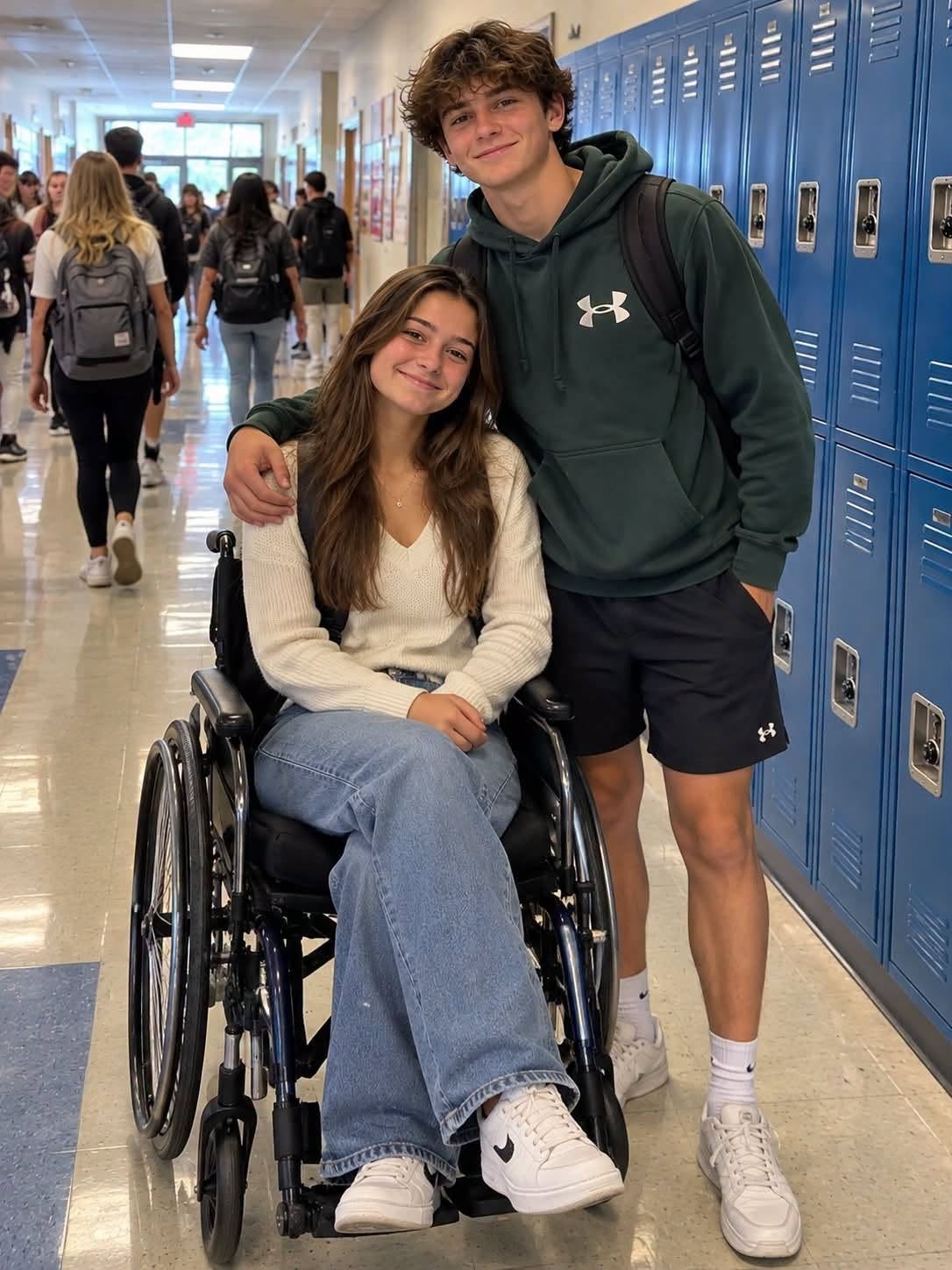
Maya Medina was a classmate of Julian’s at Westbrook Middle School. She had used a wheelchair since childhood following an accident that left her unable to walk.
Sarah knew Maya as a cheerful girl with purple-framed glasses and a beautiful singing voice. But she had never realized how much difficulty the girl was experiencing at school.
Julian explained that Maya’s wheelchair was old and increasingly unreliable. Its front wheels frequently became stuck, making it difficult to move through hallways and doorways.
The seat cushion had worn down, leaving her uncomfortable after long school days. The chair also made a squeaking sound that some classmates had cruelly turned into a joke.
Maya sometimes struggled to reach her classes on time. On one occasion, she became stuck at the cafeteria entrance while other students walked past her.
Some even laughed.
Julian couldn’t stand watching his friend struggle.
He knew Maya’s family was facing financial difficulties because of medical expenses, surgeries, rehabilitation, and other costs related to her accident.
Her parents were trying to save for a replacement wheelchair, but the family simply couldn’t afford one immediately.
Julian decided he didn’t want to wait.
He Sold Everything He Had
Sarah was overwhelmed when she learned what her son had done.
She was proud of his compassion, but she was also concerned that he had made such a major decision without discussing it with his parents.
Julian explained that he had researched wheelchairs for nearly two weeks. He found a lightweight model with improved front wheels and a comfortable pressure-relief cushion.
The wheelchair cost approximately $1,400, including shipping.
His guitar sale brought him $800.
But that wasn’t enough.
Julian also sold his PlayStation and several games, earning another $240. Then he emptied the savings tin his grandfather had given him when he was six.
Inside had been money he had saved from birthdays, holidays, allowances, and small jobs for neighbors.
There was $382.
Together, the money came to $1,422.
He had just enough to purchase the wheelchair, with ten dollars left over.
He used that final amount to buy Maya a chocolate chip cookie because he knew she liked them.
When Sarah asked why he had given up so much, Julian answered with a simplicity that broke her heart.
“Because I can save up for another guitar someday, Mom. But Maya needs to get around school comfortably right now.”
That evening, Sarah told her husband everything.
Ben was quiet for a long time. Then he walked over to Julian, placed a hand on his shoulder, and told him how proud he was.
He admitted that he was upset Julian hadn’t asked for permission, but he couldn’t be angry about the reason behind the sacrifice.
“We saved for that guitar so you’d have something you loved,” Ben told him. “And you gave the thing you loved to somebody who needed it more.”
The Wheelchair Arrived, and Maya’s Father Was Furious
The new wheelchair arrived at Maya’s home the following afternoon.
Julian had arranged the delivery himself, using information he had gathered about the family. He also included a handwritten note explaining why he had chosen to help her.
Maya was thrilled.
But her father, Rafael Medina, initially reacted with anger.
He believed someone had arranged the purchase without his permission, possibly through the police department or a charitable organization. For years, he had refused financial assistance from colleagues and friends.
Rafael was a police sergeant who had been working desk duty since a serious accident six years earlier.
At the time, he had been driving Maya home from a birthday party when a drunk driver ran a red light and struck their vehicle. Maya suffered a spinal cord injury that left her paralyzed from the waist down.
Rafael had also sustained serious injuries while rescuing his daughter from the damaged vehicle.
The accident changed the family’s life. Medical expenses, rehabilitation, surgeries, accessibility modifications, and transportation costs placed enormous financial pressure on them.
Although colleagues repeatedly offered help, Rafael refused.
He blamed himself for the accident and believed he should be responsible for handling every expense associated with his daughter’s care.
When the new wheelchair arrived, he assumed someone had ignored his wishes.
Then Maya showed him Julian’s note.
It explained that the gift wasn’t charity. It was a thank-you for something Maya had done years earlier.
A Friendship Julian Never Forgot
When Julian was nine, he had broken both legs in a trampoline accident and spent three months using a wheelchair.
During that difficult period, he felt embarrassed, frustrated, and isolated. Some children teased him, and he struggled to adjust to moving around school.
Maya had recently joined his class.
Despite dealing with her own disability, she approached Julian and offered to teach him how to maneuver his wheelchair.
She showed him how to handle ramps, navigate doorways, and lift the front wheels over obstacles.
She even practiced with him during recess.
For Julian, those lessons changed everything. Maya helped him regain confidence and made him feel less alone during a difficult experience.
He never forgot her kindness.
In his handwritten note, Julian explained that he was finally returning the favor.
He reminded Maya of those days and thanked her for helping him when he needed someone.
He also joked that the new wheelchair had quiet wheels, making her a little like a ninja.
Maya’s father read the note several times.
According to the story, he was deeply moved when he realized that his daughter had helped Julian years earlier without ever expecting anything in return.
A Police Department Gathered to Honor the Boy
Rafael contacted Officer Daniels that evening.
The next morning, officers arrived at the Vance family’s home, not to arrest Julian, but to invite him to the police station.
They wanted him to meet Maya’s father and the people who had heard about his remarkable act of kindness.
When Sarah and Julian arrived, the roll-call room was filled with officers, dispatchers, department employees, and other community members.
At the front stood Rafael Medina, alongside Maya in her brand-new wheelchair.
When Julian entered the room, Maya’s face lit up.
Rafael walked toward the boy, then slowly knelt so they could speak eye to eye.
He thanked Julian for helping his daughter and admitted that he had spent years refusing assistance because of guilt and pride.
He explained that his daughter had once been miserable after the accident, but Julian’s friendship had given her a reason to smile again.
Maya had helped Julian during his recovery, and he had never forgotten it.
Rafael realized that accepting help didn’t mean he had failed as a father. Sometimes, it simply meant allowing other people to show love and compassion.
The officers in the room listened quietly as Rafael expressed his gratitude.
For a family that had struggled for years, the wheelchair represented more than a piece of equipment. It represented relief, dignity, friendship, and the reminder that they weren’t alone.
The Guitar Was Returned
Then came another surprise.
Lenny Marsh, the owner of Westbrook Music Exchange, stepped forward carrying a black guitar case.
Julian immediately recognized it.
It was his custom Fender Stratocaster.
Lenny explained that he had bought the guitar from Julian for $800, but after learning why the boy had sold it, he felt compelled to return it.
He said Rafael had visited the store the previous evening, hoping to purchase the guitar back. Lenny refused to sell it again, deciding that Julian deserved to have his treasured instrument returned.
The guitar was handed back to its original owner without asking for any payment.
Julian opened the case and stared at the familiar sunburst finish.
He placed his hands on the guitar and began crying.
The PlayStation and games were also returned after the GameStop manager learned about Julian’s sacrifice and decided to help.
The red savings tin that Julian had emptied was restored as well, with people contributing money to help replenish his savings.
The boy who had given up nearly everything he owned to help a classmate was suddenly surrounded by people determined to show him the same kindness.
A Lesson That Lasted Far Beyond One Gift
Julian’s story is a reminder that compassion doesn’t always come from grand gestures or wealthy donors.
Sometimes, it comes from a teenager who remembers how someone once helped him.
Maya had taught Julian that a wheelchair was simply a way to get around, not a definition of who someone was. Years later, he carried that lesson into action when he noticed that she was struggling.
His decision wasn’t about recognition, applause, or rewards. He simply wanted his friend to have a better day at school.
For Sarah and Ben, the experience was a powerful reminder of the values they hoped to teach their son.
They had spent months saving for a guitar that would bring Julian happiness. Yet watching him give it up for someone else revealed something far more meaningful than the gift itself.
Their son understood that the value of something isn’t always measured by its price.
Sometimes, the greatest gift is the freedom, comfort, and dignity it can give another person.
And sometimes, a kindness offered years earlier returns when it’s needed most.
The guitar was back in Julian’s hands. Maya had a wheelchair that made getting around school easier. Two families were reminded that they didn’t have to face difficult moments alone.
But the most valuable thing Julian gave that day was something money could never buy: the reassurance that someone remembered her kindness, cared about her struggles, and believed she deserved to be treated with dignity.