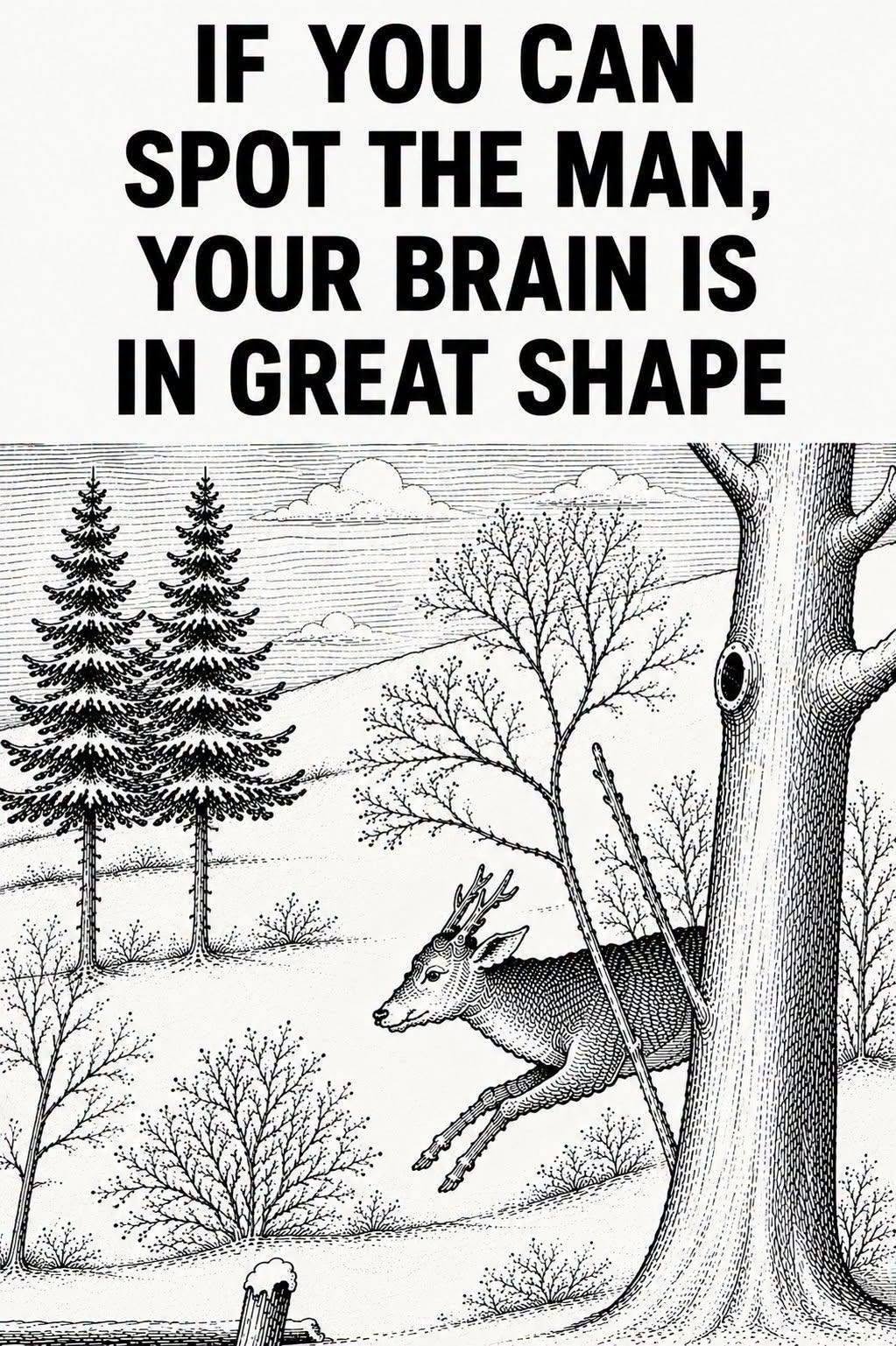
can be difficult to recognize because the viewer initially interprets them as ordinary pieces of the forest. That distinction is what makes hidden-image puzzles so entertaining. Human vision does not operate like a simple camera that gives equal attention to every visible detail. The visual system continuously organizes information, separates likely objects from backgrounds and searches for meaningful patterns.
This process is extremely useful in ordinary life because there is far more visual information around us than we could consciously examine one element at a time. In a puzzle, however,
the same efficiency can become part of the trick. Shapes that have already been categorized as branches or shadows may need to be reconsidered before the hidden image becomes noticeable. The deer provides an especially powerful visual anchor because it is immediately recognizable as a complete object.
Its body has a clear outline, and viewers do not need much time to understand what they are seeing. Once attention settles on the animal, the surrounding trees and snow can begin to feel like scenery rather than equally important information. The forest
becomes the background while the deer becomes the subject. That interpretation is perfectly reasonable, but it can make the second pattern harder to detect because the hidden face depends on parts of the image the viewer has already decided are less important.
A useful first strategy is therefore surprisingly simple: stop searching around the deer. Instead, examine the entire scene as though every section could contain meaningful information. Begin on one side of the picture and gradually move your attention toward the opposite side. Look at the spaces between trees
as carefully as the trees themselves. Notice where dark and light areas meet, where branches create unusual curves and where apparently empty patches of snow contribute to larger shapes. The goal is not to find a perfectly drawn face but to recognize how several unrelated-looking elements can combine into one.
This approach involves paying attention to what designers and artists often call negative space. Negative space is the area around and between visible objects, and it can become just as important as the objects themselves when creating an illusion. A
patch of bright snow might contribute to the impression of a forehead or cheek, while a dark gap between branches could resemble an eye. A tree trunk might define the edge of a face without representing the face itself. Once those separate areas are mentally grouped together, an image that initially seemed absent can suddenly become recognizable.
A hidden face does not need to be outlined continuously. In fact, giving it a complete outline would usually make the puzzle much easier. Instead, the illusion can rely on scattered visual clues
that the brain eventually combines. A branch may suggest one side of a nose, another dark mark may resemble an eyebrow, and a lighter region may provide the appearance of skin or facial structure. Individually, none of these elements necessarily looks unusual. Their significance becomes apparent only when the viewer begins treating them as pieces of one larger pattern.
This is related to the broader tendency of human perception to organize separate visual elements into meaningful forms. People are particularly accustomed to recognizing faces because faces are socially important visual
tiny areas of contrast. Moving farther away allows some of those smaller details to blend visually. As fine information becomes less dominant, the overall arrangement can become easier to notice. The image itself has not changed, but the balance between local details and the larger visual pattern has.
Reducing the displayed size of the picture can create a similar effect. When an image becomes smaller, tiny branches and textures lose some of their individual prominence. Larger shapes can then become relatively easier to perceive. This is why a hidden figurecan occasionally seem clearer in a thumbnail than in a large, detailed version of the same picture. Again, no new information has been introduced. The viewer has simply changed the scale at which the existing information is being processed