Skip to content

The Incredible Sense of Smell: How Far Can Animals Detect Our Scent?
Have you ever wondered just how powerful an animal’s sense of smell is compared to ours? While humans often rely more on sight, many animals navigate their world primarily through their noses. This remarkable ability allows them to detect danger, locate food, and even communicate with each other over vast distances. If you’ve ever thought your perfume might be carrying too far at the dog park, you might be surprised at just how far some animals can scent our presence.
The Amazing World of Animal Smell
Animal noses are equipped with an incredible sensory mechanism that far exceeds that of humans. Let’s break down the astonishing distances at which various animals can detect scents, showcasing just how finely tuned their olfactory systems are compared to ours.
The Scent Detection Distances
-
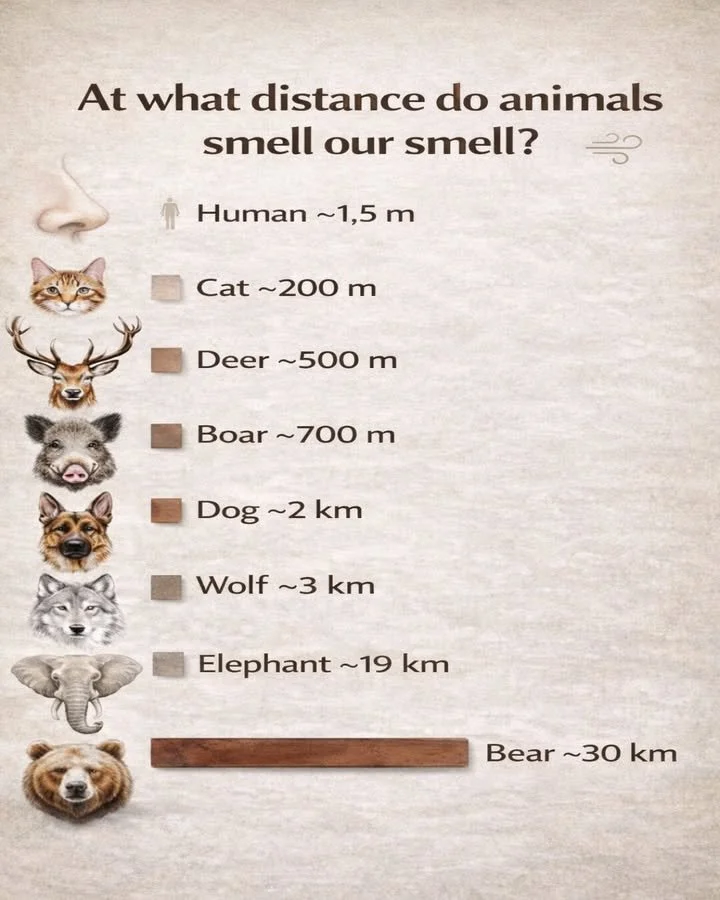
👤 Human: ~1.5 m
Humans have a relatively limited sense of smell. We can detect scents but typically only at short distances, often relying more on vision than olfaction. -
🐱 Cat: ~200 m
Cats, those enigmatic companions, boast a strong sense of smell, which is about 14 times better than that of humans. This heightened ability helps them sniff out prey and communicate with others in their territory. -
🦌 Deer: ~500 m
For deer, smelling is a vital survival mechanism. They can detect scents from a significant half-kilometer away, which allows them to sense predators before they get too close. -
🐗 Boar: ~700 m
Wild boars have an exceptional olfactory sense, capable of picking up scents and food sources hidden underground. This ability aids them not only in foraging but also evading danger. -
🐕 Dog: ~2 km
Dogs have made their mark as some of the best sniffers in the animal kingdom. Their noses contain around 300 million olfactory receptors, allowing them to smell things up to two kilometers away—an extraordinary feat that’s 40 times more sensitive than the human nose! -
🐺 Wolf: ~3 km
Wolves employ their impressive sense of smell to track prey and communicate across long distances with their packs. Their ability to pinpoint the location of animals or scents from three kilometers away is vital for hunting strategy. -
🐘 Elephant: ~19 km
Elephants have one of the strongest senses of smell known among land animals. They can detect water sources and other elephants from nearly 19 kilometers away, showcasing not just survival skills but also emotional connections through scent. -
🐻 Bear: ~30 km
Bears are truly extraordinary olfactory creatures. With the capability to smell something as far as 30 kilometers away, they can detect food or the presence of other animals long before they become visible.
Why This Matters
Understanding the immense variety in animals’ olfactory capabilities highlights not just their extraordinary adaptations but also the intricacies of animal behavior and survival strategies. For wildlife enthusiasts and pet owners alike, this information can help deepen our appreciation for these creatures and inspire thoughtful practices in our interactions with them, especially in natural settings.
What Can We Learn?
By recognizing the distances at which these animals can smell, we can approach nature with greater awareness. For example, if you’re out in the woods or a park, keeping in mind that the scents you might leave behind may be detectable from great distances emphasizes the need to respect wildlife and their habitats.
Conclusion
Animals have evolved to rely on their sense of smell in ways that are often beyond human comprehension. From the common household cat to the majestic elephant, the distances at which they can detect scents reveal not only their survival instincts but also the complex social dynamics of their species. Next time you’re out and about, consider the incredible world of scents around you and the unseen connections that animals navigate every day. It’s a whole new perspective on the natural world!