Sometimes, the smallest act of kindness creates a ripple that reaches far beyond the person who first receives it.
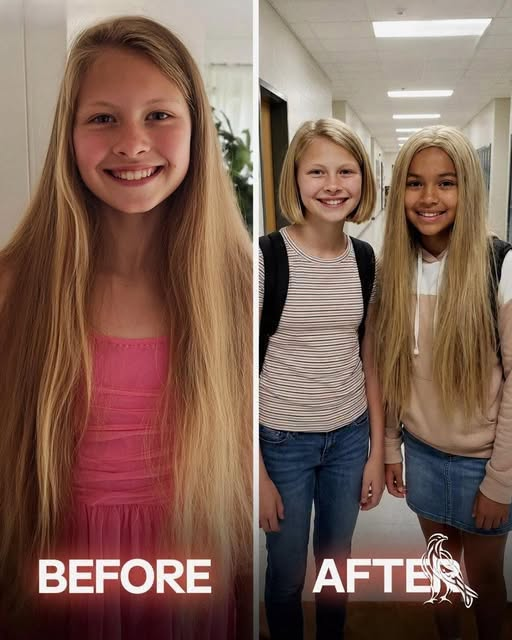
For one mother, that lesson began with a pair of kitchen scissors, a handful of hair, and a twelve-year-old daughter who wanted to make life a little easier for a classmate struggling with the emotional effects of cancer.
At first, it looked like an impulsive decision. Her daughter had cut her own hair without permission, leaving an uneven haircut and a worried mother wondering what had happened.
But the following morning, a phone call from the school principal changed everything.
“Piper, you need to come to the school immediately,” he said. “Your daughter is safe, but there’s something you need to see with your own eyes.”
What Piper discovered when she arrived was something she would never forget.
It was a reminder that kindness doesn’t always arrive with a grand announcement. Sometimes, it begins with a child noticing another child’s pain—and deciding not to look away.
The Evening I Found My Daughter With Scissors in Her Hand
Three months had passed since Piper lost her husband, Jonathan, to cancer.
The house still carried traces of his presence. His favorite mug remained in the kitchen cupboard. His old jacket hung near the door. Some mornings, Piper still caught herself listening for the familiar sound of his footsteps.
Their twelve-year-old daughter, Letty, was grieving too.
She rarely talked about it directly. Instead, her sadness appeared in small ways: a quiet dinner, a question about something her father used to do, or a sudden silence when another family mentioned a weekend outing.
Piper tried to give her daughter room to process those feelings while keeping everyday life moving.
Then, one evening, she discovered Letty standing in the bathroom, surrounded by strands of hair.
A pair of kitchen scissors rested in her hand.
“Letty?” Piper asked carefully. “What happened?”
The girl’s hair had been cut unevenly around her shoulders. She held a bundle of the cut hair tied with a ribbon, and her expression suggested she was expecting a lecture.
“Please don’t be mad, Mom.”
Piper took a breath. “I’m trying to understand what happened before I decide how I feel about it.”
Letty looked down.
“There’s a girl in my class named Millie,” she explained. “She had cancer. She’s doing better now, but her hair hasn’t grown back the way it used to.”
Piper listened as her daughter described something that had happened at school.
Some boys had laughed at Millie’s appearance. Millie had tried to pretend she wasn’t bothered, but later Letty heard her crying in the bathroom.
“I didn’t know what to say to her,” Letty admitted. “She looked so sad, and everybody acted like it wasn’t a big deal.”
She lifted the bundle of hair.
“I found out that real hair can be used to make wigs. I thought maybe mine could help her feel better.”
For a moment, Piper didn’t know what to say.
She could see the uneven haircut. She could imagine the scissors slipping and the frustration of trying to cut long hair alone.
But she could also see the reason behind it.
Her daughter hadn’t been trying to rebel. She had been trying to help someone who was hurting.
Piper stepped forward and wrapped her arms around her.
“Oh, sweetheart,” she whispered. “I wish you’d talked to me first. But I’m proud of you for caring about Millie.”
Letty began to cry.
“I know my hair looks terrible.”
Piper smiled through her own tears. “We’ll find someone who can fix it. Hair grows back. What matters is why you wanted to cut it.”
For the first time that evening, Letty relaxed.
She hadn’t solved every problem her classmate was facing. But she had taken the first step toward showing her that she wasn’t alone.
A Visit to the Hair Salon
The following morning, Piper took Letty to a local salon.
The stylist, Teresa, examined the uneven cut and listened while Letty explained what she had been trying to accomplish.
Teresa’s expression softened.
“You know,” she said, “there are much easier ways to donate hair than cutting it yourself in the bathroom.”
Letty blushed.
“I know that now.”
Teresa explained that hair donation programs generally have specific requirements regarding length, cleanliness, and how the hair should be tied before cutting. Requirements vary between organizations, so it is important to check the rules before donating.
She also explained that not every donation becomes a wig for a particular person. Some organizations collect hair to use in wigs for people experiencing medical hair loss, while others have different eligibility requirements.
Letty listened carefully.
“So I might not be able to give this directly to Millie?”
“Not necessarily,” Teresa answered gently. “But we can find out what options are available. And there may be other ways to help her, too.”
With Teresa’s help, Letty received a much more manageable haircut.
The stylist also helped the family explore appropriate options for donating hair and supporting children affected by cancer.
Piper watched her daughter study her reflection in the mirror.
“Do you regret cutting it?” she asked.
Letty considered the question.
“I wish I hadn’t made such a mess,” she said. “But I don’t regret wanting to help Millie.”
That answer stayed with Piper.
Her daughter was learning something important: good intentions did not always produce perfect results, but mistakes could become opportunities to learn how to help more effectively.
The Principal’s Unexpected Phone Call
A few days later, Piper was at home when the telephone rang.
It was Principal Brennan.
His voice sounded unusually serious.
“Piper, I need you to come to the school as soon as you can.”
Her heart immediately began racing.
“Is Letty all right?”
“She’s safe,” he assured her. “But something has happened, and I think it’s important that you’re here.”
Piper grabbed her keys and hurried out.
The last time she had received a call with that tone, her life had changed forever. She tried to remind herself that this was different, but fear did not always respond to logic.
When she arrived, the principal was waiting outside his office.
“What’s going on?” she asked.
He opened the door.
Inside, Letty stood beside a girl Piper recognized as Millie. Several adults were gathered around them, and Millie’s mother appeared to have been crying.
Millie was wearing a beautiful wig.
But that wasn’t the only thing that caught Piper’s attention.
On the principal’s desk sat an old yellow hard hat bearing Jonathan’s name. A small purple star was still attached to it, slightly crooked, just as Letty had placed it there when she was younger.
Piper stared at it.
“Where did that come from?”
One of the men in the room stepped forward.
His name was Marcus, and he had worked alongside Jonathan for years.
“I’m sorry we frightened you,” he said. “We came because we heard about what Letty did for Millie.”
Piper looked from Marcus to her daughter.
She was beginning to understand that this was about much more than a haircut.
The Men Who Remembered Jonathan
Jonathan had worked at a local industrial plant. His colleagues had known him as someone who rarely ignored a person in need.
He covered shifts when coworkers faced emergencies. He shared meals with people who had forgotten theirs. When a family was struggling, he looked for practical ways to help.
According to the story, Jonathan had also encouraged his coworkers to contribute to a small fund intended to help families facing overwhelming medical expenses.
It wasn’t a large organization. It was a modest effort built from contributions by people who understood how quickly illness could affect an entire household.
After Jonathan’s death, the men continued to remember him.
When they learned about Letty’s decision to help Millie, they saw something familiar in her actions.
“She reminded us of her father,” Marcus explained.
Piper felt tears gathering in her eyes.
Jonathan had been gone for months, and she had spent much of that time trying to help her daughter live with the loss.
She hadn’t fully realized how many people still carried memories of him.
Marcus placed an envelope on the desk.
“Your husband left some things behind,” he said. “We thought today would be a good time to share them with you.”
Piper recognized Jonathan’s handwriting on the envelope.
For a moment, the room seemed to disappear around her.
It was a small reminder of the person she had lost, and of the love that remained even after his absence had changed everything.
The Real Reason They Had Come
Millie’s mother, Jenna, explained that her daughter had been struggling more than the family realized.
Although Millie’s cancer treatment had progressed and she was doing better, the emotional effects of the experience had not simply disappeared.
Her hair had become a visible reminder of everything she had endured.
When classmates laughed at her, she felt exposed in a way that was difficult to explain.
Jenna had been trying to help her daughter rebuild her confidence, but it was hard to protect a child from every careless comment.
Then Letty had stepped forward.
Her gesture did not erase Millie’s medical experiences or instantly solve the problems she faced at school. But it helped her understand that another child had noticed her pain and wanted to support her.
Jenna turned to Piper.
“I don’t know how to thank your daughter,” she said.
Piper shook her head gently.
“You don’t have to turn this into something she needs praise for every day. Letty wanted to help her friend. That’s what matters.”
Letty looked embarrassed by the attention.
“I just didn’t want Millie to feel like everyone was looking at her hair instead of seeing her.”
The room grew quiet.
It was a simple statement, but it expressed something adults sometimes forget: children don’t always need complicated explanations to recognize unfairness.
They need opportunities to learn how to respond with compassion.
A Small Act That Inspired Something Bigger
The adults discussed ways to support Millie and other students who might be struggling.
The school could address the bullying directly, remind students that medical conditions and physical differences were never excuses for ridicule, and make sure children knew where to seek help.
The family and Jonathan’s former coworkers could also explore appropriate ways to assist families facing medical expenses.
Those steps mattered because kindness should not be expected to replace responsibility.
Letty’s gesture was meaningful, but the boys who had mocked Millie still needed to understand the harm they had caused. School staff had a responsibility to respond, and adults needed to ensure that Millie felt safe returning to class.
A thoughtful response would combine compassion with accountability.
The men also shared memories of Jonathan: how he had helped coworkers, how he talked about his daughter, and how he tried to make difficult days a little easier for others.
Piper listened, realizing that her husband had left behind more than photographs and possessions.
He had left relationships, memories, and examples of kindness that continued to influence people.
And now, in her own way, Letty was carrying that example forward.
A Letter From a Father
Later, when Piper finally had a quiet moment, she opened the envelope.
Inside was a note Jonathan had written for her.
Its message was simple: he hoped his family would remember that they did not have to face every hardship alone, and that kindness was worth practicing even when life became painful.
Piper held the letter against her chest.
She had spent months trying to be strong for Letty. She had managed school mornings, meals, difficult conversations, and the countless practical tasks that follow a loss.
Sometimes, she had mistaken being strong for carrying everything herself.
The words reminded her that accepting help was not a weakness.
She could grieve and still allow other people to care for her family. She could miss Jonathan and still create new memories. She could be frightened by the future without assuming that every difficult moment would end in tragedy.
Most importantly, she could let Letty grow into her own person without trying to protect her from every mistake.
That evening, Piper invited Millie and her mother to dinner.
It was not a grand celebration. There were no speeches or cameras. There was simply food, conversation, and a chance for two families to spend time together.
Millie laughed at one of Letty’s jokes.
For a while, the children talked about ordinary school things instead of illness, appearance, or the difficult months behind them.
That ordinary moment was its own kind of gift.
What This Story Teaches Us About Kindness
The story of Letty and Millie offers several lessons worth remembering.
First, kindness begins with noticing.
Letty paid attention when Millie was hurting. She didn’t dismiss the tears or assume someone else would help.
Second, good intentions need thoughtful action.
Cutting her own hair without asking an adult was not the safest or most effective way to donate it. But the experience gave Letty an opportunity to learn about proper donation procedures and other forms of support.
Third, bullying should never be treated as harmless entertainment.
A cruel comment about someone’s appearance can deepen the distress of a child who is already dealing with illness or other personal challenges. Schools and adults should take repeated harassment seriously.
Finally, community matters.
Friends, family members, teachers, former coworkers, and neighbors can all play a role in helping people navigate difficult periods.
No single act of kindness can solve every problem. But many small, thoughtful actions can create a stronger network of support.
Final Thoughts: Sometimes Love Continues Through the People We Help
In this story, a twelve-year-old girl wanted to help a classmate who was hurting.
She made an impulsive decision, learned that there were better ways to accomplish her goal, and discovered that even a small gesture could encourage others to act.
Her mother’s experience was equally important. She was reminded that grief did not erase the love her husband had shared with the world, and that other people could help carry some of the weight she had been shouldering alone.
The most meaningful part of the story was not the haircut, the wig, or even the unexpected gathering at the school.
It was the recognition that people deserve kindness when they are vulnerable.
A child recovering from cancer deserves dignity. A grieving family deserves support. A student who witnesses bullying deserves encouragement to speak up. And a person trying to help deserves guidance that turns good intentions into meaningful action.
We may not always know what someone else is experiencing. We may not have the perfect words or the ideal solution.
But we can listen. We can notice. We can ask what would help. And we can refuse to treat another person’s pain as something unimportant.
Sometimes, that is where a better story begins.
Because kindness doesn’t have to be extraordinary to matter. It only has to reach someone who needs it.