Learning to Raise Two Newborns Without Their Mother
Everyone kept telling me to stay strong.
“Stay strong for the girls, Tom.”
My sister Kate said it. My friends said it. Mary’s coworkers said it at the funeral.
I tried.
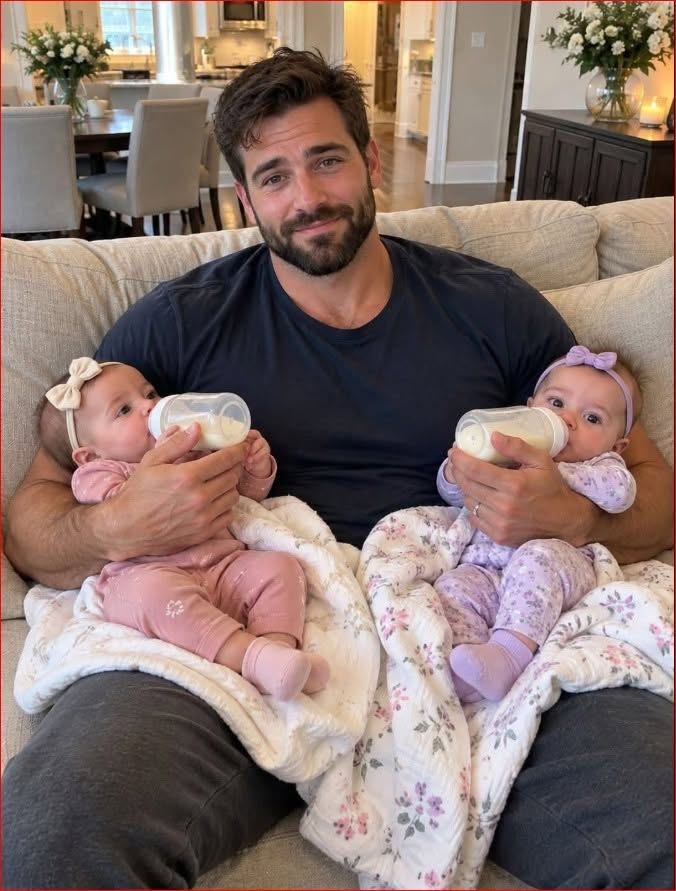
But taking care of newborn twins alone was harder than anything I had ever experienced.
I warmed bottles, changed diapers, recorded feeding times, and tried to remember which daughter had eaten last.
Sometimes I finished feeding one baby and stood in the kitchen holding an empty bottle, unable to remember which child I had just fed.
At night, I constantly checked their breathing.
I would place my hand gently against one tiny chest, wait to feel it rise, and then repeat the process with the other baby.
My sister brought food whenever she could. She prepared casseroles, soup, and lasagna, leaving instructions on the containers.
Sometimes she returned days later to discover that I hadn’t touched anything.
I was barely eating or sleeping.
And whenever the house became quiet, I heard the same words repeating in my mind.
“Save the babies.”
I knew Mary had asked me to make that choice. I remembered her expression and the way she squeezed my hand.
But grief doesn’t always listen to reason.
I kept wondering whether I should have said something different.
What if I had asked the doctors to wait longer? What if there had been another possibility? What if I had fought harder?
I knew the girls were alive because of the decision I had made, but I couldn’t stop wondering whether I had somehow failed my wife.
For the first week, I couldn’t even choose names for them.
Then, one night, I found Mary’s handwritten baby-name notes on the kitchen table.
Most of the suggestions had been crossed out.
But two names remained untouched.
June, with a small heart drawn above the letter J.
And Ellie, with a little star beside it.
Under Ellie’s name, Mary had written a funny note about how I would probably say it sounded like a cartoon elephant.
I laughed when I read it.
Then I cried until morning.
The following day, I finally registered our daughters’ names.
June was the smaller twin. Ellie was the one who always seemed to reach for her sister.
Mary had chosen perfectly.
Three Months of Silence From My Mother-in-Law
Joan attended the funeral, but she barely spoke to me.
I tried approaching her afterward, holding June against my chest while my sister carried Ellie.
Joan looked at her granddaughter, then turned away.
I didn’t know what to make of it.
After the funeral, I started sending her photographs of the girls.
I wanted her to see them growing, even if she wasn’t ready to visit.
Every message received the same short response.
“Thank you.”
My sister suggested that I call Joan instead of relying on text messages.
I tried twice, but both calls went unanswered.
Eventually, I began to believe that she blamed me for Mary’s death.
I imagined what she must have thought.
Her daughter had gone into the hospital expecting to welcome two babies and never came home. I was the husband who had agreed to save the children instead of her.
Joan hadn’t been in the delivery room. She hadn’t heard Mary’s final request.
All she knew was that her daughter was gone.
And I couldn’t stop wondering whether she would ever forgive me.
Three months passed.
My days became a routine of bottles, diapers, appointments, and sleepless nights.
I continued sending photographs to Joan, even though her replies never changed.
Then, one Thursday morning, the doorbell rang.
The Unexpected Visitor at My Front Door
When I opened the door, Joan was standing on the porch.
She was wearing the same black coat she had worn to the funeral, even though the weather was warm.
Her gray hair was neatly pinned back, but she looked exhausted.
In her hands, she held a white envelope.
It was shaking.
Before she could say anything, I started apologizing.
“I didn’t want to lose her, Joan. She asked me to save the girls. I agreed because that’s what she wanted. I should have done something. I should have fought harder.”
Joan looked at me quietly.
Then she said something I wasn’t expecting.
“Tom, do you think I stayed away because I blame you?”
I couldn’t answer.
She looked down at the envelope.
“Mary asked me not to tell you something. I promised her. I thought she would have time to tell you herself.”
My heart began beating faster.
I invited her inside, and we sat at the kitchen table.
She told me there was something about Mary’s childhood I had never understood.
Something that explained the way my wife had lived her entire life.
The Secret Joan Had Kept for Years
Joan explained that after her husband died, she had continued taking care of Mary physically.
She prepared meals, sent her to school, signed permission slips, and attended parent-teacher meetings.
But emotionally, something had changed.
Mary had inherited her father’s eyes and smile.
Sometimes, when Joan looked at her daughter, she saw her late husband so clearly that the pain became unbearable.
She missed him desperately.
One evening, several months after the funeral, Joan was sitting alone on the living room sofa, holding a photograph of her husband and crying.
She didn’t hear Mary coming downstairs.
The little girl climbed onto the sofa beside her mother and looked at the photograph.
Then she asked a question that would stay with her for the rest of her childhood.
“Do you wish Daddy was here?”
Joan answered honestly.
“More than anything.”
Mary remained quiet for a moment.
Then she asked:
“More than you want me?”
Joan froze.
She didn’t know what to say.
She was exhausted, heartbroken, and overwhelmed by grief. She couldn’t find the words to comfort her daughter.
So she said nothing.
Mary eventually climbed down from the sofa and returned to her bedroom.
But Joan never forgot that moment.
And Mary never forgot the silence.
For years, she believed her mother missed her father so much that having her daughter around was somehow a painful reminder.
She became increasingly careful.
She stopped bringing her mother drawings and photographs of her father. She stopped asking questions about him.
She learned to stay quiet whenever she sensed that someone was upset.
Suddenly, I understood something about my wife that I had never understood before.
Her constant apologies weren’t simply a personality trait.
They came from a little girl who had learned to believe that her needs might be an inconvenience to someone she loved.
The Question Mary Had Once Asked Me