The head nurse noticed it too.
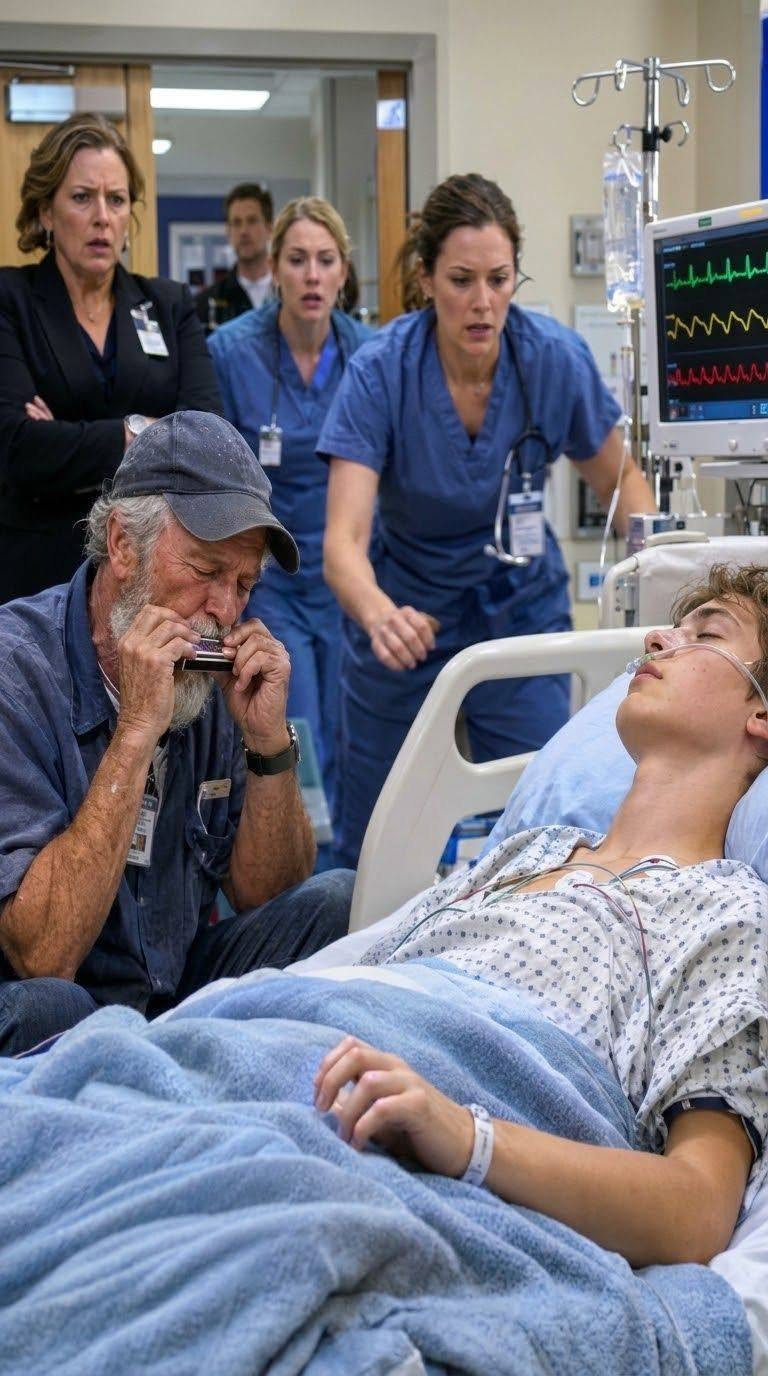
She suddenly stopped and stared at Benicio’s hand.
“Wait,” she said. “Everybody, stop. Look.”
The room fell silent, with only the steady beeping of the medical equipment breaking the quiet.
Benicio’s fingers were still moving. The movements were slow and weak, but they followed a clear rhythm.
The head nurse turned toward me.
“Umberto, play it again.”
Ms. Verity opened her mouth as if she wanted to object, but the head nurse raised her hand.
“Play it again,” she repeated, this time more gently. “Please.”
I lifted my harmonica with trembling hands and began playing my father’s river song from the beginning.
As the melody filled the room, Benicio’s heart rate gradually began to slow. The monitor showed 140, then 120, and finally 100.
His fingers continued tapping along with the music.
Then, just as I played the final note, something remarkable happened.
His eyelids began to flutter.
Slowly, they opened.
Only slightly. Only for a brief second.
But everyone in the room had seen it.
Benicio was looking at the ceiling. Then, slowly, his eyes moved to the side.
Toward me.
The head nurse immediately picked up the phone and called the doctor on duty.
“Room 412 is responding,” she said, her voice trembling. “He has opened his eyes. Please come up here right away.”
The doctor hurried into the room and examined Benicio for twenty minutes. She checked his eyes, gently squeezed his hand, and called his name.
He squeezed her hand in response.
The doctor then turned toward me, tears in her eyes.
“How long have you been playing music for him?” she asked.
“Two hundred and fifteen nights,” I replied.
She slowly shook her head.
“Music can reach parts of the brain in ways that other forms of communication sometimes cannot,” she explained. “For some patients, familiar sounds can provide comfort and a sense of connection. I believe he may have been hearing you for quite some time.”
At 5 a.m., Benicio’s mother, Tamar, arrived. Still wearing her work uniform, she hurried down the hallway with tears in her eyes.
When she entered the room, Benicio’s eyes were open. He could not speak yet, and the breathing tube was still in place, but he looked directly at her.
Then, a single tear rolled down his cheek.
She dropped to her knees beside his bed.
Over the next three weeks, Benicio gradually regained consciousness. His breathing tube was removed, and he slowly began moving his arms and then his legs. One Tuesday afternoon, he finally whispered his first word.
His mother was there, and so was I. The hospital staff had invited me to visit on my day off.
Benicio looked directly at me and whispered:
“River.”
Then he smiled.
Later, when he was able to speak more comfortably, he told us that he remembered very little about the four months he had spent unconscious. He described it as a period of darkness, interrupted occasionally by a familiar sound.
“It was like somebody was calling me,” he explained. “From really far away. There was music every night, and I kept trying to get back.”
The following day, Ms. Verity came to speak with me. She looked uncomfortable, but she was sincere.
“Umberto, I owe you an apology. I was wrong. Completely wrong.”
She then handed me a piece of paper.
The hospital had decided to establish a new volunteer program focused on music for patients receiving long-term care. They had asked me to lead it.
Today, I still mop the hospital floors three nights a week. On two other nights, I visit the long-term care unit with my harmonica, playing for patients who may not have visitors.
Benicio is now seventeen and has returned to school. He walks with the help of a cane, but he is making progress.
Last month, he came to the hospital to visit me during my shift.
He reached into his backpack and pulled out a brand-new harmonica.
“Will you teach me the river song?” he asked.
So, at three in the morning, in the quiet hospital cafeteria, I began teaching him.
The End
Sometimes, simply being present for someone can make a meaningful difference. Even when they cannot respond, a familiar voice, a kind gesture, or a favorite melody can offer comfort and connection.
Have you ever had someone stand by you during a difficult time? Share your thoughts in the comments.