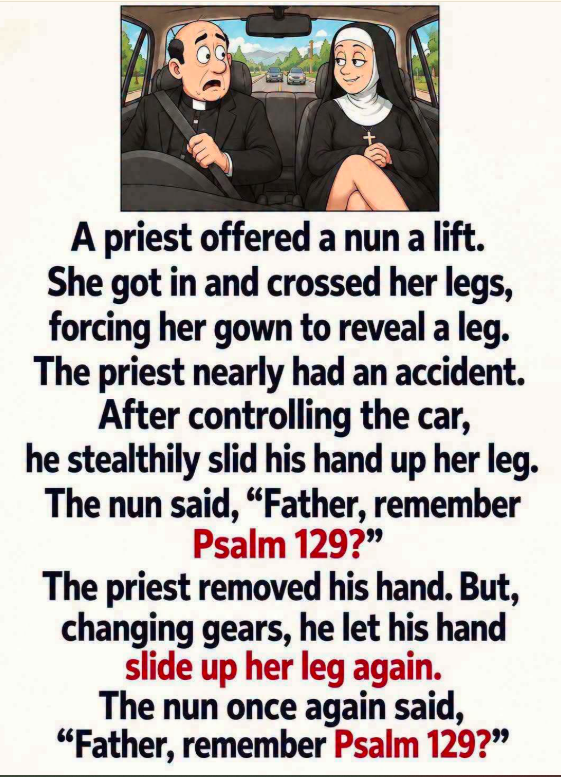
Back at the church, the priest finally looked up Psalm 129.
The joke’s punchline presents the passage as though it contains a suggestive instruction about going farther to find glory. The priest supposedly realizes that he misunderstood the nun’s words, completing the humorous twist.
But here’s the detail that makes the story even more interesting: that supposed quotation is not actually in Psalm 129.
The real psalm is about suffering, oppression and deliverance. It describes repeated hardships and expresses confidence that those who inflict suffering will not ultimately prevail. Verse 4 speaks of the Lord freeing the speaker from the cords of the wicked.
The joke relies on an invented punchline rather than the actual biblical text.
The Real Message of Psalm 129
Although the joke uses Scripture as the basis for its twist, the real psalm has a serious message.
It belongs to a collection known as the Songs of Ascents, Psalms 120 through 134. Its opening recalls a long history of hardship, while its central message emphasizes perseverance despite repeated attacks.
The image of plowing across someone’s back conveys the depth of that suffering. Yet the psalm insists that the hardship has not resulted in complete defeat.
For readers familiar with the Bible, that contrast between a serious passage and a playful fictional story is part of what makes the joke memorable.
It also offers a simple reminder: a biblical reference can sound mysterious when taken out of context, so checking the original passage is often the best way to understand what it actually says.
And in this case, the priest’s decision to consult his Bible brings the story to its conclusion, even if the punchline has little to do with the real Psalm 129.
Have you heard this priest-and-nun joke before, or was this your first time encountering it?