What Color Is Snow Really? The Surprising Answer That Has People Questioning Everything They Learned as Kids
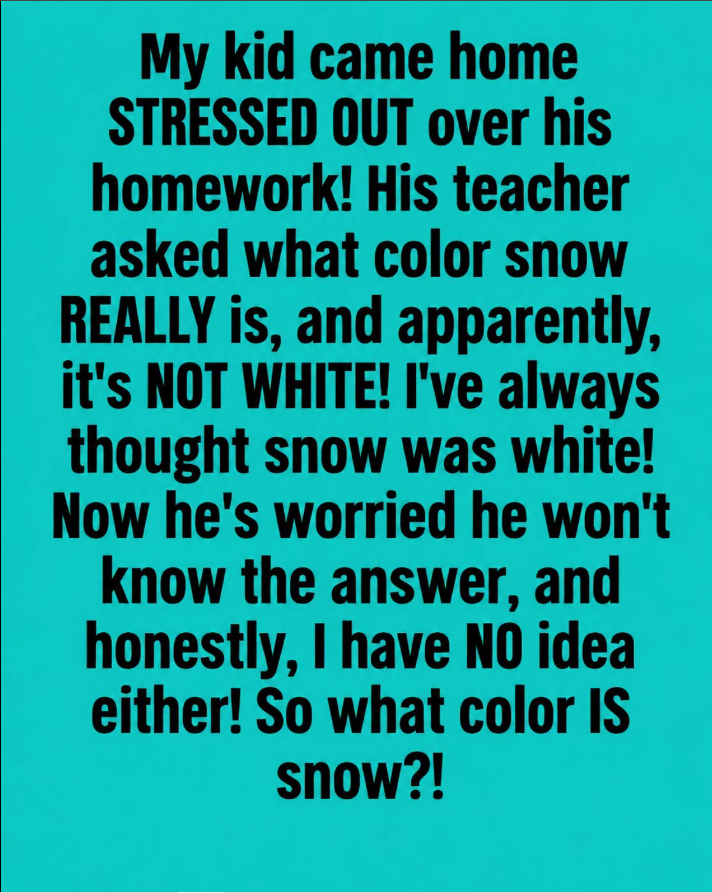
A child comes home from school with a question that seems almost too easy to answer: What color is snow?
His parent doesn’t hesitate.
White, of course.
After all, anyone who has lived through a snowy winter has seen the familiar sight of lawns, rooftops, trees, and sidewalks covered in a beautiful white blanket.
But then comes the unexpected twist.
The child’s teacher apparently says that snow isn’t actually white.
Suddenly, a question that seemed perfectly simple becomes a mystery. How could something that looks so obviously white be another color?
And if snow isn’t really white, what have we been looking at all these years?
The answer has to do with something fascinating that happens when sunlight meets millions of tiny ice crystals.
Once you understand the explanation, you may never look at a snowflake quite the same way again.
The Question That Left a Parent Completely Confused
The story begins with an ordinary homework assignment.
A child is asked to identify the real color of snow.
For most families, this wouldn’t seem like a particularly difficult question. Children learn early that grass is green, the sky is blue on a clear day, and snow is white.
Those descriptions are based on what we see.
And under normal daylight conditions, fresh snow certainly appears white.
But the teacher’s question introduces a distinction between how something looks and what it is actually made of.
That distinction is the key to solving the puzzle.
Consider a clear drinking glass filled with water.
You can usually see through the glass and the water, even though both are physical substances.
Now imagine freezing that water into ice.
Depending on the way it freezes, the ice may still appear mostly transparent.
So why does the same frozen water turn into a bright white blanket when it falls from the sky?
That’s where the science gets interesting.
The First Clue: Snow Is Made From Ice Crystals
Snow begins forming high in the atmosphere when conditions allow water vapor to develop into ice crystals.
These tiny crystals grow as water vapor attaches to them.
As they become larger and heavier, they may fall toward the ground as snow.
The exact appearance of each crystal depends on atmospheric conditions, particularly temperature and moisture.
Some develop the familiar six-sided patterns often shown in winter decorations.
Others form columns, plates, needles, or more complicated structures.
Under a microscope, the variety can be remarkable.
But there is one important characteristic that helps explain the color mystery.
Individual ice crystals are generally transparent or translucent rather than naturally white.
That means light can pass through them, although it may change direction along the way.
A snowflake is not simply a tiny piece of white material.
It is made of ice.
And ice behaves differently when light passes through a single crystal compared with a large collection of crystals.
This brings us closer to the answer.
Why One Snowflake Looks Different From a Snowbank
Imagine holding a single piece of clear ice up to the light.
You may be able to see objects through it, particularly if the ice has relatively few trapped air bubbles or imperfections.
Now imagine breaking that ice into thousands of tiny pieces.
Suddenly, the collection may look cloudy or white.
The chemical substance hasn’t changed.
It is still frozen water.
What has changed is the way light interacts with all those small surfaces.
Snow works in a similar way.
Each snowflake contains ice crystals with numerous surfaces and edges.
When sunlight reaches those surfaces, some light passes through while some is reflected or redirected.
As the light encounters additional crystals, the process happens again.
And again.
And again.
By the time the light returns to your eyes, it has traveled through a complicated collection of tiny ice surfaces and spaces filled with air.
This repeated scattering is the reason an enormous collection of mostly transparent ice crystals can appear bright white.
But why white instead of red, green, or blue?
The next detail explains that.
The Real Reason Snow Looks White
Sunlight may appear colorless, but ordinary sunlight contains a mixture of visible wavelengths that we perceive as different colors.
These include red, orange, yellow, green, blue, and violet.
When those wavelengths reach our eyes together in relatively balanced amounts, we perceive white light.
Snow is especially effective at scattering visible light.
Because its many ice crystals redirect light repeatedly, a substantial amount of the incoming sunlight returns toward the surface.
The different visible wavelengths are scattered broadly rather than one particular color dominating under typical conditions.
Our eyes therefore interpret the combined light as white.
That is the scientific explanation behind the familiar appearance of a snowy landscape.
The snow doesn’t need to contain a white pigment.
Its structure creates the appearance.
This is also why fresh snow can look so bright on a sunny day.
It sends a large amount of visible sunlight back toward our eyes.
And that’s not the only surprising thing about snow.
Under certain conditions, it can appear to be an entirely different color.
Why Snow Sometimes Looks Blue
Have you ever noticed a bluish appearance in deep snow?
Perhaps you’ve seen it in the shaded side of a snowbank or in a photograph of a snowy mountain landscape.
At first, it might seem as though something has stained the snow.
But there can be a natural optical explanation.
In deep snow or dense ice, light may travel through a relatively long path before reaching your eyes.
As light travels through ice, red wavelengths are absorbed somewhat more strongly than blue wavelengths.
Under suitable conditions, this can leave the transmitted or emerging light with a noticeable blue appearance.
Deep openings in snowbanks and certain areas of glacial ice can show this effect.
Blue snow can also be influenced by shadows and the color of light illuminating the surface.
So a patch of snow that appears blue isn’t necessarily made of a different substance.
It may simply be interacting with light differently from the bright snow surrounding it.
That raises another interesting question.
If snow can appear blue, could it also look pink or red?
Surprisingly, yes.
The Strange Phenomenon Known as Watermelon Snow
In certain cold environments, snow can develop an unusual reddish or pink appearance.
Sometimes, this phenomenon is called watermelon snow.
It isn’t caused by watermelon juice or ordinary food coloring.
Instead, the color can come from microscopic algae that live in snowy environments.
Some snow algae produce reddish pigments that help protect them from intense sunlight.
When enough of these organisms are present, patches of snow may appear pink, red, or reddish-orange.
The result can look startling against the surrounding white landscape.
Watermelon snow has been observed in mountainous and polar environments.
It demonstrates that snow’s appearance can be influenced not only by the way light interacts with ice but also by substances and organisms present within it.
However, unusual snow colors should never be treated as proof that the snow is safe to taste or handle without precautions.
Snow may contain environmental contaminants or microorganisms, even when it looks clean.
And red isn’t the only unusual color snow can take.
Can Snow Actually Look Yellow, Brown, or Black?
Most people have seen snow that changes color after sitting beside a busy road for several days.
Fresh snowfall may begin bright white, but gradually develop gray or brown patches.
This can happen when dirt, dust, soot, or other particles collect on the surface.
Road debris and pollution can also affect the appearance of snow in populated areas.
In some locations, wind can carry dust or sand over long distances before it settles on snow.
This can create yellowish, orange, or brown coloration.
Dark particles can change more than appearance.
They may also reduce how much sunlight the snow reflects.
When snow absorbs more solar energy, it can warm and melt differently from clean snow.
That relationship is important in environmental science because snow and ice help regulate how much incoming sunlight Earth’s surface absorbs.
So the color of snow is not merely a visual curiosity.
It can also provide information about environmental conditions.
Why Fresh Snow Makes Everything Look Brighter
Anyone who has looked outside after an overnight snowfall may recognize this effect.
The morning can seem unusually bright.
Even areas that normally look dark appear lighter when covered with fresh snow.
The explanation involves a property called albedo.
Albedo describes how much incoming sunlight a surface reflects.
Fresh, clean snow generally has a high albedo, meaning it reflects a large proportion of incoming sunlight.
Dark pavement, soil, and many other surfaces absorb more sunlight.
That difference becomes obvious after a heavy snowfall.
A dark driveway may absorb considerable sunlight when exposed.
Once covered with fresh snow, the same area reflects much more light.
This is one reason snowy conditions can create intense brightness, particularly in direct sunlight.
It also explains why sunglasses can be useful on clear winter days.
Snow glare can be uncomfortable and, under intense exposure, may contribute to eye injury.
The same optical properties that make snow beautiful can make bright snowy environments demanding for our eyes.
Why Snow Sparkles Like Tiny Diamonds
There’s another winter sight that seems almost magical.
On a cold, sunny morning, freshly fallen snow may appear to sparkle.
Tiny points of light seem to flash across the surface as you move.
This happens because certain ice crystal surfaces reflect sunlight toward your eyes at particular angles.
A single crystal face can briefly act like a tiny mirror.
When your viewing angle changes, the reflected light may disappear.
Another crystal then catches the sunlight and produces a new sparkle.
With countless crystals scattered across the ground, the effect can resemble thousands of miniature diamonds.
The sparkle is often especially noticeable when snow crystals are well formed and the lighting conditions are favorable.
Again, the explanation comes back to the same basic principle.
Snow’s appearance depends heavily on how its ice crystals interact with light.
And once you understand that principle, several familiar winter sights begin to make more sense.
Is Snow Transparent, Translucent, or White?
This is where the original homework question becomes a little more complicated.
There are three different terms worth understanding.
Transparent materials allow light to pass through in a way that permits objects behind them to be seen relatively clearly.
A clean window is a familiar example.
Translucent materials allow light to pass through but scatter it, making objects behind them difficult to see clearly.
Frosted glass is a common example.
Opaque materials do not allow us to see through them.
A thick wooden door is an everyday example.
Individual snow crystals can be transparent or translucent.
But a large collection of snow crystals scatters light so extensively that a snowbank generally appears opaque and white.
So if a teacher asks what color snow really is, the most scientifically useful response depends on exactly what is being asked.
Are we discussing the optical properties of individual ice crystals?
Or the appearance of snow as a collection of countless crystals?
Both descriptions matter.
And that distinction is the real lesson behind the puzzle.
What About Snowflakes That Look White in Your Hand?
You might be wondering about something.
If an individual snow crystal is transparent or translucent, why does a snowflake sometimes look white when it lands on your glove?
The answer is that what we casually call a snowflake may contain multiple ice crystals joined together.
Even a small cluster can scatter enough light to create a whitish appearance.
The texture of the surface beneath it can also influence what you see.
A tiny crystal resting on a dark glove may appear bright because it scatters light against the darker background.
Meanwhile, a particularly thin crystal examined under magnification may appear more transparent.
This is another example of how scale changes appearance.
Something that looks white to the naked eye may reveal a more complicated structure when examined closely.
And that idea applies to many familiar objects, not just snow.
The Same Science Helps Explain Why Clouds Look White
Look up at the sky on a pleasant afternoon.
You may see large, fluffy white clouds drifting above.
But clouds aren’t made from white cotton or another white substance.
They contain enormous numbers of tiny water droplets, ice crystals, or both.
Those particles scatter incoming sunlight.
When the visible wavelengths are scattered in a way that produces a relatively balanced mixture of light, clouds appear white.
As clouds become thicker, less sunlight may reach their lower portions.
That can contribute to the gray appearance of some clouds.
Snow and clouds are not identical, but their familiar white appearance involves related principles of light scattering.
Understanding one phenomenon can therefore help explain another.
It’s a wonderful example of how a simple childhood question can lead to a much broader understanding of the natural world.
Why Scientists Care About Snow’s Color
The optical properties of snow are important for more than answering homework questions.
Scientists study how snow reflects and absorbs sunlight because those processes influence Earth’s energy balance.
Large snow-covered areas can reflect substantial amounts of incoming solar radiation.
When snow melts and exposes darker ground or water, more sunlight may be absorbed.
This can affect local and regional temperatures.
Researchers also study how dust, soot, and other particles change snow’s reflectivity.
A snow surface covered with dark material can behave differently from clean, freshly fallen snow.
These effects are relevant to understanding mountain snowpack, glaciers, water resources, and climate processes.
So the same physical principle that explains why a child sees white snow outside the window also matters to scientists studying the planet.
What begins as a simple color question leads all the way to atmospheric physics and environmental science.
A Simple Way to Explain the Answer to a Child
If a child comes home confused about the color of snow, there’s no need to begin with complicated scientific terminology.
Start with something familiar.
Ask the child what color a glass of water appears.
They will probably answer that it’s clear.
Then explain that snow is made from frozen water.
An individual snow crystal is generally clear or translucent.
But when millions of crystals gather together, they scatter sunlight in many directions.
That scattered light makes the snow look white.
You might use this simple comparison:
Imagine looking through one clean piece of glass.
Now imagine looking through a thick pile of tiny pieces of glass, each pointing in a different direction.
It becomes much harder to see through the pile because the light is being redirected repeatedly.
Snow behaves somewhat similarly, although real ice crystals have their own particular optical properties.
The explanation helps children understand the difference between what a material is made of and how it appears.
And it introduces an important scientific habit: asking why something looks the way it does instead of assuming the first explanation must be correct.
So, What Color Is Snow Really?
After all the clues, we can finally answer the original question.
Individual snow crystals are generally transparent or translucent, while snow as a whole usually appears white because its many ice crystals scatter visible light.
That is the important distinction.
Snow isn’t white because frozen water naturally contains a white coloring substance.
It looks white because of how light behaves when it encounters a large collection of ice crystals.
Under certain conditions, snow can also appear blue, pink, red, yellow, gray, or brown.
Some of those colors are caused by optical effects.
Others result from algae, dirt, pollution, or other substances.
But fresh snow under ordinary daylight conditions generally looks white.
So the child who answered “white” wasn’t necessarily wrong.
The teacher was likely encouraging students to look beyond the familiar appearance and understand the science behind it.
And that is what makes this question so interesting.
The Winter Mystery Hiding in Plain Sight
Sometimes, the most surprising discoveries involve things we’ve seen thousands of times.
Snow has covered streets, fields, rooftops, and mountains throughout human history.
Children have built snowmen.
Families have enjoyed snowball fights.
Generations have watched flakes drift past their windows.
And through all those experiences, most people have simply called snow white.
That description works perfectly well in everyday conversation.
But science reveals something more fascinating beneath the surface.
Those beautiful white landscapes are made from tiny ice crystals that interact with sunlight in complicated ways.
Each crystal contributes to the appearance of the larger snow-covered world.
The next time you look outside after a snowfall, remember that the bright white blanket isn’t quite what it seems.
It is a remarkable display of light passing through and reflecting from countless tiny structures of frozen water.
And perhaps that’s the best part of the story.
A question that seemed so simple turned out to reveal one of winter’s most beautiful scientific secrets.
Would you have answered “white” immediately, or did you already know that individual snow crystals are actually transparent or translucent?
Sources and References
Editorial Disclaimer
This article is intended for general informational, educational, and entertainment purposes only. The classroom scenario is based on the supplied social media post and has not been independently verified as an actual event involving a specific student or teacher.
The scientific explanations concerning snow, ice crystals, light scattering, and color are based on publicly available educational and scientific resources.
The appearance of snow can vary depending on lighting conditions, crystal structure, surrounding surfaces, environmental particles, and other natural factors. Descriptions of snow as transparent, translucent, or white refer to different physical scales and optical conditions.
This article is not intended to replace formal science instruction or specialized scientific guidance. Readers seeking detailed information about atmospheric physics, snow science, or climate processes are encouraged to consult established scientific organizations and qualified educators.