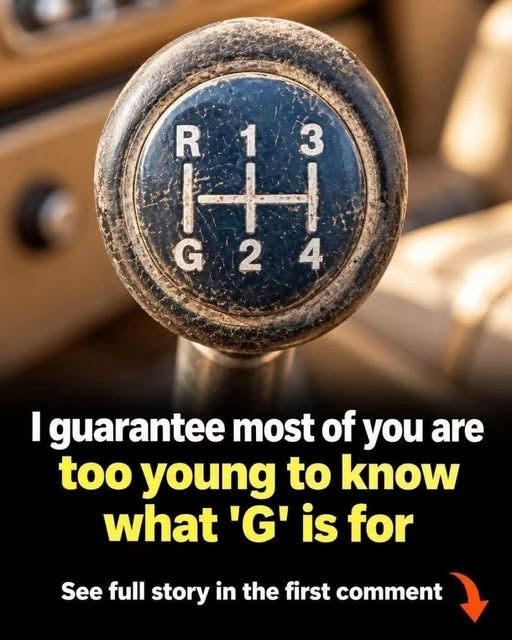
# What Does the “G” Mean on a Manual Stick Shift? Many Drivers Don’t Know
If you’ve ever looked at a manual gear stick and noticed a mysterious letter “G” instead of the familiar number one, you might have wondered what it means. Is it an extra gear? A special driving mode? Or perhaps a feature designed to make a car faster?
The answer is surprisingly interesting.
On certain specialized transmissions, the letter “G” stands for the German word *Gelände*, meaning “terrain.” It is associated with an extremely low gear designed to help a vehicle move slowly while maintaining substantial pulling power. This type of gear is often called a **crawler gear**.
One famous example appeared in the legendary Porsche 959, a high-performance sports car introduced in the 1980s with engineering inspired partly by rally competition. Its unusual gear arrangement helped distinguish it from conventional sports cars.
But why would a car need a gear that makes it move more slowly? And why don’t all manual vehicles have one?
Let’s explore the purpose of the mysterious G gear, the engineering behind it, and what drivers should know if they encounter it.
## 1. What Does the “G” Actually Stand For?
The letter “G” is connected to the German word *Gelände*, which translates to “terrain” or “land.” The related word *Geländewagen* means an all-terrain vehicle and is familiar to automotive enthusiasts through the Mercedes-Benz G-Class.
In the context of certain manual transmissions, G identifies a particularly low gear intended for situations where controlled movement matters more than speed.
Most conventional manual cars use a familiar arrangement:
* First gear for moving away from a stop.
* Intermediate gears for gradually increasing speed.
* Higher gears for cruising efficiently.
* Reverse for moving backward.
A transmission equipped with a dedicated G position can have an additional very-low forward gear.
However, the label isn’t universal. Not every vehicle uses G to mean crawler gear, and the exact function depends on the transmission design. Always consult the owner’s manual for the particular vehicle rather than assuming every letter has the same meaning.
## 2. What Is a Crawler Gear?
A crawler gear is designed to let a vehicle travel at very low speeds while delivering strong torque to its wheels.
To understand why this matters, imagine driving across a rocky trail. You don’t want the vehicle to rush forward every time you gently press the accelerator. You need to move slowly, avoid obstacles, and maintain control over the wheels.
A regular first gear may not provide the low-speed control required for demanding terrain.
A crawler gear uses a very low gear ratio. This allows the engine to turn while the wheels rotate much more slowly, increasing the mechanical leverage available at the wheels.
In practical terms, the vehicle can crawl forward without requiring the driver to rely excessively on clutch slipping.
This is useful when climbing steep slopes, maneuvering over rocks, or moving a heavy vehicle from a standstill.
The trade-off is straightforward: a crawler gear is designed for control and pulling force, not for high road speeds.
## 3. Why Would a Sports Car Like the Porsche 959 Need One?
The Porsche 959 is an especially interesting example because it combined supercar performance with technology developed for demanding driving conditions.
Introduced in the 1980s, the 959 was influenced by Porsche’s ambitions in rally competition. Its engineering included advanced systems for its era, and its unusual transmission arrangement reflected those performance and terrain-related goals.
The G gear occupied an exceptionally low position in the transmission. In the road-going car, the gear arrangement was also connected to historical vehicle noise regulations and the way certain testing procedures were conducted.
Porsche’s solution meant that the extremely low gear was marked G, while the following gear functioned as the normal starting gear for ordinary driving. This made the transmission different from the standard numbered sequence drivers would expect.
The detail is a reminder that automotive engineering doesn’t always follow the conventions drivers are used to.
Sometimes, an unusual feature exists because engineers are solving several problems at once: performance, traction, regulations, and the intended purpose of the vehicle.
## 4. When Is an Extra-Low Gear Useful?
A crawler gear is most useful when a vehicle needs to move slowly without sacrificing control.
Consider a few examples.
**Driving over rocky ground:** A low gear can help a driver approach obstacles carefully rather than rushing over them.
**Climbing a steep incline:** The lower ratio provides more mechanical leverage at the wheels, helping the vehicle move uphill at a controlled pace.
**Moving a heavy load:** Certain work vehicles use low gearing to help get a heavy load moving from a standstill.
**Navigating difficult trails:** When space is limited and the terrain is uneven, slow, predictable movement can be more useful than speed.
**Reducing unnecessary clutch slipping:** In suitable conditions, an appropriately low gear can help the vehicle crawl while the clutch remains engaged, reducing the need to repeatedly slip it to control speed.
These benefits depend on the specific vehicle and transmission. A dedicated crawler gear in a specialist vehicle is not necessarily equivalent to first gear in an ordinary passenger car.
It is also important to remember that low gearing does not guarantee traction. Tires, vehicle weight, surface conditions, drivetrain design, and driver technique all influence how effectively a vehicle moves over difficult ground.
## 5. Is G Gear the Same as First Gear?
Not necessarily.
In a conventional manual car, first gear is usually the lowest forward gear intended for normal starting and low-speed driving.
A dedicated G gear may have a significantly lower ratio than the ordinary first gear found in many passenger cars.
The difference is similar to choosing between walking slowly and taking extremely small steps. Both move you forward, but one gives you finer control over how quickly you progress.
A crawler gear is designed for situations where the vehicle needs that extra degree of control.
In some vehicles, the gear marked G serves as the lowest forward ratio, and the following gear is used for ordinary starts. In other transmissions, the arrangement may be different.
That is why drivers should never rely on a general online explanation to operate an unfamiliar gearbox. The owner’s manual explains the correct gear sequence, shifting procedure, and any restrictions.
## 6. Why Don’t All Manual Cars Have a G Gear?
Most passenger cars are designed primarily for paved roads, commuting, and everyday transportation.
Their transmission ratios are selected to balance several goals: moving away smoothly, accelerating efficiently, cruising at highway speeds, and keeping fuel consumption and engine noise within reasonable limits.
For an ordinary car driven mainly through towns and on highways, a dedicated crawler gear often isn’t necessary.
The lowest conventional gear generally provides enough leverage for normal starts, including many everyday uphill situations.
Vehicles intended for more demanding work may have different requirements. Trucks, specialist off-road vehicles, and some commercial transmissions can benefit from very low gearing because they may need to move heavy loads or travel slowly over difficult surfaces.
Manufacturers therefore choose transmission designs according to the vehicle’s purpose rather than including every possible gear in every model. Certain commercial transmissions, for example, explicitly use a crawler ratio as part of their gear arrangement.
For most drivers, never encountering a G gear is entirely normal.
## 7. Can You Use G Gear in Everyday Traffic?
That depends on the specific vehicle, but a dedicated crawler gear generally isn’t intended for ordinary driving at normal road speeds.
Its very low ratio can make the engine rev quickly relative to the vehicle’s road speed. Trying to use it for normal acceleration or cruising could be uncomfortable and may risk mechanical damage if the transmission is operated outside its intended limits.
If a vehicle has a G position, don’t assume it should be used every time you start moving. Read the manufacturer’s instructions to understand when and how it is designed to be selected.
Likewise, don’t assume that a vehicle without G needs an aftermarket crawler gear or any special technique for routine driving. Standard first gear is designed for normal starts.
A good rule is simple: use each gear for the purpose the vehicle’s engineers intended.
## 8. What Should You Do If You See a G on Your Gear Stick?
If you encounter a manual transmission marked with G, take a moment to identify the vehicle and transmission before trying to use it.
Start by checking the owner’s manual. Look for the gear pattern, the description of the low gear, and any instructions about selecting it.
If you’re considering buying an older or specialist vehicle, ask the seller or a qualified mechanic to explain how its transmission operates. This is especially important if the gear pattern differs from the conventional arrangement you’re familiar with.
Never experiment with an unfamiliar transmission in traffic or on a steep slope simply to discover what a particular gear does.
Understanding the gear pattern beforehand makes driving safer and reduces the chance of selecting the wrong ratio.
And if you’re simply curious about the letter’s meaning, remember that G in this context is associated with terrain and very low-speed capability—not extra horsepower or a secret high-speed mode.
## Final Thoughts: A Small Letter With a Big Purpose
The mysterious G on certain manual gear sticks is a fascinating example of how specialized automotive engineering can differ from everyday designs.
Associated with the German word *Gelände*, the marking can identify an exceptionally low gear intended for controlled movement and substantial pulling force. The Porsche 959 helped make this unusual arrangement memorable, combining high performance with engineering influenced by demanding driving conditions.
But the most important point is that G is not a universal marking. Its meaning depends on the vehicle, and drivers should always consult the appropriate owner’s manual before using an unfamiliar gear.
The next time you see a G on a manual shifter, you’ll have a much better idea of what it may represent.
It isn’t necessarily a gear designed to make the car go faster. In the right transmission, it is designed to help the vehicle go **slowly, deliberately, and with greater control when the terrain demands it**.
And sometimes, that is exactly what good engineering is all about.