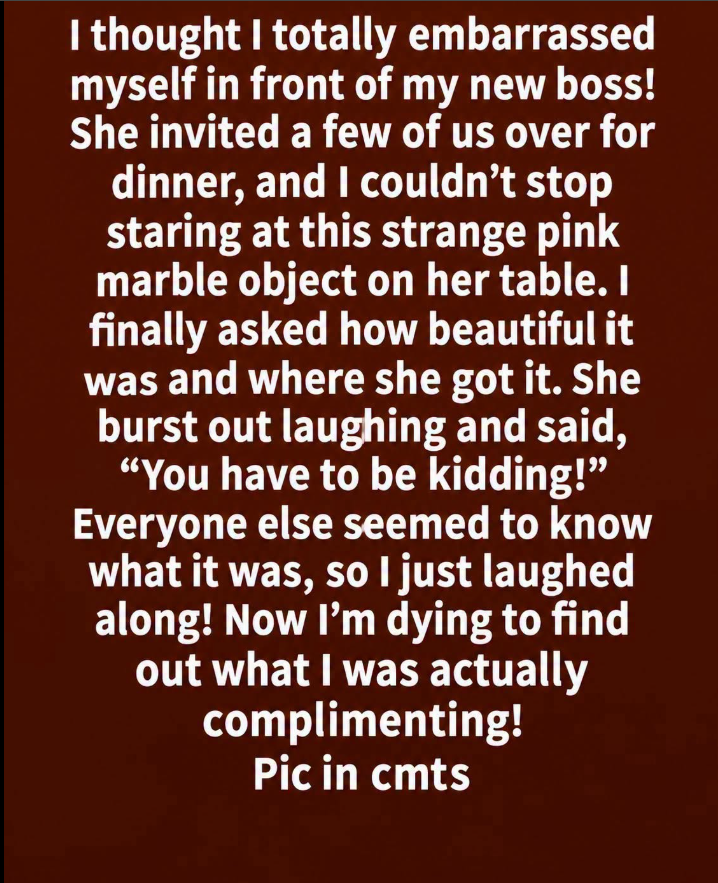
Imagine being invited to dinner at your new boss’s home. You want to make a good impression, so you choose your words carefully, join the conversations, and try to appear comfortable in an unfamiliar setting.
Everything seems to be going well until something unusual catches your attention.
Sitting on the table is a strange pink object with what appears to be a beautiful marble finish. It looks decorative, perhaps even expensive, but you can’t figure out what it is.
You keep glancing at it throughout the evening.
Eventually, curiosity gets the better of you.
You compliment the object and ask your boss where she bought it.
Instead of giving you the answer you expected, she bursts into laughter.
“You have to be kidding!”
Everyone else seems to understand the joke.
You don’t.
And suddenly, what began as a polite compliment becomes one of those awkward social moments you wish you could rewind.
But the most interesting part of the story is the question that follows: What exactly was that pink object, and why did everyone else seem to recognize it?
The Dinner Party That Took an Unexpected Turn
The story circulating online describes an employee attending dinner at a new boss’s home.
Being invited into a supervisor’s personal space can feel different from an ordinary dinner with friends.
At work, people generally understand the expectations. They have familiar responsibilities, professional conversations, and established routines.
But a social gathering outside the office can feel less predictable.
You want to be friendly without becoming too familiar.
You want to participate in conversations without monopolizing them.
And naturally, you hope to avoid saying anything embarrassing.
That is the situation described in the viral post.
The guest notices an unusual pink object on the table and becomes fascinated by its appearance.
It seems attractive enough to deserve a compliment.
But the guest doesn’t recognize its purpose.
Rather than asking immediately, the person spends part of the evening wondering what it might be.
Eventually, the question comes out.
And the response changes the mood completely.
One Compliment, One Laugh, and a Very Awkward Silence
Complimenting someone’s home is generally considered polite.
Guests might admire a painting, a vase, an antique, or an unusual piece of furniture.
Asking where someone found a beautiful object is usually a harmless way to begin a conversation.
But this particular compliment receives an unexpected reaction.
According to the circulating account, the boss starts laughing and responds with surprise.
The other guests appear to understand why the question is funny.
The person who asked, however, remains confused.
Instead of admitting that they don’t recognize the object, they simply laugh along.
It’s an understandable response.
When everyone around you seems to know something you don’t, asking for an explanation can suddenly feel uncomfortable.
You may worry that the answer is obvious.
Perhaps you suspect the object has a purpose that would make your question seem foolish.
Or maybe you’re simply afraid of attracting even more attention.
So you smile, laugh, and hope the conversation moves on.
Unfortunately, that doesn’t make the mystery disappear.
Why an Ordinary Object Can Look Completely Different to Someone Else
One of the most entertaining aspects of household mysteries is how differently people interpret unfamiliar objects.
A piece of equipment that seems ordinary to its owner may look like a decorative sculpture to a visitor.
The reverse can happen, too.
Something designed purely for decoration might resemble a practical household tool.
Consider the variety of objects people display in their homes.
Some collect polished stones or decorative spheres.
Others enjoy unusual candleholders, handcrafted pottery, or abstract sculptures.
There are also household accessories made from colorful resin, glass, ceramic, and stone-like materials.
Without knowing an object’s original purpose, it can be surprisingly difficult to identify.
Shape alone doesn’t always provide an answer.
A small rounded item might be decorative, functional, or part of something larger.
Its material may offer another clue, but appearances can be misleading.
Something that looks like marble might actually be resin, ceramic, or another manufactured material.
That is why the guest’s mistake is easy to understand.
An unfamiliar object can look beautiful without revealing what it was designed to do.
The Pink Marble Detail Makes the Mystery More Interesting
The original social media caption contains one particularly intriguing description.
The object is described as pink and marble-like.
That detail immediately creates a certain impression.
Pink marble is often associated with decorative household items, including trays, sculptures, containers, and bathroom accessories.
The color can make an object appear elegant or intentionally designed.
But the phrase “pink marble” does not necessarily establish that the object was made from natural stone.
It could simply describe the surface pattern.
Many modern decorative products use marble-like finishes on completely different materials.
And this distinction matters because the circulating photograph does not actually show the object.
The image shared with the story contains text describing the dinner party and directs viewers toward a picture supposedly placed in the comments.
Without that photograph, there isn’t enough visual information to identify the item.
Its exact dimensions, shape, material, and intended purpose remain unknown.
That leaves plenty of room for speculation.
But the accompanying article adds another twist.
The Linked Story Describes a Different Kind of Mystery
The webpage titled Peek Inside This Curious Little Find describes a decorative object that someone purchased because she found it beautiful.
Another person apparently considered it useless.
The disagreement later became the subject of an online post that attracted guesses and arguments.
According to that account, the discussion eventually became more interesting than the object’s original function.
That is an important detail.
The accompanying article does not establish that the object had an embarrassing purpose.
It also doesn’t provide a confirmed identification.
Instead, it focuses on how people react when they encounter something unfamiliar.
Some immediately begin guessing.
Others insist that the object must have a practical function.
And some believe it is perfectly reasonable to own something simply because it looks attractive.
The social media caption and the linked article therefore emphasize slightly different situations.
One presents an awkward dinner-party encounter.
The other focuses on a disagreement over an unusual decorative purchase.
But both revolve around the same fascinating question: Why do people feel such a strong need to know what an unfamiliar object is supposed to do?
Does Every Object in a Home Need a Practical Purpose?
This question is more interesting than it may initially seem.
Most household objects serve recognizable functions.
A lamp provides light.
A chair offers somewhere to sit.
A clock tells the time.
But decorative objects operate differently.
Their purpose may simply be to make a space more attractive or personally meaningful.
A small sculpture doesn’t need to hold something.
A polished stone doesn’t have to open, close, or perform a mechanical task.
And an abstract ornament may not represent anything recognizable.
People buy decorative items for many reasons.
Perhaps the color matches the room.
Maybe the texture is appealing.
Or the object reminds them of a particular trip, person, or experience.
Its value may be entirely personal.
That doesn’t make it useless.
A home is more than a collection of practical equipment.
It is also a place where people express their tastes, interests, and memories.
The unusual pink object in the story could have a practical function, a decorative purpose, or both.
The available information simply doesn’t establish which explanation is correct.
Why People Laugh When Someone Doesn’t Recognize Something
There is another side to this story that many readers may recognize.
Sometimes, a person asks a perfectly sincere question and receives laughter instead of an explanation.
The laughter may not be intended to hurt anyone.
People occasionally react with surprise when someone doesn’t recognize an item they consider familiar.
But the experience can still feel embarrassing.
Imagine visiting a friend’s kitchen and asking about an unfamiliar utensil.
To you, it looks like a strange piece of metal.
To your friend, it’s a potato ricer that has been sitting in the drawer for twenty years.
The difference is simply experience.
One person knows the tool because they’ve used it.
The other has never encountered it.
The same thing happens with modern technology, vintage household items, specialized hobbies, and personal-care accessories.
An older adult may instantly recognize a kitchen tool from the 1960s that leaves a younger person confused.
Meanwhile, a teenager may identify a modern electronic accessory that completely puzzles their grandparents.
Knowledge often depends on what we’ve had opportunities to encounter.
Not recognizing something doesn’t necessarily mean a person is uninformed.
Sometimes, it simply means the object belongs to someone else’s everyday experience.
The Moment When Laughing Along Makes Everything Worse
The guest in the viral story makes a decision that many people have made in uncomfortable situations.
Instead of asking for clarification, they laugh along.
At first, that might seem like the easiest way to handle the moment.
The conversation continues.
Nobody needs to stop and explain the joke.
And the person avoids drawing additional attention to their confusion.
But there is a small problem.
They still don’t know what the object is.
That unanswered question can become more frustrating than the original embarrassment.
Later, the person may replay the conversation in their mind.
Was the object something ordinary?
Was it a personal item?
Was the boss laughing because the compliment sounded unusual?
Or was there another explanation entirely?
Without asking, there is no reliable way to know.
The guest may have been only one simple question away from understanding everything.
Yet embarrassment can make that question surprisingly difficult to ask.
Why Internet Users Enjoy Solving Household Mysteries
Mysterious objects have become a familiar part of online entertainment.
Someone discovers an unusual gadget in an old drawer.
Another person finds a strange metal tool while cleaning out a garage.
A visitor notices an unfamiliar item in a bathroom or living room.
The photograph is posted online with a simple question.
“What is this?”
The responses can be entertaining because different people bring different experiences to the discussion.
Some offer practical explanations.
Others compare the item with objects they remember from childhood.
Collectors may recognize unusual antiques.
People familiar with particular professions might identify specialized equipment immediately.
Occasionally, the answer is surprisingly simple.
A complicated-looking device may turn out to be an ordinary kitchen utensil.
An unusual decorative object may actually serve a specific purpose.
But there is also a common problem with online identification.
A confident answer is not always a correct answer.
Several people can agree on an explanation and still be mistaken.
The strongest identification usually comes from recognizable design features, manufacturer information, or a clear photograph showing the complete object.
And in this case, that evidence is missing.
Could the Boss Have Been Laughing at Something Else?
The viral caption encourages readers to assume that the object itself explains the awkward reaction.
But the story leaves room for other interpretations.
Perhaps the boss was surprised that someone admired something she considered ordinary.
Maybe the item was inexpensive, handmade, or purchased in an unexpected place.
It could have been an object with sentimental value rather than monetary worth.
Or perhaps the laughter resulted from an inside joke shared by people who already knew its history.
These are possibilities, not established explanations.
The caption doesn’t provide enough information to determine what the boss meant.
That uncertainty matters because social situations often look very different depending on the missing context.
A laugh can communicate amusement, surprise, affection, or discomfort.
Without knowing the people involved and the full conversation, interpreting the reaction becomes guesswork.
The object may have been unusual.
But the laughter doesn’t prove that it was inappropriate or embarrassing.
How to Identify a Mysterious Decorative Object
If you’ve ever encountered something similar, a few observations can help narrow down its purpose.
Start with the object’s general shape.
Does it appear designed to stand upright, hold another item, or open in some way?
Look at the material.
Is it glass, ceramic, metal, stone, resin, or plastic?
Check whether it has a removable lid, hidden opening, hinge, or manufacturer marking.
The weight may also provide a clue.
A solid stone decoration will feel different from a hollow plastic container.
But avoid forcing an unfamiliar object open or taking it apart.
Some decorative pieces are fragile, while certain functional items may contain sharp components or materials that require careful handling.
If the item belongs to someone else, the simplest solution is usually the most respectful one.
Ask the owner.
A friendly question can be more effective than spending an entire evening trying to solve the mystery privately.
So, What Was the Strange Pink Object?
After all the speculation, the answer remains uncertain.
The original social media post describes a pink marble-like object displayed on a table during a dinner party.
The person who complimented it reportedly felt embarrassed when the boss and other guests laughed.
Meanwhile, the linked article describes an unusual decorative purchase that sparked an online discussion.
Neither piece of available material provides a clear photograph or confirmed identification of the object.
There is no reliable basis for claiming it was a particular household accessory, personal-care product, antique, or decorative sculpture.
And inventing a dramatic answer would create a story that the available information does not support.
The most meaningful conclusion is that the object remains unidentified in the material provided.
But the experience itself still carries a familiar and entertaining lesson.
Sometimes the Funniest Mistakes Begin With Good Intentions
The guest didn’t set out to create an awkward moment.
The intention was simple: offer a compliment and perhaps learn something about an attractive object.
But the unexpected reaction transformed that polite gesture into a mystery.
It is the kind of experience many people can relate to.
We’ve all encountered things we didn’t recognize.
We’ve all occasionally hesitated to ask a question because we feared the answer might be obvious.
And many of us have smiled through a conversation while secretly wondering what everyone else understood.
The interesting part isn’t necessarily the unidentified object.
It’s the way ordinary curiosity can become complicated by embarrassment.
In the end, a respectful question is rarely something to be ashamed of.
And if an unfamiliar object is beautiful enough to catch your attention, appreciating its appearance is perfectly reasonable, even if you don’t understand its purpose.
Have you ever complimented something in another person’s home, only to discover that it wasn’t what you thought it was?
Editorial Disclaimer
This article is intended for general informational, storytelling, and entertainment purposes only. It is based on the supplied social media caption and accompanying source webpage.
The identity, appearance, and intended purpose of the pink marble-like object have not been independently established. The supplied graphic does not include a photograph of the item, and the linked webpage does not provide a confirmed identification.
The dinner-party account has not been independently verified, and interpretations of the individuals’ reactions are presented as possible explanations rather than established facts.
Any household objects or materials discussed are illustrative examples only and should not be considered confirmed identifications. This article does not claim access to private conversations, unpublished photographs, or additional statements from the individuals involved.