Some people stretch out across the entire bed. Others curl up tightly beneath the blankets, while some prefer lying perfectly straight with their arms resting at their sides.
These little habits can seem completely ordinary. But a popular personality challenge circulating online suggests that the way you sleep might reveal something unexpected about your personality, including how relaxed, energetic, or laid-back you tend to be.
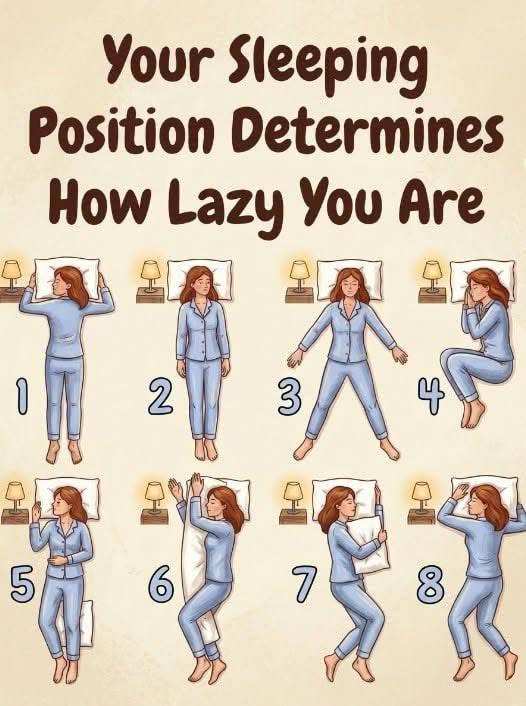
The challenge presents eight different sleeping positions and invites readers to choose the one that most closely resembles their own.
But before you decide which number describes you, there’s an interesting detail worth knowing.
Although sleeping positions have inspired personality theories for decades, scientists have not established a reliable connection between the way someone sleeps and whether that person is lazy, hardworking, generous, or adventurous.
Still, the traditional interpretations can be entertaining, and the physical reasons behind our sleeping habits are surprisingly interesting.
Take a moment to remember the position you naturally choose when getting into bed. Then see what the eight sleeping styles are commonly associated with.
Why Your Favorite Sleeping Position Feels So Natural
Most people don’t consciously decide how they will position their bodies throughout the night.
They simply settle into whatever feels comfortable.
Someone who has slept on their side for decades may find it difficult to relax while lying flat on their back.
Another person might feel most comfortable stretching their arms above their head.
These preferences can develop through habit, physical comfort, mattress support, and changing health needs.
As people grow older, their favorite sleeping positions may also change.
A position that felt perfectly comfortable at 25 might place too much pressure on the shoulders, hips, or lower back at 65.
That is why sleeping posture can sometimes tell us more about physical comfort than personality.
Nevertheless, traditional sleep-position descriptions have become popular because they offer a playful way to compare everyday habits.
And some of the descriptions might sound surprisingly familiar.
Position 1: The Stomach Sleeper Who Likes to Stretch Out
The first position shows someone lying face down with their arms bent and extended near the pillow.
This posture resembles a variation of stomach sleeping, sometimes associated with the traditional “freefall” position.
In popular personality interpretations, people who prefer this sleeping style are sometimes described as independent and determined.
They supposedly enjoy making their own decisions and dislike unnecessary restrictions.
Some descriptions also associate this position with people who appear confident but may be more sensitive to criticism than others realize.
Of course, these are traditional personality associations, not established psychological findings.
From a physical perspective, stomach sleeping can feel comfortable for certain people, but it may place additional strain on the neck and lower back.
Because the head usually turns to one side, the neck can remain twisted for extended periods.
If you regularly wake up with neck stiffness, this may be worth discussing with a healthcare professional.
But choosing this position certainly doesn’t mean you’re lazy.
In fact, many stomach sleepers simply find it difficult to fall asleep any other way.
Position 2: The Straight Sleeper Who Appreciates Order
The second illustration shows someone lying flat on their back with their arms resting naturally beside the body.
This position is commonly called the soldier position.
In traditional personality descriptions, soldier sleepers are often associated with discipline, calmness, and a preference for structure.
They are sometimes portrayed as people who appreciate organized routines and clear expectations.
Imagine someone who enjoys planning the next day before going to bed.
They prefer knowing where things belong, keeping appointments, and completing responsibilities on time.
That is the kind of personality often associated with this sleeping style.
But there is another interesting side to the soldier position.
Sleeping on the back can help some people maintain a comfortable alignment of the spine, especially when the pillow and mattress provide suitable support.
However, lying flat on the back may worsen snoring or obstructive sleep apnea in some individuals.
So while the traditional description emphasizes discipline, the practical question is whether this position helps you sleep comfortably and breathe well.
Position 3: The Starfish Sleeper Who Takes Up Space
Position three shows someone lying on their back with their arms and legs spread outward.
This resembles the starfish sleeping position.
If you’ve ever shared a bed with someone who sleeps this way, you may already know that the position can require a generous amount of space.
In popular personality interpretations, starfish sleepers are sometimes described as friendly, generous, and willing to help others.
They may be portrayed as good listeners who enjoy supporting friends and family.
Interestingly, traditional descriptions do not necessarily associate these individuals with wanting to be the center of attention.
Instead, they are often described as people who prefer meaningful friendships over constant recognition.
Of course, taking up more space in bed doesn’t prove someone is especially generous.
A person may simply find that spreading their arms and legs reduces pressure or helps them relax.
If this is your favorite position, consider whether your mattress and pillows provide sufficient support.
And if you share your bed, you might also want to make sure your sleeping partner has enough room.
Position 4: The Curled-Up Sleeper Who Loves Comfort
The fourth illustration shows someone curled on their side, with their knees drawn upward and their arms close to the body.
This is the fetal position.
It is one of the most recognizable sleeping postures.
The position gets its name from the curled shape of a developing baby in the womb.
In traditional personality descriptions, fetal sleepers are often associated with sensitivity, kindness, and a desire for security.
They may be described as people who appreciate familiar surroundings and close relationships.
Some interpretations suggest that although they appear reserved at first, they become warm and affectionate when they feel comfortable.
But the physical explanation is much simpler.
Curling onto the side can feel soothing and may reduce discomfort for certain sleepers.
Side sleeping is also extremely common among adults.
The position may be particularly comfortable when the knees are slightly bent rather than pulled tightly toward the chest.
For some people, placing a pillow between the knees can help maintain comfortable alignment through the hips and lower back.
The important detail is that curling up doesn’t reveal whether you’re emotionally strong or sensitive.
It may simply be the position that allows your body to relax.
Position 5: The Side Sleeper Who Prefers a Balanced Routine
The fifth illustration shows someone resting on their side with the knees slightly bent and one arm positioned near the face.
Unlike the tightly curled fetal position, this posture appears more relaxed and open.
It resembles a semi-fetal sleeping position.
Traditional personality descriptions sometimes associate relaxed side sleepers with flexibility, calmness, and a preference for avoiding unnecessary conflict.
They may be described as people who appreciate familiar routines while remaining willing to adapt when circumstances change.
Imagine someone who enjoys a quiet evening at home but doesn’t mind an occasional spontaneous outing.
That balance is often the theme of this interpretation.
Physically, side sleeping can be comfortable because it allows the body to rest in a relatively natural posture.
However, the position of the pillow matters.
A pillow that is too thick or too thin may cause the neck to bend unnaturally.
The goal is to keep the head and neck aligned as comfortably as possible with the spine.
If position five looks familiar, your sleeping preference may have more to do with comfortable support than any particular personality trait.
Position 6: The Raised-Arms Sleeper Who Likes Freedom
Position six shows someone resting on their side with both arms extended upward near the pillow.
This is a less conventional sleeping posture, and its exact shape doesn’t correspond neatly to one of the better-known traditional categories.
Still, popular personality games sometimes associate open or extended sleeping positions with curiosity, spontaneity, and independence.
People who identify with this description may enjoy trying new things or dislike feeling restricted by rigid routines.
They might appreciate having the freedom to make decisions at their own pace.
But there’s an important physical consideration with this particular position.
Keeping the arms raised for long periods can sometimes contribute to shoulder discomfort or sensations of tingling and numbness.
This can happen when pressure affects nerves or blood flow.
If you occasionally wake up with an arm that feels temporarily numb, repositioning may help.
However, repeated numbness, persistent pain, or weakness should be evaluated by a healthcare professional.
A comfortable sleeping position should not regularly leave you waking up in pain.
Position 7: The Pillow Hugger Who Enjoys Feeling Secure
The seventh illustration shows someone sleeping on their side while holding a pillow close to the body.
This is a familiar position for people who enjoy hugging a pillow while they sleep.
In popular personality interpretations, pillow huggers are sometimes associated with affection, loyalty, and a strong appreciation for close relationships.
They may be described as people who value emotional connection and enjoy making others feel comfortable.
For some readers, that description might sound surprisingly accurate.
But the physical benefits of hugging a pillow offer another explanation.
Holding a pillow can help support the upper arm and keep the shoulders in a more comfortable position.
A body pillow may also provide support for the legs and knees, depending on how it is positioned.
This can be especially helpful for people who experience discomfort when sleeping on their side.
The sense of comfort that comes from holding a pillow doesn’t necessarily reveal anything about emotional needs.
Sometimes, the body simply appreciates the extra support.
And there’s nothing wrong with that.
Position 8: The Restless-Looking Sleeper Who Finds Their Own Comfort
The eighth illustration shows someone resting in a partly turned position, with the arms near the pillow and the legs bent.
It resembles a combination of side and stomach sleeping.
People sometimes settle into positions like this without realizing how unusual they might look to someone else.
In playful personality descriptions, people who sleep in less conventional positions are sometimes associated with adaptability and individuality.
They may be portrayed as people who prefer doing things their own way.
Some interpretations also describe them as imaginative or difficult to predict.
But the most likely explanation is far less mysterious.
The body may simply be adjusting to the mattress, pillow, temperature, or pressure on particular joints.
Many sleepers also change positions several times during the night.
Someone who begins on their side may wake up partly on their stomach.
That movement is normal.
However, if a twisted sleeping posture regularly causes discomfort, a supportive pillow or a different mattress arrangement may help.
Which Sleeping Position Is Supposed to Be the Laziest?
This is the question raised by the viral image.
It claims that the way you sleep determines how lazy you are.
But the eight illustrations don’t provide a scientifically established ranking of laziness.
There is no reliable evidence that someone who sleeps curled up is lazier than someone who sleeps stretched out.
Nor does lying perfectly straight mean a person is more hardworking.
Laziness is a subjective label, and sleeping posture is not a validated way to measure someone’s motivation, productivity, or work ethic.
A person who spends the day working physically demanding hours might sleep in a completely relaxed position simply because their body needs rest.
Someone who has an office job might prefer the same position.
And a person who changes positions frequently may do so because of comfort rather than personality.
So if you’re wondering which number deserves the title of “laziest sleeper,” the answer is simple.
None of them. Your preferred sleeping position cannot determine how hardworking or lazy you are.
But it may offer useful clues about how comfortably you’re sleeping.
The Surprising Connection Between Sleeping Position and Aging
As we grow older, sleep can change in several ways.
Some people become more sensitive to uncomfortable mattresses.
Others develop joint stiffness or find that certain positions place pressure on their shoulders, hips, or lower back.
These changes can influence which sleeping posture feels most natural.
For example, someone who slept comfortably on their stomach for decades may eventually prefer sleeping on their side.
Another person may begin using additional pillows to support their knees or back.
There is nothing unusual about these adjustments.
The body changes over time, and sleep habits often change with it.
For adults over 55, comfort and adequate rest are generally more important than trying to maintain a particular sleeping posture.
If you sleep soundly, breathe comfortably, and wake up without significant pain, your preferred position may be working well for you.
But if you regularly wake up exhausted, uncomfortable, or short of breath, the issue deserves more attention.
How to Make Your Favorite Sleeping Position More Comfortable
You don’t necessarily have to abandon the position you’ve enjoyed for years.
Small adjustments may improve comfort.
For side sleepers, placing a pillow between the knees can sometimes reduce strain on the hips and lower back.
For back sleepers, a small pillow beneath the knees may provide additional support.
For stomach sleepers, a very thin pillow or an alternative position may help reduce neck strain.
The mattress also matters.
A mattress that is too soft may allow parts of the body to sink excessively.
One that is too firm may create uncomfortable pressure around the shoulders and hips.
The goal is to find a combination that supports your body while allowing you to relax.
And remember that good sleep involves more than posture.
A consistent bedtime, comfortable room temperature, limited nighttime disturbances, and appropriate management of health conditions can all contribute to better rest.
If you have sleep apnea, significant reflux, chronic pain, or another medical condition, ask a healthcare professional which sleeping positions are appropriate for you.
Why These Personality Challenges Are So Popular
There is a simple reason people enjoy quizzes about sleeping positions.
Everyone sleeps.
And almost everyone has a preferred way of getting comfortable.
That makes the subject immediately relatable.
You don’t need special knowledge or expensive equipment to participate.
You simply look at the illustrations and choose the one that resembles your habits.
The personality descriptions then encourage you to compare your own characteristics with the suggested interpretation.
Sometimes, a description may feel surprisingly accurate.
Other times, it may seem completely wrong.
That’s part of the entertainment.
But personality is far too complex to be explained by one physical habit.
Our behavior is shaped by experiences, relationships, preferences, responsibilities, and many other factors.
Sleeping position is only one small part of everyday life.
So, What Does Your Sleeping Position Really Say About You?
The eight sleeping positions in the viral image offer an entertaining way to think about familiar nighttime habits.
Some people stretch out.
Others curl up.
Some hug pillows, while others prefer lying straight on their backs.
Traditional interpretations connect these positions with traits such as confidence, kindness, independence, discipline, and emotional sensitivity.
But those associations are not reliable personality tests.
The more meaningful information comes from how comfortable you feel while sleeping.
Does your position help you relax?
Do you wake up rested?
Are your neck, back, and shoulders comfortable in the morning?
Those questions can tell you much more about your sleep than an online ranking of laziness.
So the next time someone claims that your favorite sleeping position reveals how lazy you are, remember that the real answer is a little more interesting.
Your posture may reflect comfort, habit, and physical needs, but it doesn’t define your character.
Now that you’ve explored all eight positions, which number looks most like the way you usually sleep?
Sources and References
Editorial Disclaimer
This article is provided for general informational, educational, and entertainment purposes only. The personality descriptions associated with different sleeping positions are based on popular interpretations and traditional theories, not scientifically validated psychological assessments.
There is no reliable scientific evidence that sleeping position determines laziness, intelligence, emotional strength, work ethic, or other personality characteristics. The eight illustrated positions are discussed for entertainment and general sleep-awareness purposes.
Information about sleeping posture, physical comfort, and sleep-related conditions is general guidance and should not replace individualized medical advice.
Readers experiencing persistent sleep difficulties, chronic pain, numbness, loud snoring, breathing interruptions, or excessive daytime fatigue should consult a qualified healthcare professional or sleep specialist before making significant changes to their sleeping habits.
Sleep needs and appropriate sleeping positions vary depending on age, health conditions, physical comfort, and individual circumstances.