
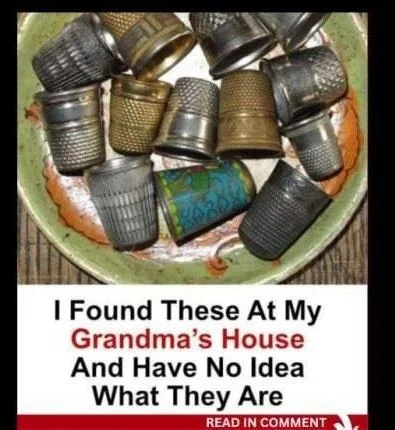
At first glance, those little metal cups might look like tiny pieces of hardware, old bottle caps, or even miniature containers. But if you found a pile of these in an old sewing box or at your grandmother’s house, there’s a good chance you’re looking at something much more familiar: sewing thimbles.
And there’s a reason so many of them have that strange pattern of tiny dents around the outside. Those little dimples weren’t just decorationthey helped keep a sewing needle from slipping when someone pushed it through thick fabric.

So, What Are They?
They’re sewing thimbles, small protective covers traditionally worn on a finger while hand sewing.
When sewing through heavier fabric, leather, or several layers of material, pushing a needle through can require considerable pressure. A thimble gives the finger a hard surface against which the back of the needle can be pushed.
Museums describe the basic purpose in exactly those terms: protecting the finger from being pricked while pushing a needle through fabric.
For someone who grew up sewing by hand, a thimble wasn’t an unusual object at all.
It was simply part of the sewing kit.
Why Do They Have All Those Little Dents?
This is one of the most interesting details.
The tiny indentations covering many traditional thimbles help catch and control the back of the needle.
Without that textured surface, a smooth metal thimble could allow the needle to slide when pressure was applied.
The dimples therefore have a practical purpose, not just a decorative one. Museum collections specifically identify these indentations as helping prevent the needle from slipping.
And if you look closely at old thimbles, you may notice that the pattern isn’t always perfectly uniform.
That’s because older examples were sometimes made using hand-punched indentations before manufacturing became more mechanized.
How Was a Thimble Actually Used?
The basic technique is surprisingly simple.
A person would place the thimble on the finger used to push the needle.
As the needle passed through the fabric, the back end could be pressed against the thimble rather than directly against the fingertip.
That made it easier to apply pressure without repeatedly sticking or irritating the finger.
The exact finger could vary depending on the person’s sewing technique. Although the middle finger became the usual location, historical sources note that thimbles were originally associated with the thumb.


Why Did Grandma Have So Many?
Finding several thimbles together isn’t particularly surprising.
Thimbles were produced in many different materials, sizes, shapes, and designs. Some were inexpensive working tools, while others were decorative objects or keepsakes.
Over time, collecting thimbles also became a hobby.
Some examples were beautifully decorated, made from silver, enamel, porcelain, or other materials. Museums today hold collections containing both practical sewing thimbles and elaborate decorative examples.
So a box containing several thimbles could have been:
- An everyday sewing collection
- Spare thimbles in different sizes
- Pieces inherited from another family member
- Decorative or souvenir thimbles
- A beginning of a personal collection
In other words, a pile of thimbles doesn’t necessarily mean someone had a very unusual sewing habit.
Thimbles Are Much Older Than Your Grandmother
Here’s the part that makes these tiny objects especially interesting.
Thimbles aren’t a recent invention.
Archaeological examples of thimbles date back many centuries, and museum collections contain examples from the medieval and Victorian periods. The basic idea—protecting the finger while pushing a needle through material—has remained remarkably consistent.
Metal thimbles became particularly widespread in Europe, and brass was an important material for early examples. Later, silver thimbles became popular as both useful objects and gifts.
That means one of those little objects sitting in an old sewing basket can represent a surprisingly long history of hand sewing.
What Were Old Thimbles Made From?
Metal is probably what most people picture, but thimbles have been made from many materials.
Historical examples include:
- Brass
- Silver
- Steel
- Copper alloys
- Leather
- Wood
- Glass
- Porcelain
- Bone and other historical materials
The material can sometimes give you a clue about an object’s history, but you shouldn’t try to date a thimble from material alone.
The shape, manufacturing marks, decoration, maker’s mark, and construction can all provide additional clues.

Are All of Them Actually Old?
Not necessarily.
This is where it’s easy to get carried away when finding something in a family home.
A thimble can look old because it’s scratched, tarnished, dented, or discolored. But appearance alone isn’t enough to establish its age.
Modern thimbles can also resemble older examples.
If you’re trying to determine whether one is genuinely antique, look for clues such as:
- A maker’s mark
- Hallmarks on silver examples
- Unusual construction
- Hand-worked or irregular dimples
- Wear consistent with long-term use
- Distinctive decoration
- Evidence of how the metal was formed
Even then, a photograph usually isn’t enough to give a reliable date.
What About the Thimbles in This Photo?
The objects shown appear to be metal sewing thimbles, but the photograph alone doesn’t establish their exact age, maker, or monetary value.
The different colors and surface finishes could simply reflect different metals, alloys, finishes, or levels of wear.
Some may have been ordinary working thimbles, while others could have been decorative or collectible pieces.
So if these came from your grandmother’s house, don’t assume every piece is an antique worth a lot of money—or that every piece is worthless.
A maker’s mark or hallmark can be much more informative than the general appearance.
Why Are Some Thimbles Open on Top?
Not every thimble is a completely enclosed metal cup.
Different sewing techniques led to different designs.
Some open-top or specialized thimbles allow the user to maintain more contact with the fabric and needle while still protecting the part of the finger that takes the pressure.
Modern sewing enthusiasts still use different styles depending on the type of sewing they’re doing.
The important thing isn’t necessarily which design is “correct.”
It’s which design fits the person’s finger and sewing technique comfortably.
Why Were Silver Thimbles So Popular?
Silver thimbles became especially popular as both practical objects and gifts.
But silver has an important weakness: it’s relatively soft.
Constant pressure from sewing needles can damage silver, which eventually led to clever construction methods. Some later silver thimbles incorporated steel cores to give them greater strength while retaining the appearance of silver.
That’s one reason a beautiful old silver thimble can be more interesting to collectors than an ordinary mass-produced metal example.
Could One Be Valuable?
Possibly—but don’t judge value simply by age or appearance.
Things that can matter include:
- Precious-metal content
- Maker
- Hallmarks
- Rarity
- Condition
- Decoration
- Provenance
- Unusual design
- Historical significance
A plain, common thimble may have little monetary value but still have considerable sentimental value.
Meanwhile, a small decorated silver thimble with a recognizable maker’s mark could deserve a closer look.
If you think you’ve found something special, avoid aggressive polishing until you’ve identified what it is. Cleaning can sometimes remove surface details or affect the appearance collectors want to preserve.
Why Did People Stop Using Them as Much?
Hand sewing became less central to everyday household life as ready-made clothing and modern sewing machines became widespread.
That doesn’t mean thimbles disappeared.
They are still used by people who sew, quilt, embroider, tailor, and work with heavier fabrics.
But for many families, a thimble that once lived beside needles, thread, buttons, and scraps of fabric eventually became more of a keepsake than an everyday tool.
That’s probably why these little objects can feel so mysterious today.
A Tiny Object With a Surprisingly Big Story
It’s easy to look at a collection of old metal thimbles and see nothing more than a handful of tiny cups.
But each one represents a practical problem people have been solving for centuries:
How do you push a needle through stubborn material without destroying your fingertip?
The answer was simple—a small protective cap, covered with little indentations that helped control the needle.
Over generations, that humble tool became part of sewing baskets, family collections, gifts, souvenirs, and even museum collections.
So if you found these at your grandmother’s house, you probably didn’t uncover a mysterious piece of hardware after all.
You found a little piece of sewing history.
And before you throw them into a drawer or donate them, check the bottoms and sides for maker’s marks, hallmarks, initials, or unusual decorations. That’s where the story of a particular thimble may really begin.