
At first glance, this looks like a simple subtraction problem. You start with six eggs, a few are broken, some are fried, and some are eaten. So how many should be left?
Before you answer, slow down and read the sentence one more time. The trick isn’t really in the math. It’s in whether the same eggs are being described by several different actions.
The Egg Puzzle
Here is the riddle:
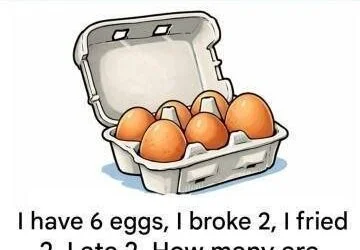
“I have 6 eggs. I broke 2, fried 2, and ate 2. How many eggs do I have left?”
It sounds as though three separate groups of two eggs were used.
If that were the case, you might immediately calculate:
6 − 2 − 2 − 2 = 0
But there is a problem with that interpretation.
The riddle never says that six different eggs were involved.
And that’s where the puzzle changes completely.
The Answer Is 4 Eggs
The two eggs that were broken can be the same two eggs that were fried and then eaten.
Think about what happens when you cook an egg.
You first break the egg.
Then you fry that same egg.
Then you eat it.
Those aren’t necessarily three separate events involving six different eggs. They can simply be three steps involving the same two eggs.
So from the original six:
- 2 eggs were broken.
- Those same 2 were fried.
- Those same 2 were eaten.
- The remaining 4 eggs were never used.
Answer: 4 eggs remain.
That’s the little detail that makes the riddle work.
Why So Many People Answer 0
The puzzle takes advantage of something our brains do very quickly: we treat each action as a new subtraction.
When we see:
broke 2 → fried 2 → ate 2
our minds can automatically interpret those as three separate groups.
That produces the tempting answer of zero.
But a good riddle forces you to ask a different question:
Are these actions happening to the same objects?
Once you ask that, the wording becomes much easier to understand.
The Key Is the Order of Events
The sequence is important.
Imagine you have six eggs sitting in a carton.
You take two eggs out.
First, you crack them.
Then you fry them.
Finally, you eat them.
At no point did you need another four eggs to perform the later actions.
The same two eggs simply moved through three stages:
broken → fried → eaten
That means only two eggs disappeared from your original six.
6 − 2 = 4


Why the Wording Matters
This is a classic example of a puzzle where language matters more than arithmetic.
If the riddle had said:
“I broke two eggs, fried two different eggs, and ate two more eggs.”
then the answer would be different.
You would have three separate groups of two.
But it doesn’t say that.
It simply says:
“I broke 2, fried 2, and ate 2.”
The wording leaves room for the same two eggs to be counted in all three actions.
That’s why rushing to calculate can lead you in the wrong direction.
A Simple Way to Solve Riddles Like This
Whenever a puzzle gives you several actions involving the same type of object, don’t immediately subtract every number.
Instead, ask:
Continue Reading For More Helpful Tips →
Continue Reading →