

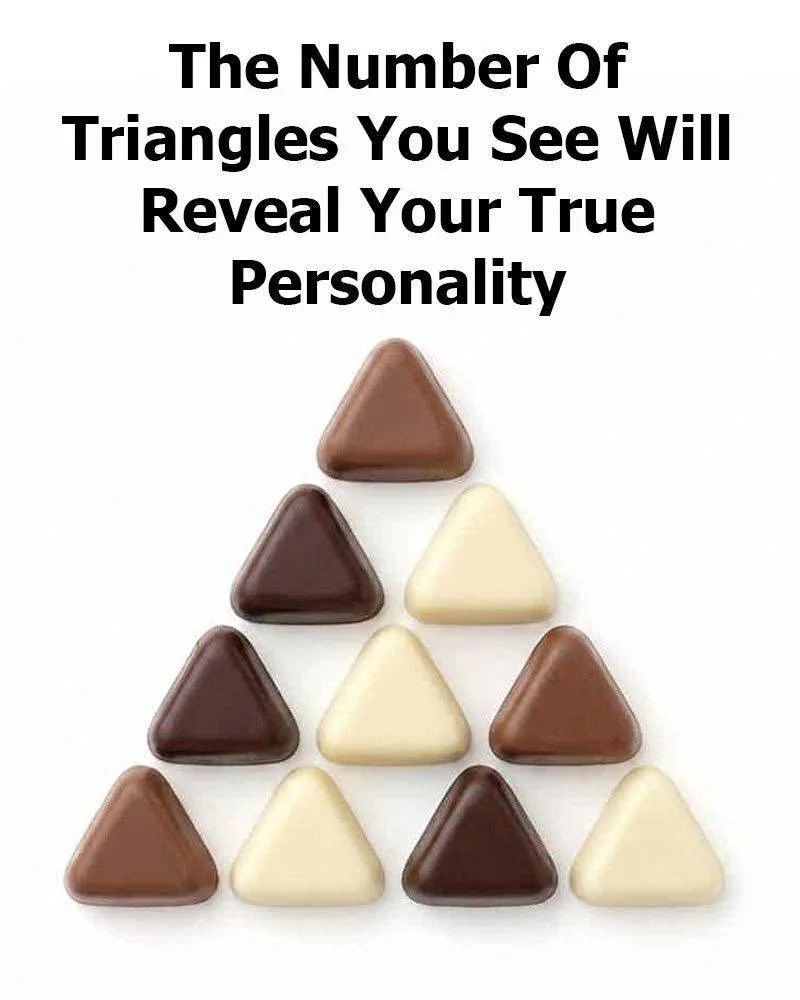
Take a quick look at the picture above before reading any further. Don’t count slowly, and don’t go back and check your answer. Just look at it for a few seconds and decide:
How many triangles did you see?
You might be surprised by how differently people answer the same visual puzzle. Some immediately notice the individual shapes, while others instinctively see the larger pattern first. That difference makes this kind of personality-style puzzle so fun to share.

Before you read the meanings below, write down your number. The interesting part is seeing whether the description matches the way you normally approach everyday situations.
One important note: this is a fun personality exercise, not a scientifically validated personality test. Research has found some relationships between visual-illusion sensitivity and personality traits, but popular social-media claims that a particular visual answer definitively reveals someone’s personality are much stronger than the evidence supports.
So, treat the result as a conversation starter—not a diagnosis.
If You Saw 1–3 Triangles: You Tend to Look at the Big Picture
If you noticed only a small number of triangles at first, you may naturally focus on the overall impression rather than every individual detail.
You may be the type of person who walks into a room and notices the atmosphere before noticing what’s sitting on the table.
In everyday life, this can show up as a preference for:
- Looking at the main idea first
- Making decisions without overanalyzing every detail
- Understanding how different pieces fit together
- Keeping things simple
- Moving forward instead of getting stuck on minor imperfections
This way of thinking can be useful when a situation is complicated and someone needs to understand what really matters.
The possible downside?
You may occasionally overlook a small detail that someone else would catch immediately.


If You Saw 4–6 Triangles: You’re Probably a Balanced Observer
If your eyes picked up several individual triangles but you didn’t immediately try to count every single one, you may have a middle-ground approach.
You notice details, but you don’t necessarily let them take over your thinking.
People with this kind of approach may enjoy understanding both the small pieces and the larger picture.
You might be someone who:
- Listens before making a decision
- Notices important details
- Doesn’t need everything to be perfect
- Can change direction when circumstances change
- Likes having enough information before committing
In a family discussion, for example, you might be the person who hears everyone’s side before offering an opinion.
That flexibility can be especially valuable when there isn’t one obvious answer.
If You Saw 7–9 Triangles: Details Probably Catch Your Attention Quickly
If you counted most of the visible triangles, your attention may naturally move toward individual elements.
You may notice things other people overlook—a misplaced object, a small change in someone’s expression, or a minor inconsistency in a story.
That can make you a strong problem-solver.
You may prefer to:
- Check the details before deciding
- Understand how something works
- Notice patterns
- Prepare rather than improvise
- Make sure important things haven’t been overlooked


But there’s another side to being detail-oriented.
Sometimes, looking closely at everything can make a simple decision feel more complicated than it needs to be.
Knowing when to stop analyzing can be just as valuable as noticing the details in the first place.
If You Saw 10 Triangles: Your Eyes Went Straight to the Individual Shapes
There are 10 obvious triangular pieces in the arrangement.
If you immediately counted all of them, you may have a particularly systematic way of approaching visual information.
You might naturally think:
“Let’s count everything before we decide what it means.”
That tendency can show up in other areas of life too.
You may like:
- Knowing exactly what you’re dealing with
- Organizing information
- Checking your work
- Solving puzzles
- Comparing options before choosing
- Having a clear plan
You may also be the person friends call when they need someone to spot something they missed.
But don’t take the result too seriously. Being able to count the triangles doesn’t prove that you’re more analytical than someone who saw fewer.
It simply gives you a fun way to think about how your attention works in that moment.
Why Can People See the Same Picture Differently?
This is where the puzzle becomes more interesting.
Our visual system doesn’t simply record an image like a camera. The brain interprets what reaches the eyes, organizes shapes, detects patterns, and decides which information deserves attention.
Researchers have studied individual differences in how people respond to visual illusions. One 2023 study found evidence for a general factor related to sensitivity to several types of visual illusions and reported some associations with personality traits.
But that doesn’t mean a single puzzle can accurately tell you whether you’re generous, intelligent, lazy, introverted, emotional, or any other fixed personality category.
In fact, research specifically examining popular claims that ambiguous images reveal personality found that many of those claims were not supported by the evidence.
That’s an important distinction.
Your answer can be interesting without being a scientific measurement of who you are.
Your Answer Can Also Change
Continue Reading For More Helpful Tips →
Continue Reading →
Continue Reading For More Helpful Tips →
Continue Reading →