Your gums can tell you a lot about your oral health.
Redness, swelling, tenderness or bleeding when you brush may seem like minor annoyances. Some people even assume that bleeding gums are simply something that happens with age.
They aren’t something you should routinely ignore.
Gum disease is extremely common, and it can progress gradually. Early gum disease, called gingivitis, is often reversible with good daily oral care. More advanced periodontal disease is different: it can damage the tissues and bone supporting your teeth and requires professional treatment.
The good news is that several simple habits at home can help protect your gums and reduce the buildup that causes problems.
Here are eight worth knowing.


1. Brush Twice a Day With Fluoride Toothpaste
One of the most effective things you can do for your mouth is also one of the simplest.
Brush your teeth twice a day with fluoride toothpaste.
Plaque is a sticky film containing bacteria that constantly forms on your teeth. If you don’t remove it regularly, it can contribute to tooth decay and gum inflammation.
But brushing harder isn’t better.
In fact, aggressive scrubbing can irritate your gums.
Instead, use gentle movements and angle the toothbrush toward the gumline so you clean the area where the teeth and gums meet.
The National Institute of Dental and Craniofacial Research recommends brushing all sides of the teeth with gentle, small circular motions rather than forceful back-and-forth scrubbing.
If your toothbrush bristles become worn, replace the brush.
2. Clean Between Your Teeth Every Day
A toothbrush can’t reach every surface between your teeth.
That’s where cleaning between the teeth becomes important.
Dental floss is one option, but it isn’t the only one. Depending on the space between your teeth and your individual needs, you might use interdental brushes, a floss holder or a water flosser recommended by a dental professional.
The goal is simple:
Remove plaque before it has a chance to harden into tartar.
Once plaque hardens into calculus, ordinary brushing and flossing can’t remove it. A dental professional has to remove it with professional cleaning instruments.


3. Don’t Ignore Bleeding Gums
Seeing a little blood when you brush or floss can be easy to dismiss.
But bleeding gums are one of the warning signs of gum inflammation.
Other symptoms can include:
- Red or swollen gums
- Tender gums
- Persistent bad breath
- Gums pulling away from the teeth
- Loose or sensitive teeth
- Pain when chewing
These are signs worth discussing with a dentist, particularly if they persist.
There’s an important distinction here.
If your gums bleed because you haven’t been cleaning between your teeth and you suddenly start doing it gently and regularly, mild gingivitis may improve.
But persistent bleeding shouldn’t be treated indefinitely with home remedies.
It deserves an evaluation.
4. Don’t Try to Scrape Away Tartar Yourself
This is an important one because social media is full of DIY dental-cleaning tricks.
You may see people recommending household tools, sharp objects, baking soda mixtures or aggressive scraping to remove hardened buildup.
Don’t do that.
Tartar is hardened plaque, and it cannot be safely removed simply by brushing and flossing. Professional dental instruments are designed for this job.
Trying to scrape it away yourself can injure the gums or damage the surfaces around your teeth.
If you can actually see a hard yellow or brown deposit that doesn’t disappear with normal brushing, schedule a professional cleaning instead.


5. Quit Smoking if You Smoke
Smoking isn’t just harmful to your lungs.
It is also one of the most important risk factors for gum disease.
The National Institute of Dental and Craniofacial Research identifies tobacco use as a major risk factor and notes that smoking can also make treatment less successful.
The CDC likewise recommends quitting tobacco as part of protecting your gums and reducing the risk of serious periodontal disease.
If quitting feels difficult, that doesn’t mean you have to do it without help.
Talk with your healthcare professional about evidence-based ways to quit.
Every step away from tobacco is a step toward better overall health.
6. Pay Attention to Dry Mouth
A dry mouth can be more than uncomfortable.
Saliva plays an important role in protecting your mouth, and dry mouth can make oral-health problems more difficult to manage.
This can become particularly relevant as people get older because some medications and health conditions can reduce saliva production. The CDC notes that oral-health problems can increase with age partly because of changes such as dry mouth and physical difficulties with brushing or flossing.
If you regularly wake up with a very dry mouth, constantly need water while eating, or feel that your mouth is unusually dry throughout the day, mention it to your healthcare professional or dentist.
Don’t stop a medication on your own because you suspect it is causing dry mouth.
There may be other ways to manage the problem.
7. Keep Up With Dental Visits
Good home care is essential.
But it isn’t a replacement for professional dental care.
A dentist can identify gum inflammation, deeper periodontal pockets, tartar buildup and other problems that aren’t always obvious when you look in the mirror.
The CDC recommends regular dental checkups and professional cleanings, with frequency adjusted according to individual risk.
This becomes especially important if you have diabetes, smoke, have previously had periodontal disease or have other factors that increase your risk.
Sometimes the earliest sign of a problem is something you can’t see or feel yourself.
That’s one reason routine examinations matter.


8. Be Careful With DIY “Cures”
This may be the most important lesson from all the viral gum-health recipes online.
You’ll find recommendations involving baking soda, vinegar, oils, salt mixtures and other kitchen ingredients.
Some may make your mouth feel temporarily cleaner.
That doesn’t mean they can cure periodontal disease.
The underlying problem in gum disease involves plaque, inflammation and, in more advanced disease, destruction of the tissues and bone supporting the teeth. Treatment depends on how advanced the condition is.
For example, early gingivitis can often be reversed with improved daily brushing and cleaning between the teeth.
Periodontitis is different.
It cannot simply be “cured” with a homemade rinse or paste. Professional treatment may include deep cleaning below the gumline, medications or, in advanced cases, surgery.
So if a recipe promises to eliminate gum disease in a few days, be skeptical.
Your gums deserve better than an internet experiment.
What About Baking Soda?
Baking soda is often presented online as a natural way to fight gum disease.
It’s important not to confuse a household ingredient with a proven treatment for periodontal disease.
The established recommendations from NIDCR and CDC focus on removing plaque through brushing and interdental cleaning, regular professional dental care, tobacco cessation and appropriate treatment when disease is present.
That doesn’t mean every use of baking soda is automatically dangerous.
It means there isn’t a good reason to rely on a baking-soda recipe as a substitute for proper dental care.
If you have gum disease, the most important question isn’t:
“What homemade ingredient should I try?”
It’s:
“How advanced is the disease, and what treatment do my gums actually need?”
Can Gum Disease Affect More Than Your Mouth?
Your mouth doesn’t exist separately from the rest of your body.
Periodontal disease involves inflammation and infection of the tissues surrounding and supporting the teeth.
It’s also associated with several chronic health conditions and risk factors, including diabetes and smoking.
That doesn’t mean gum disease automatically causes heart disease, diabetes or other illnesses.
Those claims are often exaggerated online.
But it does mean oral health deserves to be treated as part of your overall health rather than something completely separate.
Taking care of your gums is one more part of taking care of yourself.
When Should You See a Dentist?
Don’t wait until a tooth becomes loose.
Make an appointment if you notice persistent:
- Bleeding gums
- Swelling or redness
- Bad breath that doesn’t go away
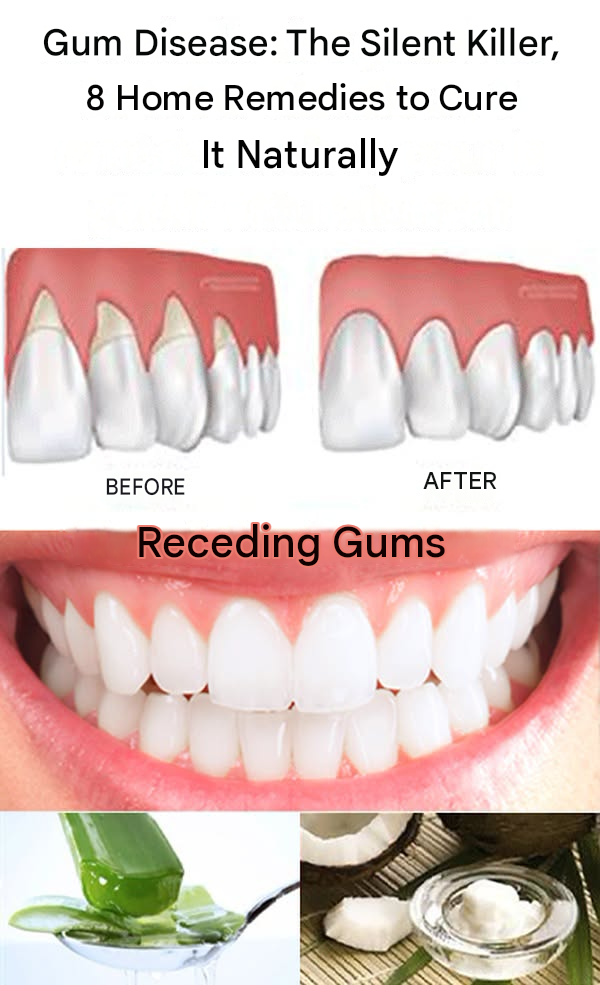
- Gum recession
- Sensitive or loose teeth
- Pain when chewing
- Changes in how your teeth fit together
These symptoms can have different causes, and a dental examination is the best way to determine what’s happening.
If you’ve already been diagnosed with periodontal disease, follow the treatment plan recommended by your dental professional.
Home care is still extremely important, but it works alongside professional treatment rather than replacing it.


The Bottom Line
Healthy gums don’t require complicated kitchen recipes.
The most reliable approach is much simpler:
Brush twice a day with fluoride toothpaste. Clean between your teeth every day. Don’t smoke. Keep up with dental visits. And don’t ignore persistent bleeding, swelling or loose teeth.
Gingivitis can often be reversed when caught early.
Periodontitis is more serious and requires professional management because it can damage the tissues and bone supporting your teeth.
So don’t let a viral “natural cure” convince you that professional dental care isn’t necessary.
Your gums may not always get your attention.
But when they start sending warning signs, they’re worth listening to.