
PART 1
I was 26 years old when I found out I was pregnant with our fifth child.
We already had four boys.
Our youngest was still a baby himself, and honestly, another pregnancy wasn’t something we’d planned.
But when I saw those two lines on the test, I smiled.
Another baby.
Another little person to love.
For the first few weeks, everything seemed normal.
Then something changed.
I wasn’t experiencing the usual morning sickness I’d had with my other pregnancies.
I was exhausted, but I blamed that on having four boys running around the house.
Still, there was a feeling I couldn’t shake.
Something wasn’t right.
I finally called my doctor.
“I think I need an ultrasound.”
He asked why.
“I don’t know,” I admitted. “I just don’t feel like everything is okay.”
At twelve weeks, I went to a specialist.
My husband couldn’t come because he was working, so I sat alone in the ultrasound room.
At first, everything felt normal.
I heard the heartbeat.
Fast.
Strong.
Beautiful.
I smiled.
Maybe I’d been worrying for nothing.
Then the technician became quiet.
Too quiet.
She stopped talking.
She measured something.
Then measured it again.
My smile disappeared.
A few minutes later, she told me the doctor would be coming in.
“Don’t clean the gel off yet.”
My stomach dropped.
When the doctor entered, she began examining the ultrasound herself.
Then she showed me what she was seeing.
There was extra fluid around my baby’s head.
Around his neck.
Around his heart.
The doctor explained that findings like these could sometimes be associated with chromosomal conditions.
I stared at the screen.
“But I have four healthy children.”
My voice sounded like someone else’s.
“How can this be happening?”
The genetic counselor explained my options.
There were invasive tests.
There were other tests we could wait for.
And there was a blood test that could screen for certain chromosomal conditions.
I chose the blood test.
Then I went home.
And waited.


5
A few days later, I was at the clinic with my youngest son when my phone rang.
It was the genetic counselor.
Her voice was calm.
Almost too calm.
“Your baby’s results are showing markers for Trisomy 13.”
I stopped breathing.
I knew enough to understand that this wasn’t good news.
But my mind couldn’t process the diagnosis.
I had one question.
The only question that suddenly mattered.
“What is the baby?”
She paused.
“Are you sure you want to know?”
“Yes.”
My voice shook.
“Please tell me.”
“It’s a boy.”
I closed my eyes.
A boy.
Another little boy.
I immediately called my husband.
When he answered, I could barely speak.
“It’s a boy.”
He laughed softly.
Four boys already.
And now another.
But there was something else happening inside me.
As scared as I was…
I already loved him.
I didn’t know how long we’d have together.
I didn’t know what the diagnosis meant for his future.
But he was my son.
And I was going to meet him.
We chose his name that same day.
Ezrah.
I didn’t know then how deeply that name would become part of our family forever.
PART 2
My doctor wanted us to get another opinion.
He couldn’t believe what the tests were suggesting.
“You don’t expect something like this at your age,” he told me.
But the ultrasound findings continued to line up with the possibility of Trisomy 13.
So my husband and I went to a children’s hospital for a more detailed examination.
I was fifteen weeks pregnant.
We walked into the specialist’s office terrified.
Then the ultrasound began.
There he was.
Our baby.
Moving on the screen.
Alive.
Beautiful.
The specialist found several abnormalities, including a cleft lip.
There were other concerns too.
But there was something that surprised every doctor.
His heart looked remarkably strong.
The doctors couldn’t promise us anything.
They couldn’t tell us how long he would live.
They couldn’t tell us exactly what his future would look like.
But we could see one thing clearly.
He was fighting.
And so were we.
From that point forward, we went to the children’s hospital regularly.
Every appointment became a milestone.
Every ultrasound became a celebration.
At twenty weeks, I felt him move.
I put my hand on my stomach and started crying.
Not because I was sad.
Because I could feel my son.


7
We decided to tell our family and friends what was happening.
We didn’t want people to be afraid of him.
We wanted them to know him.
Not his diagnosis.
Him.
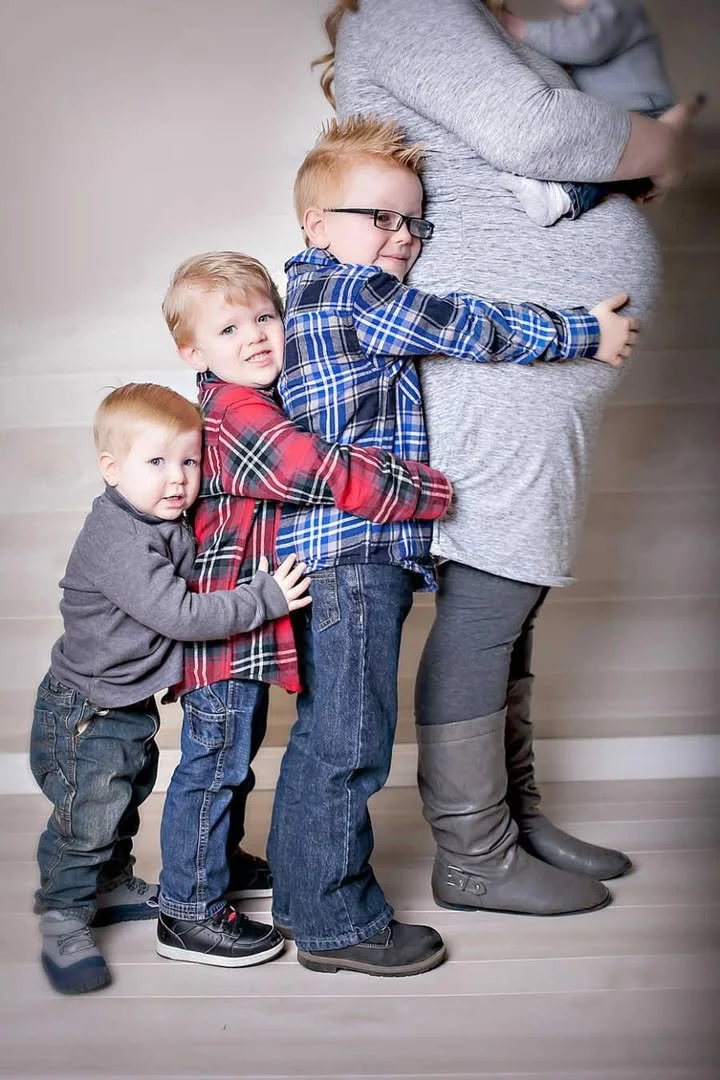
So we took maternity pictures.
We prayed.
We talked about him.
Our boys asked questions.
And little by little, Ezrah became part of everyone’s world before he was even born.
But as the pregnancy progressed, the doctors began noticing that his growth was slowing.
At one appointment, we were told this could happen with babies who had his condition.
My anxiety became overwhelming.
Some days I was terrified.
Other days I felt completely peaceful.
I learned to stop looking too far ahead.
Instead, I focused on the next appointment.
The next kick.
The next heartbeat.
The next day.
At one point, doctors performed a detailed examination of his heart.
I held my breath while they looked.
Then they told us something we’d been desperately hoping to hear.
His heart was functioning surprisingly well.
There was no major hole.
No significant valve problem.
No obvious defect that explained how sick they feared he might be.
For us, that was enough reason to celebrate.
So we celebrated everything.
Every kick.
Every pound he gained.
Every week he stayed inside me.
Every ultrasound where we got to see his face.
Then we reached the final weeks of the pregnancy.
The plan was simple.
I would stay near the hospital.
We would deliver around thirty-nine weeks.
The goal was to give Ezrah the best chance possible.
But then, during what was supposed to be a routine appointment, everything changed.
The ultrasound technician wasn’t the one we’d been seeing.
The room felt different.
Something felt wrong.
They checked his movement.
Then his heart rate.
Then the fluid around him.
The doctor walked in.
Her expression told me everything before she spoke.
“We need you to go to Labor and Delivery.”
I stared at her.
“Why?”
“His movements aren’t where we’d like them to be.”
My heart started pounding.
The induction we’d planned was still days away.
We hadn’t arranged everything.
Our other children were hours away.
Nothing was ready.
But suddenly…
none of that mattered.
Our son needed to come.
We called our friends.
They took care of our boys.
People from our church stepped in.
Everyone moved quickly.
And that night, we returned to the hospital.
The induction began.
I held my husband’s hand.
He held mine.
Neither of us knew what the next twenty-four hours would bring.
But we knew one thing.
After months of waiting…
we were finally going to meet our son.
And I had no idea that the moment I heard his first cry…
would become one of the most beautiful and heartbreaking moments of my life.
PART 3
The induction started just after midnight.
The room was dim except for the monitors beside my bed.
My husband sat next to me, holding my hand.
Neither of us talked much.
There wasn’t much left to say.
For months, we’d imagined this moment.
Now it was finally here.
Only it didn’t feel like the beginning we’d dreamed about.
It felt like a race against time.
The nurses checked his heartbeat constantly.
Every time the monitor changed, my heart jumped.
Then, sometime before sunrise, the doctor came in.
“He’s ready.”
My hands started shaking.
I looked at my husband.
“Are we really about to meet him?”
He smiled through tears.
“Yeah.”
A few hours later, our son was born.
And the entire room became quiet.
There was no loud cry.
No dramatic moment.
Just a tiny baby being lifted carefully into the world.
“He’s here,” the nurse whispered.
I couldn’t see him clearly at first.
Then they brought him closer.
And I saw his face.
His little mouth.
His tiny fingers.
The features we’d stared at on ultrasound screens for months were suddenly real.
I reached out.
“Can I hold him?”
They placed him on my chest.
I started crying immediately.


5
He was so small.
But he was beautiful.
I whispered his name.
“Ezrah.”
His little hand moved against my chest.
My husband leaned over us.
“Hey, buddy.”
For a few minutes, nothing else existed.
Not the diagnosis.
Not the doctors.
Not the statistics.
Not the future.
Just us.
A mother.
A father.
And their son.
The nurses took him for some tests.
His oxygen levels needed to be monitored.
There were concerns about feeding.
But he was fighting.
And we were grateful for every second.
Our other boys eventually came to meet him.
They stood around the hospital bed, nervous and excited.
One of them looked at Ezrah and whispered:
“He’s really little.”
I laughed through my tears.
“Yes, he is.”
Then he asked the question I’d been dreading.
“Is he going to be okay?”
I looked at my husband.
We didn’t know.
So I answered honestly.
“We don’t know how long we’ll have with him.”
The room became quiet.
“But however long we have…”
I looked down at Ezrah.
“…we’re going to love every second.”
For the next few days, we lived in a strange world.
Sometimes Ezrah was stable.
Sometimes the monitors made our hearts race.
Sometimes we thought we’d be taking him home.
Then another problem would appear.
But every morning, I walked into his room and said the same thing.
“Good morning, handsome.”
And every night, I whispered:
“Mommy loves you.”
We stopped counting the days.
We started counting moments.
His first bath.
His tiny yawns.
The way he held our fingers.
The sound of his brothers talking to him.
The little expressions he made while sleeping.
Everything became precious.
Then, thirteen days after he was born…
I woke up before sunrise.
Something felt different.
I walked into his room.
The nurses were already there.
My heart dropped.
One of them looked at me.
“Mom…”
I knew.
Before anyone said another word…
I knew.
PART 4
I ran to his bedside.
My husband was right behind me.
Ezrah was quiet.
Too quiet.
I reached for his hand.
It was warm.
I held it between both of mine.
“Hi, baby.”
My voice broke.
“I’m here.”
The doctors worked around us.
Machines beeped.
People moved quickly.
But I barely heard any of it.
I only saw my son’s face.
The face I’d imagined meeting long before he was born.
The face I’d prayed over.
The face I’d memorized during every ultrasound.
My husband stood beside me.
His eyes were full of tears.
Then the room became still.
The doctors stopped.
And I understood.
Ezrah was gone.
Thirteen days.
That’s all we had been given.
Thirteen days that somehow contained an entire lifetime of love.


6
I held him for the last time.
I didn’t want to let go.
He was my son.
Not a diagnosis.
Not a statistic.
Not a medical case.
My son.
I kissed his forehead.
“You changed me,” I whispered.
“I wish you could have stayed.”
My husband put his hand on my shoulder.
We cried together.
Then we called his brothers.
They came into the room.
They touched his tiny hands.
They said goodbye.
One of them brought a drawing he’d made.
It was a picture of our family.
Six people.
He had drawn Ezrah in the middle.
I folded it carefully and placed it beside him.
Because even though his life had been short…
he had always belonged to us.
In the days that followed, our house felt unbearably quiet.
There was a crib we never got to use.
Clothes that still had their tags.
A car seat that had carried him only once.
A room we’d prepared for a baby who would never sleep there.
Grief came in waves.
Sometimes I could laugh.
Then I’d suddenly remember.
He was gone.
And I’d break all over again.
But eventually, something changed.
I stopped thinking only about the thirteen days we lost.
I started thinking about the thirteen days we were given.
Thirteen days of holding him.
Thirteen days of knowing his face.
Thirteen days of his brothers becoming brothers.
Thirteen days of hearing his name spoken with love.
Thirteen days in which he was never alone.


6
People sometimes ask me whether I wish I had never known.
Whether knowing how short his life would be made the pain worse.
The answer is simple.
No.
I would choose him again.
Every single time.
Even knowing the ending.
Because love isn’t measured by how long someone stays.
It’s measured by how deeply they change the people who loved them.
Ezrah changed our family.
He taught his brothers compassion.
He taught us to slow down.
He taught us that a life doesn’t have to be long to matter.
And he taught me something I’ll carry for the rest of my life:
A diagnosis can describe a condition.
It can never describe a person’s worth.
My son lived for thirteen days.
But in those thirteen days, he was loved more than I could ever explain.
And years later, when I say his name, I don’t want people to think about what he couldn’t do.
I want them to remember that he was here.
That he was wanted.
That he was held.
That he was loved.
That he was ours.
For thirteen days…
and forever.







