PART 1
The first thing I noticed was the silence.
Not the kind of silence you hear in an empty room.
A terrifying silence.
The kind that happens when everyone realizes something has gone horribly wrong.
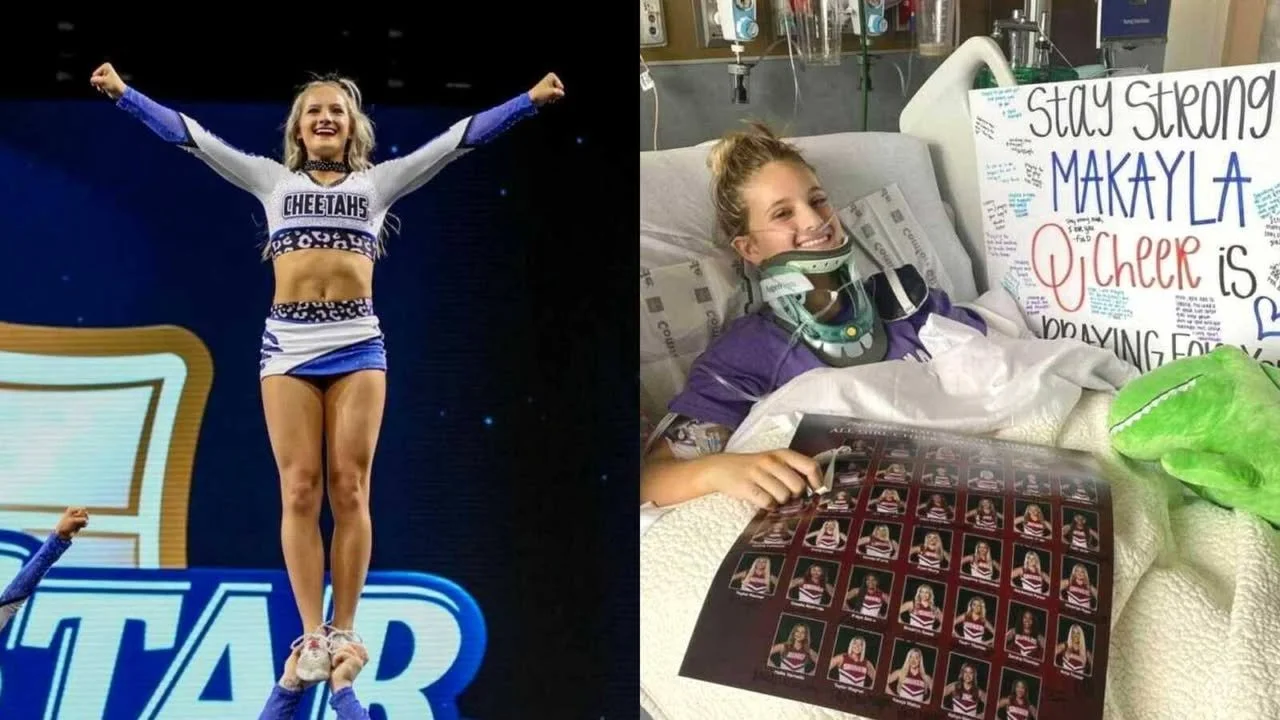
I was seventeen years old, standing in a backyard in Texas, surrounded by my cheer teammates.
We had been practicing for our school’s upcoming homecoming rally.
I had done the move hundreds of times.
Flip.
Rotate.
Land.
It was supposed to be automatic.
It wasn’t.
My body twisted in the air.
For one split second, I saw the sky.
Then the ground.
My neck hit first.
Everything stopped.
I could hear people screaming.
Someone shouted for an ambulance.
But I couldn’t move.
I tried to lift my arms.
Nothing.
I tried to move my legs.
Nothing.
Panic exploded through my chest.
“Why can’t I move?”
One of my teammates dropped beside me.
“Don’t move. Help is coming.”
I stared at the sky, fighting to breathe.
And somewhere deep inside, I already knew.
Something had happened to my spine.


6
The ambulance arrived within minutes.
The paramedics carefully stabilized my neck and rushed me to the hospital.
I was awake the entire time.
That was almost the worst part.
I could hear every question.
Every instruction.
Every worried voice.
But I couldn’t move my body.
At the hospital, doctors rushed me into surgery.
My parents arrived while I was being prepared.
My mom grabbed my hand.
She was crying.
I had never seen her look so scared.
“You’re going to be okay,” she kept saying.
I wanted to believe her.
The surgeons worked for hours.
When I finally woke up, I couldn’t recognize the room.
Machines surrounded me.
My parents were sitting beside the bed.
I tried to move.
Nothing.
My eyes filled with tears.
“Mom?”
“I’m here.”
“Can I move?”
She looked at the doctor.
That tiny pause told me everything.
The doctor explained that I had suffered a devastating spinal cord injury.
I was now quadriplegic.
I stared at him.
“Will I walk again?”
He chose his words carefully.
“We don’t know.”
“But will I?”
He looked at me.
“Most people with an injury this severe don’t regain the ability to walk.”
I felt something inside me break.
Not because he said I couldn’t.
Because for the first time…
I realized how much of my life I had taken for granted.
Walking to class.
Running across a field.
Jumping.
Dancing.
Getting out of bed without thinking about it.
All of it had disappeared in one afternoon.
That night, when everyone left the room, I stared at the ceiling.
I cried.
I was terrified.
Angry.
Confused.
But somewhere underneath all of that…
there was still a tiny voice inside me.
And it said:
“Not yet.”
PART 2
The next morning, rehabilitation started.
I hated it.
Every movement was exhausting.
Things that had once taken seconds now required concentration, equipment, and help from other people.
A therapist asked me to try moving one finger.
Just one.
I stared at my hand.
“Come on.”
Nothing.
I tried again.
Nothing.
Again.
Still nothing.
I wanted to scream.
Instead, I laughed.
The therapist looked surprised.
“Why are you laughing?”
“Because this is ridiculous.”
She smiled.
“That’s one way to look at it.”
I looked at her.
“No.”
I took a breath.
“I’m going to learn how to do this.”
That became my new mindset.
Not tomorrow.
Not someday.
Today.


6
Every day brought another challenge.
Sitting upright.
Balancing.
Strengthening my arms.
Learning how to transfer from one surface to another.
Some days I left therapy exhausted and angry.
Some days I cried before I even started.
But I kept showing up.
Because I remembered who I had been before the accident.
I had spent years pushing my body to its limits as an athlete.
Now I had to train it in a completely different way.
My parents never treated me like I was fragile.
They encouraged me.
They challenged me.
And when I said I couldn’t do something, my mom would look at me and say:
“Maybe not today.”
Then she’d smile.
“But let’s find out.”
So I started documenting my recovery.
I filmed the difficult days.
The embarrassing moments.
The small victories.
The days when I needed help getting dressed.
The days when I couldn’t stop crying.
And the days when I accomplished something that doctors once told me might never happen.
I wanted people to see the reality.
Not just the inspirational photographs.
Not just the smiling wheelchair pictures.
I wanted them to understand that disability wasn’t the end of my life.
It was a completely different life.
And I was learning how to live it.
Then something unexpected happened.
People started messaging me.
A teenager told me she had been struggling after an accident.
A mother told me her son had recently suffered a spinal cord injury.
Someone else said my videos had given them enough courage to start physical therapy again.
I read every message.
And suddenly my recovery wasn’t only about me.
One afternoon, my therapist asked me what my ultimate goal was.
I didn’t hesitate.
“I want to walk.”
She nodded.
“Then we’ll work toward that.”
I knew there were no guarantees.
I knew the statistics.
I knew what the doctors had told me.
But I also knew something they couldn’t measure.
How badly I wanted it.
So I kept training.
One repetition.
One movement.
One painful day at a time.
And then, months after the accident, my hometown announced something I never expected.
They wanted to honor me.
Not because I had already walked again.
Not because my recovery was finished.
But because they had watched me refuse to give up.
And on that day, surrounded by the people who had carried me through the darkest chapter of my life…
I realized something.
Maybe strength wasn’t about proving I could walk again.
Maybe strength was refusing to let one terrible moment decide who I would become.
PART 3
The first time I stood between two parallel bars, my hands were shaking.
My therapist stood beside me.
“Take your time.”
I looked down at my legs.
For months, they had felt like they belonged to someone else.
I tightened my grip.
Then I pushed.
My body rose.
Not completely.
Not gracefully.
But enough.
My knees trembled violently.
“You’re standing,” my therapist whispered.
I couldn’t believe it.
I was standing.
With help.
For only a few seconds.
But I was standing.
I started crying.
So did my mom.
She covered her mouth with both hands, trying not to make a sound.
I laughed through my tears.
“Did you see that?”
My therapist smiled.
“We all saw it.”


5
That tiny victory changed everything.
It didn’t mean I was suddenly cured.
The next day, I couldn’t repeat it.
Then the day after that, I could barely hold myself upright.
But now I had proof.
My body could still surprise me.
So I kept going.
Weeks became months.
My arms became stronger.
My balance improved.
I learned how to transfer independently.
I learned how to navigate buildings that weren’t designed with people like me in mind.
And I learned something even more important.
I stopped measuring my life by everything I had lost.
Instead, I started measuring it by everything I was gaining.
Independence.
Patience.
Confidence.
A voice.
My story began reaching people far beyond my hometown.
Schools invited me to speak.
Young athletes wrote to me.
Families dealing with spinal cord injuries contacted me.
And every time someone told me they felt less alone because of my story, I remembered that scared seventeen-year-old girl lying on the pavement.
She had believed her life was over.
She couldn’t have been more wrong.
Then came the day my therapist gave me a challenge.
She positioned a walker in front of me.
“Ready?”
I laughed nervously.
“Absolutely not.”
She laughed.
“Good. Let’s do it anyway.”
I placed my hands on the walker.
My heart was pounding.
My legs were trembling.
I shifted my weight.
Then I moved one foot.
Barely.
But it moved.
I froze.
“Did I just—”
“Yes.”
I tried again.
Another tiny movement.
Then another.
My mom started crying.
I didn’t care.
I was crying too.
I wasn’t running.
I wasn’t doing a cheer routine.
I wasn’t the athlete I had been before.
I was something different.
Someone who had survived.
Someone who was still becoming.
And for the first time since the accident…
I stopped asking myself whether I’d ever become the old me.
I didn’t want to.
I wanted to become the new me.
PART 4
Years have passed since the accident.
I still use a wheelchair.
I still have difficult days.
There are mornings when my body hurts.
There are places I enter where I immediately notice the stairs.
There are moments when I remember the person I was before the accident and feel a quiet ache for everything that changed.
But I don’t consider my life broken.
Not anymore.


6
I went back to school.
I continued speaking about disability awareness.
I started working with young people who were dealing with injuries and suddenly had to rebuild their entire lives.
And I kept training.
Not because I needed to prove something to the doctors.
Not because I wanted strangers to call me inspirational.
I trained because movement made me feel alive.
One afternoon, I returned to the gym where I had once practiced cheerleading.
I sat at the edge of the floor and watched a group of girls rehearsing.
They were laughing.
Messing up.
Trying again.
Exactly like I used to.
One of them noticed me.
“Are you a cheerleader?”
I smiled.
“I was.”
She looked at my wheelchair.
“Are you still?”
I thought about the question.
Then I smiled.
“Yeah.”
She looked confused.
“You don’t cheer anymore.”
I laughed.
“Cheerleading isn’t only what your body can do.”
She thought about that.
Then she smiled.
“Can you teach me something?”
I looked at the girls.
“Sure.”
And I did.
That moment meant more to me than any award ever could.
Because I finally understood what my accident had taught me.
I had spent years believing strength meant being able to throw your body into the air and land perfectly.
I was wrong.
Strength was getting up after life throws you somewhere you never expected to be.
Strength was asking for help without feeling ashamed.
Strength was trying again after failing.
Strength was accepting that your life could change without believing it had lost its value.
And strength was realizing that your identity is much bigger than your body.


5
Sometimes people ask me if I wish I could go back and change that day.
Of course I do.
I’d give anything to prevent that accident.
But I can’t.
None of us can rewrite the moment that changes our lives.
What we can choose is what happens afterward.
I could have spent the rest of my life asking:
“Why me?”
Instead, I decided to ask:
“What now?”
That question changed everything.
Today, when I look at the girl I was before the accident, I don’t feel sorry for her.
And when I look at the woman I’ve become, I don’t see someone who lost everything.
I see someone who discovered a strength she never knew she had.
The accident changed my body.
It changed my plans.
It changed my future.
But it didn’t take away my dreams.
And it certainly didn’t take away my life.
If anything…
it taught me how precious that life really is.
So no, I don’t have the same story I thought I would have at seventeen.
But I have a story.
And I’m still writing it.
One day. One challenge. One impossible thing at a time.