
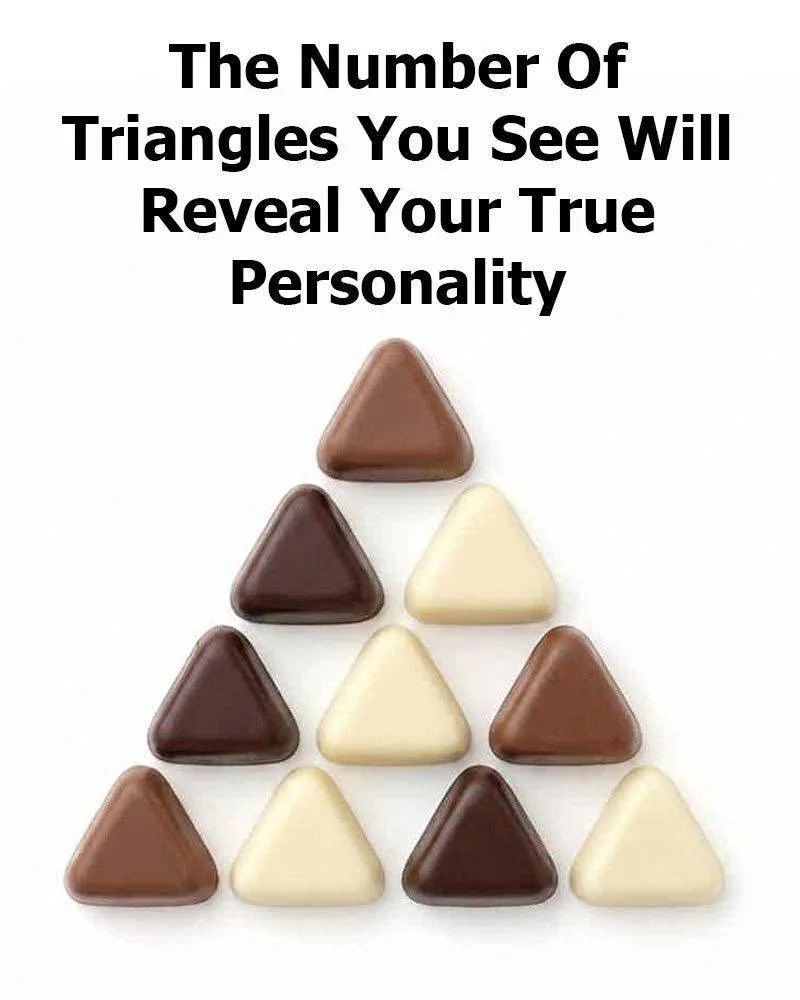
Try looking at the picture again.
You may notice that your eyes now behave differently because you already know what you’re looking for.
That’s another reason these puzzles are entertaining. Once your brain has learned to search for individual triangles, you may start seeing them more easily.
The same thing happens in everyday life.
A person who has never repaired a particular appliance may see “a machine.”
Someone experienced with that appliance may immediately notice the loose part, unusual sound, or damaged component.
What we notice isn’t determined by our eyes alone. Experience, attention, expectations, and context all play a role.


What Does Your Result Really Say About You?
Probably not as much as the headline suggests—and that’s okay.
If you saw only a few triangles, you may enjoy thinking about the big picture.
If you saw many, you may enjoy examining details.
If you landed somewhere in the middle, you may naturally shift between the two approaches.
But none of those answers makes one person “better” than another.
In real life, both perspectives are useful.
The big-picture thinker can see where things are going.
The detail-oriented thinker can notice what might go wrong along the way.
And the person who can switch between the two may have an especially useful skill: knowing when to zoom in and when to step back.
The Fun Part: Ask Someone Else
Now show the picture to a friend, spouse, sibling, or family member.
Don’t explain the categories first.
Just ask:
“How many triangles do you see?”
Write down their answer before showing them yours.
You may discover that two people looking at exactly the same image notice very different things.
And that’s probably the most interesting takeaway from the whole puzzle.
One Last Look
So, how many did you see?
1–3? Big-picture observer.
4–6? Balanced observer.
7–9? Detail-focused observer.
10? Systematic counter.
Just remember: these descriptions are meant for fun and self-reflection, not as a scientific personality assessment. The real value of the puzzle isn’t proving what kind of person you are. It’s making you stop for a moment and notice how you look at the world.