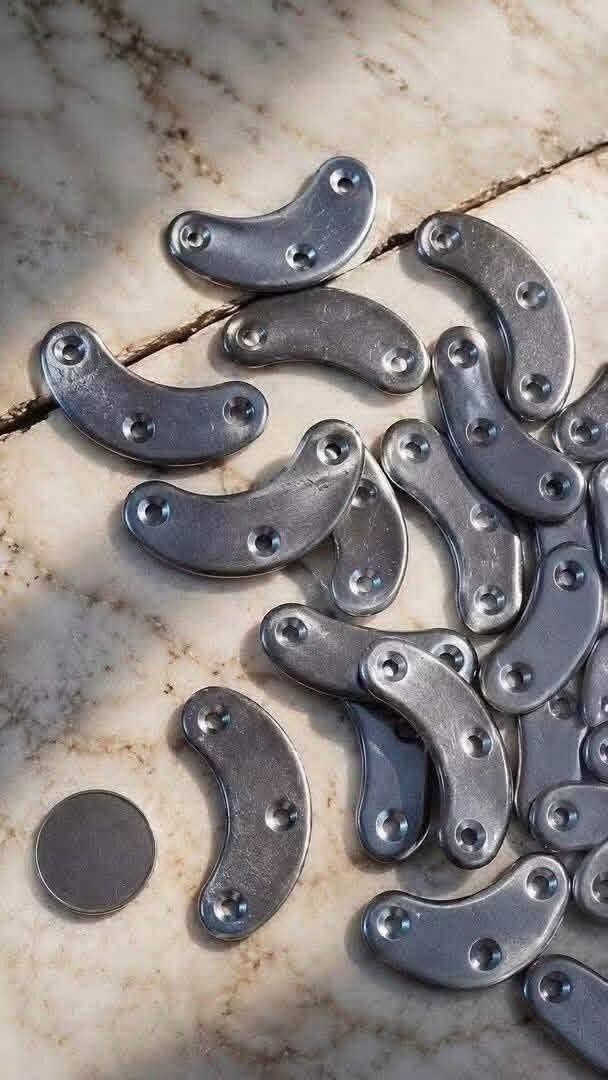
If you came across a handful of small, curved metal pieces like these, you might honestly wonder what you’re looking at.
They can resemble scraps from an old machine, pieces of hardware, or even tiny decorative brackets.
But their real purpose is much more ordinary: they were made to protect shoes and boots from wear.
These pieces are commonly known as heel plates, heel taps, or sole protectors. Some older versions were designed to be nailed or otherwise fastened directly onto the heel or sole of a shoe.
And once you understand what they were designed to do, their unusual shape suddenly makes a lot more sense.


What exactly are these little metal pieces?
A heel plate is a small piece of metal designed to cover an area of a shoe that receives a lot of wear.
The heel is one of the hardest-working parts of footwear. Every time you take a step, it repeatedly meets the ground, and over thousands of steps, that constant impact gradually wears away leather, rubber, or other sole materials.
Before modern synthetic soles became commonplace, replacing an entire shoe could be expensive.
So instead of throwing away a perfectly usable pair of boots or shoes, people could reinforce the areas that were wearing out.
A metal plate provided a durable surface that could take some of that punishment.
Historical patents from the late 19th and early 20th centuries specifically describe metal heel plates designed to reduce wear and extend the useful life of footwear.
Why are they curved?
This is probably the part that makes the objects look most mysterious.
The curved shape wasn’t simply decorative.
A heel plate needed to fit the shape of the heel rather than sitting awkwardly on a flat surface. Some designs wrapped around portions of the heel or were shaped to follow its contours.
An 1882 U.S. patent, for example, describes heel plates designed to pass around the sides of a shoe heel, with the edge positioned to help protect the part of the heel that contacts the ground.
The holes, prongs, or other fastening features also had a practical purpose.
They allowed the plate to be secured to the footwear with nails, screws, or specially designed fasteners.


They were basically an early form of shoe protection
Today, we take durable rubber soles and replaceable heel caps for granted.
Older footwear often didn’t have that luxury.
Leather soles could wear down surprisingly quickly, particularly when someone walked long distances or worked on hard surfaces every day.
A relatively small metal component could therefore make a significant difference.
The idea wasn’t to make the entire shoe out of metal. It was to put a tougher material exactly where wear was greatest.
Some historical manufacturers produced a variety of metal protectors for different parts of footwear, including heel plates, toe plates, studs, and other small pieces.
Blakey’s, for example, became well known for metal shoe and boot protectors, with products designed to take abrasion instead of the leather sole. The company’s history traces commercial metal heel and sole protectors back to the 19th century.
They weren’t only used on everyday shoes
Metal footwear protectors could be useful in situations where durability mattered.
Work boots are an obvious example.
Someone who spent long hours walking or standing on rough surfaces could wear through a heel much faster than someone who mostly walked indoors.
Military and parade footwear also used metal components.
Historical examples of military-style footwear show metal plates and fasteners used on soles and heels.
And there’s another use that many people recognize immediately: tap dancing.
Tap shoes deliberately use metal plates to create sound when the dancer strikes the floor. Historical patents even describe improvements to toe and heel plates specifically intended for dancing shoes.
So although these little pieces might look like obscure hardware today, they belong to a much larger history of footwear repair and reinforcement.


Why don’t we see them on most shoes anymore?
Modern footwear changed the equation.
Today’s shoes commonly use rubber, polyurethane, EVA foam, thermoplastic materials, and other synthetic compounds that can provide durability without requiring a piece of exposed metal.
Manufacturers can also design soles with different layers and replaceable sections.
That makes the old-fashioned metal plate much less necessary for everyday shoes.
There are still situations where metal toe taps or heel plates are used, particularly with certain leather-soled dress shoes, boots, costumes, dance shoes, historical reproductions, and specialty footwear.
But they’re no longer something most people encounter during an ordinary trip to the shoe store.
There’s a downside to exposed metal
Metal may be extremely durable, but it isn’t perfect for every walking surface.
One problem is traction.
A metal surface can be considerably more slippery than rubber, particularly on smooth surfaces.
It can also produce a distinctive clicking or scraping sound when it contacts hard flooring.
People who have used older metal heel plates have reported that the noise and slipperiness were among the reasons these fittings became less popular for ordinary footwear.
That’s one reason modern rubber heel pieces became so useful.
They can provide durability while also offering the grip people expect from everyday footwear.
Could these pieces actually be valuable?
Finding a pile of old heel plates doesn’t necessarily mean you’ve discovered something extremely valuable.
Their historical interest, however, can be genuine.
Older shoe hardware can help tell us how footwear was manufactured, repaired, and maintained before modern materials became widespread.
Some vintage pieces have distinctive shapes, markings, designs, or manufacturing characteristics that make them interesting to collectors of antique tools, footwear, military equipment, or historical artifacts.
For example, old advertisements and patents show that heel plates were commercially manufactured in different sizes and styles more than a century ago.
So a strange-looking little piece of metal that appears worthless at first glance can actually be a small reminder of how people once maintained expensive possessions instead of simply replacing them.


What about the pieces with unusual shapes?
Not every curved metal piece found around an old shoe necessarily has the exact same function.
Some were designed for heels.
Others were intended for the toe or front portion of the sole.
There were also studs, cleats, decorative fittings, and specialized protectors.
The shape can therefore provide clues, but identifying an individual piece with certainty may require looking at its dimensions, fastening holes, thickness, markings, and the type of footwear it came from.
That’s particularly important when dealing with antique objects.
A piece that looks like a heel plate could sometimes be another type of footwear hardware.
A simple idea that solved a real problem
What makes these little objects fascinating isn’t really the metal itself.
It’s the problem they solved.
Shoes are constantly exposed to friction, impact, moisture, dirt, and pressure. The areas that touch the ground naturally wear faster.
People hundreds of years ago had to deal with exactly the same basic problem.
Their solution was often simple: put a durable piece of material over the area that takes the most abuse.
Today, that might mean a rubber heel cap or a synthetic outsole.
In the past, it could mean a small piece of shaped metal.
And that explains why these strange curved pieces look the way they do.
They weren’t random pieces of scrap.
They were small, practical pieces of footwear technology designed to help a good pair of shoes last longer.
The next time you find one…
If you discover a handful of these in an old toolbox, workshop, attic, or garage, don’t immediately throw them away.
Take a closer look.
Check for markings, unusual patterns, fastening holes, or a shape that clearly follows the curve of a heel.
You may be holding an old shoe-repair component that was once attached to someone’s boots or shoes decades ago.
It’s a tiny object, but it represents an era when repairing and extending the life of everyday possessions was a normal part of life.
And once you know what you’re looking at, those mysterious little metal crescents aren’t so mysterious anymore.
They’re heel and sole protectors, made to take the wear so the shoe didn’t have to.