

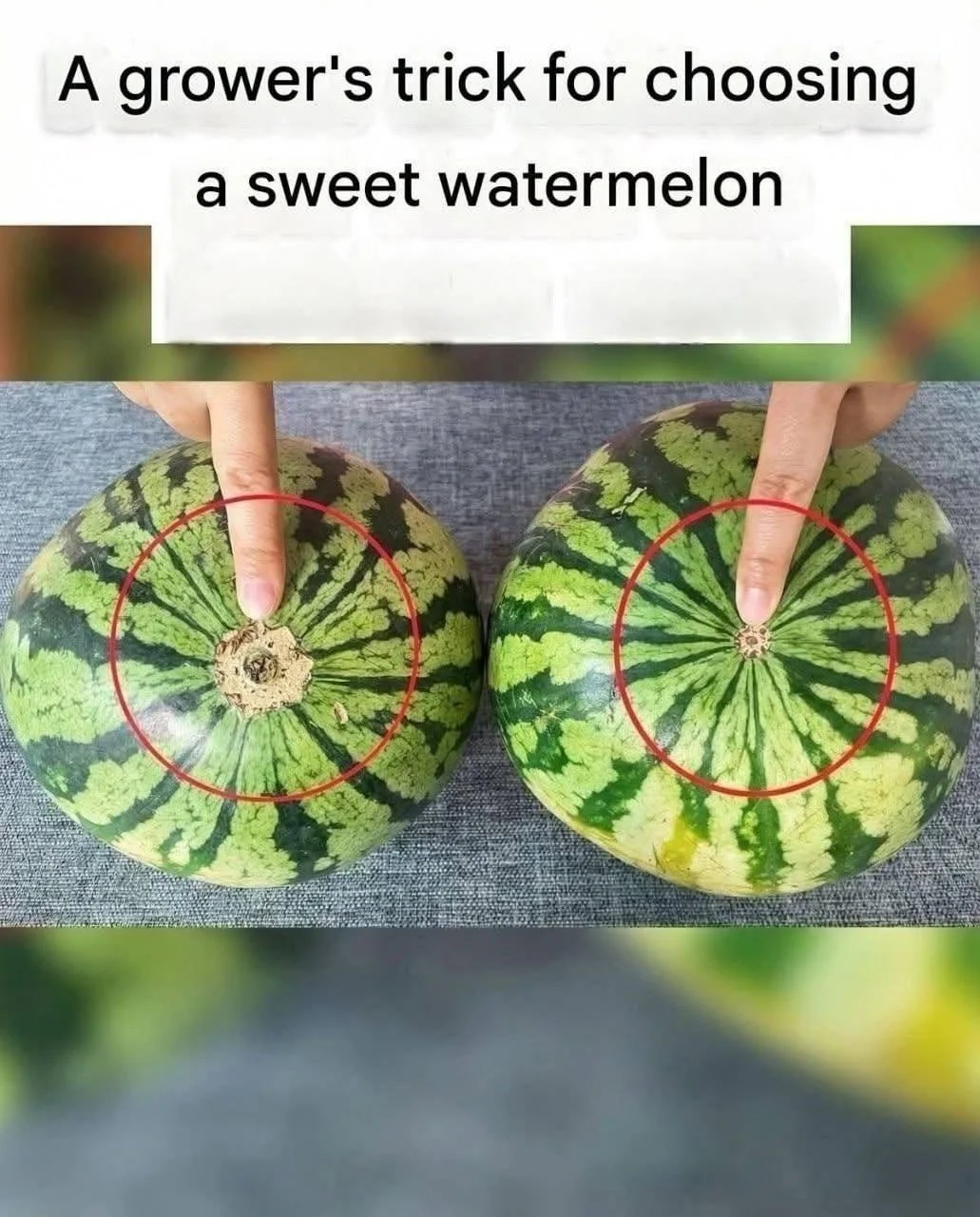
You don’t need to remember seven rules while standing in the produce aisle.
Try this instead.
Step 1: Find two or three similar-sized melons
Don’t compare a tiny personal-size melon with a giant watermelon.
Choose several that are roughly comparable.
Step 2: Check the field spot
Turn them over.
Look for a mature-looking yellow or creamy-yellow area rather than a very white or greenish-white patch.
Step 3: Compare the weight
Lift them.
Which one feels heavier for its size?
That’s the one I’d favor.
Step 4: Inspect the outside
Look for a firm, healthy watermelon without serious bruising, cracks, soft spots or decay.
Step 5: Check the stem or tendril if visible
A dry, brown tendril can provide another maturity clue.
Step 6: Tap it if you want
Use the sound as an additional clue—not a final verdict.
That entire process can take less than a minute.
Does a Watermelon Get Sweeter If You Leave It on the Counter?
This is one of the most important things to understand.
No—not in the normal ripening sense.
Watermelon is a non-climacteric fruit. It should reach maturity while still on the vine rather than being expected to become significantly sweeter after harvest.
That means putting an underripe watermelon on your kitchen counter for several days isn’t the same thing as letting a banana ripen.
The fruit may change in quality during storage, but it isn’t going to transform from bland to exceptionally sweet just because you waited.
That’s why the selection step matters so much.
What Actually Determines How Sweet a Watermelon Is?
There isn’t one mark on the rind that controls sweetness.
Several factors are involved, including:
- Variety
- Growing conditions
- Time spent developing on the vine
- Plant health
- Weather
- Water management
- Harvest maturity
Research from USDA has found relationships between external characteristics—including weight, ground-spot color and senescent tendrils—and internal maturity measures.
That’s also why no grocery-store trick can honestly promise you a perfectly sweet watermelon every time.
You’re stacking the odds in your favor.
Watermelon-Picking Myths That Aren’t Worth Obsessing Over
“More brown webbing means more sugar.”
Not reliably. Webbing can be part of normal fruit development, but it isn’t a dependable sugar test.
“The biggest watermelon is the sweetest.”
Not necessarily. Size alone doesn’t tell you how sweet the flesh will be.
“A perfectly round watermelon is always better.”
No. Shape depends partly on variety. A well-formed oval watermelon can be perfectly good.
“A shiny rind means the watermelon is definitely unripe.”
Not necessarily. Rind appearance varies by variety, so use it as one clue rather than a rule.
“The knock test tells you exactly how sweet it is.”
No. Sound can provide a maturity clue, but it doesn’t measure sugar content.
Your Simple Watermelon Shopping Checklist
Before you put one in your cart, remember:
✓ Yellow or creamy-yellow field spot
✓ Heavy for its size
✓ Firm, healthy exterior
✓ Reasonably well-formed shape
✓ No major bruises, cracks or soft spots
✓ Dry stem or nearby tendril when visible
✓ Knock test only as an extra clue
If you remember only three things, make them:
Yellow spot. Heavy melon. Healthy outside.
Those three checks are far more useful than trying to decode every little mark on the rind.
How to Store Your Watermelon at Home
An uncut watermelon can be kept in a cool, dry place for a period of time, although storage conditions affect quality. Once you cut it, refrigerate it promptly in a clean, covered container.
For the best quality, keep cut pieces chilled and avoid leaving them sitting out for long periods.
If you’re not planning to eat the whole melon soon, cutting only what you need can also help preserve the texture of the remaining fruit.
The Bottom Line
Picking a good watermelon doesn’t have to be a complete guessing game.
You can’t look at the outside and guarantee exactly how sweet the inside will be. But you can look for several signs that point toward better maturity and quality.
Start with the field spot.
Then compare the weight.
Check the condition of the rind and shape, and look for a dry tendril or stem when one is visible. Use the knock test as a bonus rather than treating it like a scientific measurement.
And remember the biggest takeaway:
A watermelon won’t become dramatically sweeter just because you leave it on the counter.
So the next time you’re standing in front of a pile of melons, don’t automatically grab the biggest or prettiest one.
Turn it over.
Feel its weight.
Inspect it for damage.
Give the best candidates a quick comparison.
Those extra 30 seconds may save you from bringing home the watermelon you were hoping would be sweet—only to discover that it never had much sweetness to begin with.