

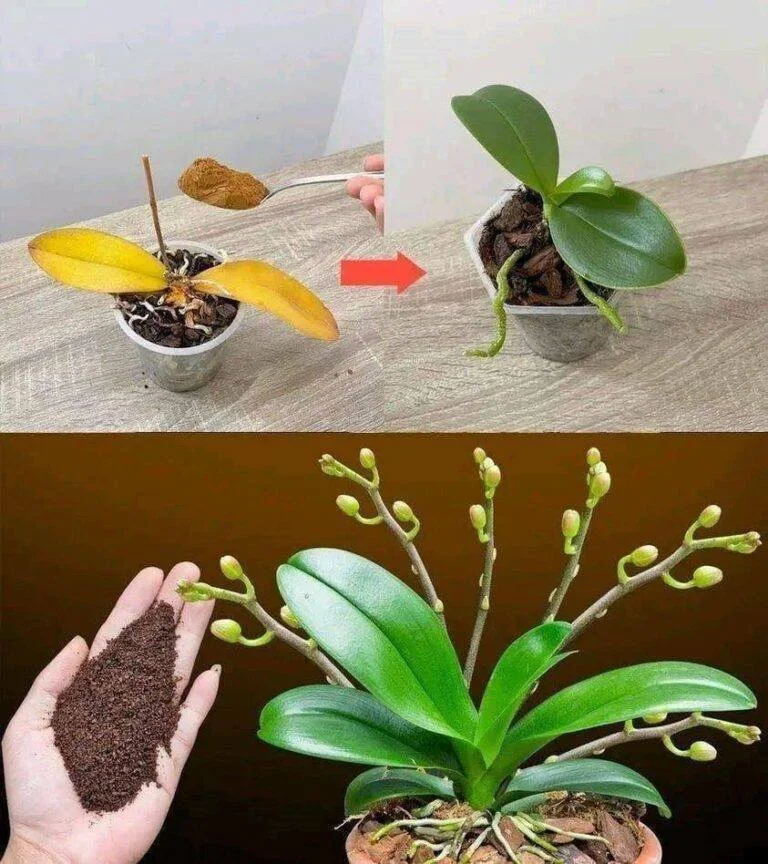
Your orchid has beautiful leaves, healthy roots, and plenty of space—but somehow, those flowers just won’t come back. Then you hear a surprisingly simple tip: use just a teaspoon of diluted coffee. Could something sitting in your kitchen really make a difference?
The idea comes from a popular home-gardening trick: giving an orchid a very small amount of diluted coffee as an occasional alternative to its normal watering routine.
But before you reach for your coffee cup, there’s an important detail to understand. Coffee isn’t a magic flowering switch, and the biggest factors behind successful orchid blooming are still light, proper watering, temperature, growing medium, and appropriate fertilizer. The American Orchid Society specifically emphasizes balancing these conditions for healthy growth and flowering.
The coffee trick is interesting—but it should be treated as an experiment, not a guaranteed miracle.
First, Make Sure Your Orchid Has What It Needs
Before trying any homemade fertilizer idea, look at the basics.
Bright, indirect light
Orchids need sufficient light to produce the energy required for growth and flowering. Too little light is one reason an otherwise healthy orchid may refuse to bloom.
Place it somewhere bright, but avoid harsh direct sunlight that can scorch the leaves.
Don’t keep the roots constantly wet
Overwatering is one of the most common ways orchids get into trouble. The growing medium needs time to dry appropriately between waterings, and poor drainage can lead to root loss.
Give it appropriate humidity and airflow
Orchids generally appreciate humidity, but humidity doesn’t mean stagnant, permanently wet conditions. Air movement and proper drainage are also part of good orchid culture.
Don’t forget fertilizer
Orchids can survive for surprisingly long periods with little fertilizer, but proper feeding can support healthy roots, foliage, and flowers. The American Orchid Society recommends using an appropriate orchid fertilizer rather than relying on improvised feeding alone.


So Where Does the Coffee Trick Come From?
This is the part that makes the idea so tempting.
The original article proposes using about one teaspoon of diluted coffee per cup of water, then using the mixture occasionally in place of normal watering.
The reasoning behind the trick is that coffee contains nutrients, including nitrogen, and that its acidity might suit plants that prefer a somewhat acidic environment.
There is, however, a catch.
You shouldn’t assume that coffee automatically improves an orchid’s growing medium just because coffee is acidic.
In fact, recent gardening guidance notes that the acidity of brewed coffee isn’t a reliable reason to use it as an orchid fertilizer, and coffee products can create problems when used incorrectly—particularly with epiphytic orchids such as Phalaenopsis.
So the honest takeaway is simple:
Coffee is an interesting home experiment, but it isn’t a scientifically established shortcut to abundant orchid flowers.
If You Still Want to Try It, Keep It Very Dilute
If you’re determined to test the method described in the source, don’t pour a cup of strong coffee directly onto your orchid.
The source’s suggested approach is:
- Prepare ordinary coffee.
- Allow it to cool completely.
- Dilute it heavily.
- Use approximately 1 teaspoon of coffee per cup of water.
- Apply it only occasionally rather than repeatedly.
- Watch the orchid closely for any negative reaction.
And most importantly, don’t replace a proper orchid-feeding program with coffee.
A balanced orchid fertilizer is designed to provide known amounts of nutrients. Coffee doesn’t give you that same control. The American Orchid Society explains that orchids need a range of macro- and micronutrients, not simply one source of nitrogen.


What About Coffee Grounds?
This is where things get even more confusing.
Don’t confuse diluted brewed coffee with dumping used coffee grounds into an orchid pot.
Orchids such as the common Phalaenopsis are typically grown in airy, chunky media rather than ordinary garden soil. Coffee grounds can interfere with drainage and create conditions that encourage moisture problems, mold, or root problems if used improperly.
So if you’re experimenting with the coffee idea, the source is talking about diluted liquid coffee—not covering the roots with coffee grounds.
The Real Secret to Getting More Orchid Flowers
If your orchid isn’t blooming, coffee may not be the problem—or the solution.
Start by asking yourself a few questions.
Is it getting enough light?
If the leaves are very dark green and the plant isn’t flowering, insufficient light may be contributing to the problem.
Are you watering too frequently?
Constantly wet roots can eventually lead to root loss, making it difficult for the plant to remain healthy enough to flower.
Does the potting medium drain properly?
Orchids need an environment that provides both moisture and air around their roots.
Are you using a proper fertilizer?
A suitable orchid fertilizer gives you much more predictable nutrition than homemade coffee mixtures.