

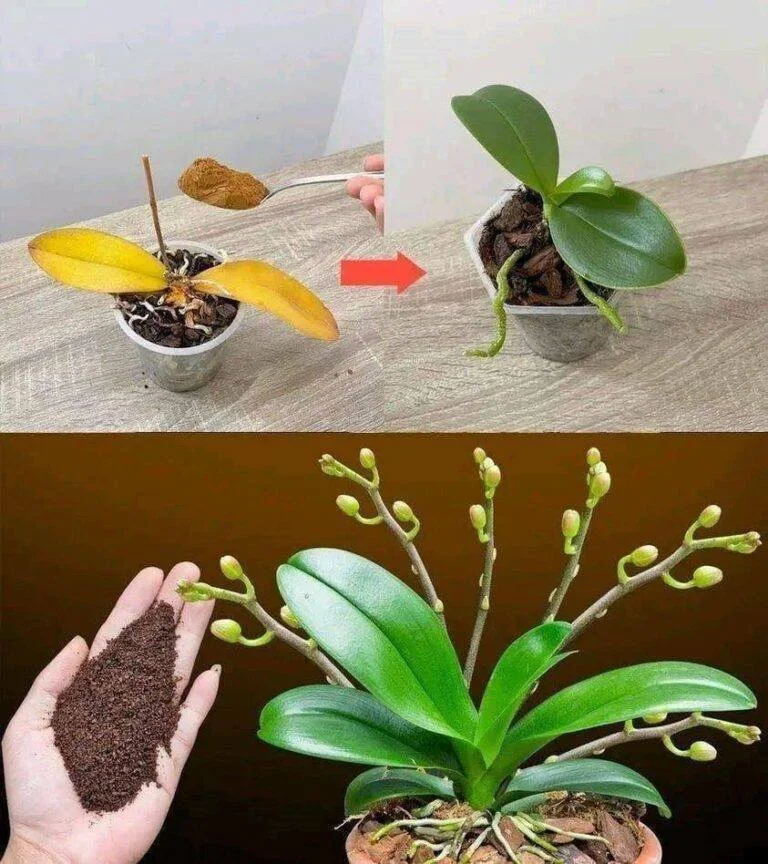
That’s the part I’d be careful with.
The source presents the teaspoon of diluted coffee as a surprising way to encourage flowering.
But there isn’t enough evidence to promise that one teaspoon will suddenly produce lots of flowers.
Orchid flowering depends on several interacting conditions, and different orchid species and hybrids can have different requirements.
That’s why the better approach is to see coffee as an optional experiment, not the foundation of your orchid-care routine.
If your orchid is already receiving suitable light, correct watering, appropriate humidity, good airflow, and proper nutrition, you’re giving it the conditions it needs to grow and flower.
A Better Way to Think About This Trick
There’s nothing wrong with being curious about old-fashioned gardening experiments.
In fact, that’s part of what makes them fun.
But there’s a big difference between saying:
“Some gardeners use diluted coffee and report good results.”
and saying:
“One teaspoon of coffee will make your orchid bloom.”
The first is a reasonable gardening experiment.
The second is a promise we can’t honestly make.
And your orchid deserves the first approach.
Final Thoughts
The one-teaspoon coffee trick is certainly intriguing, especially if your orchid has healthy leaves but hasn’t produced flowers for a while.
If you want to experiment, keep the coffee heavily diluted, use it sparingly, and watch the plant carefully.
But don’t overlook the things that matter much more: bright indirect light, sensible watering, good drainage, appropriate humidity, airflow, and orchid-specific nutrition. These fundamentals are consistently emphasized by established orchid-care guidance.
So, will one teaspoon suddenly cover your orchid with flowers?
Maybe not.
But if your orchid has been stubbornly refusing to bloom, checking its basic growing conditions may reveal something far more useful than a kitchen trick ever could.