

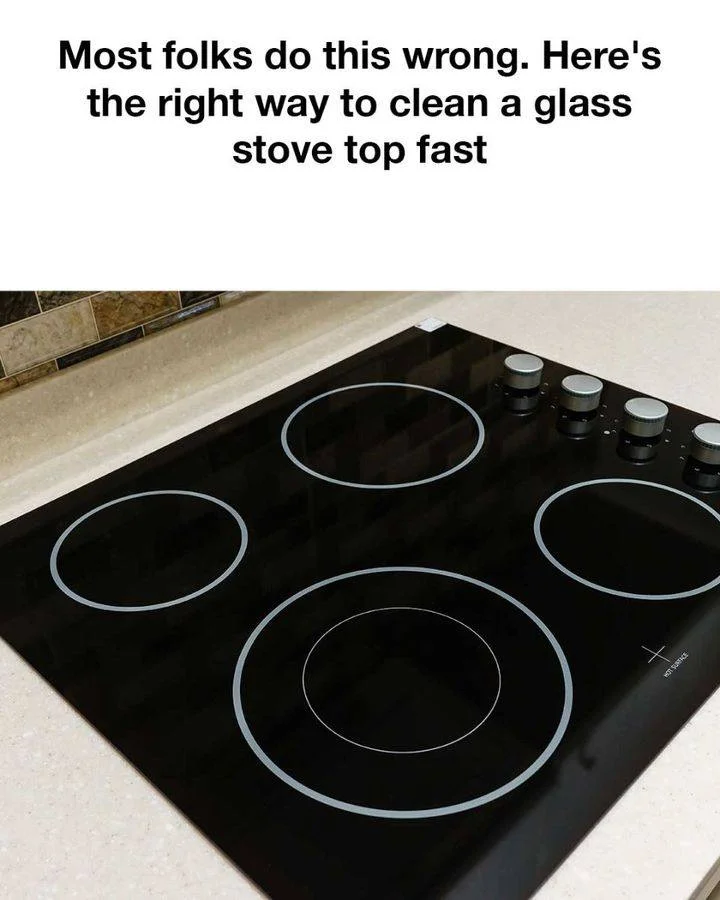
That shiny glass stovetop may look easy to clean, but one wrong move can leave behind scratches, cloudy marks, or stubborn residue that becomes even harder to remove.
And if you’ve been attacking burnt-on food with a rough sponge or cleaning the surface while it’s still hot, you may be making the job harder than it needs to be.
The good news? A glass stovetop usually needs less scrubbing, not more.


4 Common Mistakes That Make Glass Stovetops Harder to Clean
1. Using Rough Scrubbers
Steel wool, abrasive pads and harsh powdered cleaners can scratch some glass-ceramic cooktop surfaces.
Once scratches appear, the surface can become more difficult to keep looking clean.
Instead, start with a soft microfiber cloth or a cooktop-safe non-abrasive pad.
For stubborn cooked-on residue, check your appliance manufacturer’s instructions before using a scraper or specialized cooktop cleaner.
2. Cleaning While the Cooktop Is Still Hot
This is one of the easiest mistakes to avoid.
A hot surface can burn you, and applying cleaning products to a hot cooktop may cause them to dry or behave differently than intended.
Let the surface cool before beginning your normal cleaning routine.
There is one important exception: some manufacturers provide specific instructions for removing certain spills while the surface is still warm. Your appliance manual should take priority over generic cleaning advice.


3. Using Too Much Cleaner
More product doesn’t automatically mean a cleaner stovetop.
Excess cleaner can leave a film behind, creating the exact cloudy appearance you’re trying to eliminate.
A small amount of an appropriate cooktop cleaner—or a lightly dampened cloth for everyday spills—is often enough.
4. Waiting Until the Mess Becomes Burnt-On
A small splash is much easier to wipe away once the cooktop has cooled.
Leave it there through several cooking sessions, however, and it can turn into a hardened layer that requires considerably more effort.
A quick wipe after cooking can save you from a much bigger cleaning job later.
A Simple Way to Deal With Everyday Grease and Spills
You don’t necessarily need a complicated homemade mixture.
Start with the simplest approach:
- Turn off the cooktop and allow it to cool according to the manufacturer’s instructions.
- Remove loose crumbs and debris with a soft cloth.
- Wipe the surface with a damp microfiber cloth.
- For greasy or stubborn residue, use a cleaner specifically labeled as suitable for glass or ceramic cooktops.
- Wipe away the cleaner according to its instructions.
- Finish with a clean, dry microfiber cloth.


What About Baking Soda and Vinegar?
This is where a lot of online cleaning advice becomes misleading.
Baking soda and vinegar are both popular household cleaning ingredients, but mixing them together doesn’t create a magical super-cleaner.
When acidic vinegar reacts with alkaline baking soda, they largely neutralize each other and produce carbon dioxide, water and a salt solution.
The fizz may look impressive, but the bubbles themselves aren’t what makes burnt food disappear.
For a glass cooktop, it’s generally better to use a method recommended by the manufacturer rather than assuming every homemade combination is safe for the particular surface.
If you want to use baking soda, don’t automatically assume that rubbing it aggressively across the glass is harmless. Even a relatively mild abrasive can potentially leave marks depending on the surface and how much pressure is used.
When a Scraper Can Help
Stubborn, cooked-on residue may require more than a cloth.
Some glass-ceramic cooktop manufacturers recommend a cooktop scraper designed for the surface. If your appliance manual permits one, use it exactly as directed.
The technique matters.
Don’t attack the residue with force. Keep the scraper controlled and follow the manufacturer’s recommended angle and method.
And never substitute a random sharp object for a proper cooktop scraper.


What You Should Avoid
To protect the surface, be cautious with:
- Steel wool
- Abrasive scouring pads
- Harsh powdered cleaners
- Dragging heavy cookware across the glass
- Using excessive force while scrubbing
- Cleaning with products not approved for your cooktop
- Pouring large amounts of liquid around controls or openings
And don’t assume that a method that works on stainless steel or another type of stovetop is automatically appropriate for glass.
The Easiest Routine Is Also the Most Consistent
You don’t need to wait for the cooktop to become visibly filthy.
After cooking:
Cool → wipe → clean stubborn spots → dry.
That small routine can prevent grease and food residue from accumulating and becoming much harder to remove.
For regular maintenance, follow the cleaning products and techniques recommended in your appliance’s manual.
One More Important Detail: Not All Glass Cooktops Are Identical
“Glass stovetop” is often used as a general term, but different appliances can have different surface materials, coatings and manufacturer instructions.
That’s why a cleaning trick that works beautifully for one model may not be recommended for another.
Before using vinegar, baking soda, a scraper or any specialty cleaner, check the manufacturer’s care instructions.
This is especially important if the cooktop has a damaged, cracked or chipped surface.
The Bottom Line
A sparkling glass stovetop doesn’t require aggressive scrubbing.
The biggest difference usually comes from using the right tool, waiting until the surface is safe to clean, removing spills before they become baked-on residue, and following the manufacturer’s instructions for stubborn stains.
And if you were planning to cover the entire cooktop with baking soda and vinegar because of that satisfying fizz, there’s no need to rely on the reaction.
For glass cooktops, simple and surface-safe usually beats dramatic.