

For years, your aloe vera may sit quietly on a windowsill, producing one thick green leaf after another. Then, almost out of nowhere, a tall stalk begins rising from the center.
And suddenly, there are flowers.
If you’ve never seen it happen before, it can feel almost mysterious. Is the plant stressed? Is it dying? Does flowering mean you’re doing something right?
The answer is much simpler—and more interesting.
When an aloe vera flowers, it is entering its reproductive stage. Flowering usually means the plant has reached maturity and has experienced environmental conditions that are favorable for reproduction.


What Does a Flowering Aloe Vera Look Like?
The first thing you may notice isn’t actually a flower.
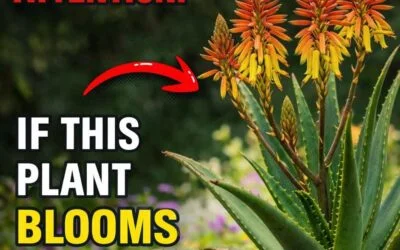
A tall stalk begins pushing upward from the center of the aloe’s rosette. As it grows, clusters of small tubular flowers develop near the top.
True Aloe vera typically produces yellow flowers, although other aloe species and hybrids can have orange, red, coral, or other colors.
The flowers don’t all open at once. They generally open progressively along the flower cluster, which allows the plant to remain in bloom for a period rather than displaying everything simultaneously.
For a plant that spends most of its time looking like a compact succulent, the transformation can be surprisingly dramatic.
Why Does Aloe Vera Flower?
The simplest explanation is that the plant is mature enough and its environment is giving it the signals it needs to reproduce.
Aloe vera doesn’t flower simply because you watered it on a particular day or added a certain fertilizer.
Flowering is influenced by several factors, including:
- The plant’s maturity
- Strong light
- Seasonal changes
- Temperature
- Water availability
- The plant’s overall growing conditions
A mature plant growing outdoors in a suitable climate has a much better chance of flowering than an aloe kept indoors under relatively low light.
Age Matters More Than You Might Think
Young aloe plants usually concentrate their energy on growing leaves and establishing themselves.
Flowering requires the plant to invest resources in reproduction, so a small, immature aloe isn’t necessarily going to produce a flower stalk simply because it receives plenty of sunlight.
Sources on aloe cultivation commonly place flowering maturity at around four years or more, although the exact timing can vary with growing conditions and the particular plant.
So if your young aloe has never flowered, there’s probably nothing wrong with it.
It may simply not be ready.


Why Indoor Aloe Vera Plants Rarely Bloom
This is where many aloe owners become frustrated.
Your plant may look healthy, yet years can pass without a single flower.
One major reason is light.
An aloe sitting beside a bright window may look perfectly healthy to your eyes, but indoor light can still be considerably weaker than the intense sunlight available outdoors.
Aloe vera generally needs plenty of strong light to thrive and build the energy needed for flowering.
Temperature and seasonal changes can matter too.
Outdoor plants experience natural shifts between warmer and cooler periods. An indoor plant living in a heated room at roughly the same temperature throughout the year doesn’t receive exactly the same seasonal signals.
That doesn’t mean every indoor aloe needs to be exposed to cold temperatures. In fact, exposing aloe to frost or freezing conditions can damage it.
The goal is to provide bright light and appropriate temperatures, not to deliberately stress the plant.
Does Flowering Mean Your Aloe Vera Is Dying?
No.
This is one of the most common misconceptions about flowering succulents.
Some plants are monocarpic, meaning they flower once and then die. But aloe vera isn’t generally one of them.
A healthy aloe can survive flowering and continue growing afterward.
So if you suddenly see a tall flower stalk emerging from your aloe, you don’t need to panic.
Your plant isn’t necessarily saying goodbye.
It’s reproducing.
Can You Make Aloe Vera Bloom?
You can’t guarantee that an aloe will flower on command.
But you can give it conditions that support healthy growth and make flowering more likely.
Give It Plenty of Light
Place your aloe in the brightest suitable location available.
If you’re moving a plant that has been indoors into stronger direct sunlight, do it gradually. A sudden change can cause sun damage to leaves that aren’t accustomed to intense light.
Don’t Keep the Soil Constantly Wet
Aloe vera is a succulent and stores water in its leaves.
It generally does better when its soil is allowed to dry between waterings than when it remains continuously wet.
Good drainage is especially important.
A pot without adequate drainage can allow water to remain around the roots, creating conditions that are unfavorable for a succulent.
Give It Time
This might be the most important tip.
A healthy young aloe doesn’t need to flower to prove that you’re taking good care of it.
Some plants simply aren’t mature enough yet.
Others may live indoors for years without receiving the combination of light and seasonal conditions that encourages flowering.
What Should You Do When the Flowers Appear?
Mostly, enjoy them.
You don’t need to remove the flower stalk simply because it has appeared.
Letting the plant bloom allows you to enjoy the flowers and gives pollinators an opportunity to visit if your aloe is outdoors.
Once flowering has completely finished and the stalk begins to dry, you can remove the spent stalk with clean, sharp tools if you want to keep the plant looking tidy.
There is no need to cut the stalk while the flowers are still fresh unless you have a particular reason for doing so.
What About Aloe Vera Flower “Meanings”?
You’ll find plenty of claims online saying that an aloe vera bloom represents good luck, protection, positive energy, prosperity, or a special message for the home.
Those beliefs can certainly be interesting as cultural or symbolic traditions.
But they shouldn’t be presented as scientific facts.
From a botanical perspective, the explanation is straightforward: the plant has reached a reproductive stage under conditions that support flowering.
If you personally like the symbolism, there’s nothing wrong with enjoying it.
Just keep the distinction clear between tradition and biology.


Why Your Aloe May Never Flower
If you’ve owned an aloe for years and haven’t seen a flower, don’t automatically assume you’re doing something wrong.
Possible reasons include:
It isn’t mature enough.
Young plants may need several years before they’re capable of flowering.
It doesn’t receive enough strong light.
This is particularly common with indoor plants.
Its environment doesn’t provide much seasonal variation.
Constant indoor conditions can differ significantly from the seasonal cues experienced by outdoor plants.
Its growing conditions aren’t ideal.
Poor drainage, inappropriate watering, or generally weak growth can prevent a plant from having the resources needed for reproduction.
And sometimes, there simply isn’t a guarantee.
Aloe vera flowering depends on a combination of conditions rather than one secret trick.
A Flowering Aloe Is a Special Sight—but Not a Requirement
Seeing an aloe vera flower for the first time can be exciting because most people are familiar with its leaves, not its flowers.
But don’t fall into the trap of thinking that an aloe without flowers is unhealthy.
Aloe vera can be perfectly healthy without ever producing a flower stalk in your home.
Flowering is one part of the plant’s life cycle, not a scorecard for how good a plant owner you are.
Final Thoughts
When an aloe vera suddenly sends a tall stalk toward the sky, there isn’t necessarily anything mysterious or worrying happening.
It’s a mature plant responding to its environment and entering reproduction.
Give it strong, appropriate light, well-draining soil, sensible watering, and time. If the conditions line up, you may eventually get to see those unusual tubular flowers for yourself.
And if your aloe never blooms?
That’s okay too.
A healthy aloe is still a healthy aloe—even without the flowers.