

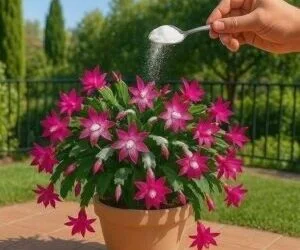
Your plant can look wonderfully healthy green leaves, strong stems, plenty of new growth and still refuse to produce a single flower. Before reaching for another fertilizer, it helps to ask a more important question: is the plant actually getting what it needs to bloom?
Flowering can be affected by several factors, including light, watering, pruning, and soil nutrition. Bone meal and vegetable charcoal are two natural soil amendments often recommended by gardeners, but they don’t do the same job—and neither one is a magic “bloom booster.”


Why a Healthy Plant May Still Not Flower
Lots of leaves don’t necessarily mean lots of flowers.
A plant may fail to bloom because it isn’t receiving enough sunlight, is being overwatered or underwatered, has been pruned at the wrong time, or is growing in soil where an important nutrient is lacking. The original article also points to nutrition as one possible reason flowering plants produce foliage without developing many buds.
That is why adding fertilizer blindly isn’t always the best first step.
If the real problem is insufficient light, for example, adding more phosphorus won’t magically turn the plant into a heavy bloomer.
Bone Meal: A Slow Source of Phosphorus
Bone meal is made from finely ground animal bones and is commonly used as an organic fertilizer.
Its main nutritional value is phosphorus, along with calcium and smaller amounts of other nutrients depending on the product. Phosphorus is important for plant development and is involved in processes connected with root growth and reproduction.
That makes bone meal potentially useful when a soil test or other reliable information indicates that phosphorus is actually lacking.
But there’s an important misconception worth clearing up: more phosphorus does not automatically mean more flowers.
If your soil already contains sufficient phosphorus, adding extra may provide little benefit. The University of New Hampshire Extension specifically notes that many garden soils already contain adequate phosphorus and recommends soil testing before adding more.


Bone Meal Isn’t an Instant Fix
Another reason not to expect overnight results is that bone meal is generally a slow-release amendment.
It needs time to break down and become available to plants. Its effectiveness can also depend on soil conditions, including pH. The original source notes that bone meal is better suited to slightly acidic to neutral conditions and is less effective in alkaline soils.
So if your plant is already struggling to bloom, sprinkling bone meal around it today isn’t likely to produce flowers tomorrow.
Think of it as a long-term soil amendment, not an emergency flowering treatment.
What Vegetable Charcoal Actually Does
Vegetable charcoal is often discussed alongside bone meal, but its role is quite different.
When gardeners use charcoal-like material as a soil amendment, they’re generally talking about biochar—a carbon-rich material produced by heating plant material under limited oxygen.
Biochar is not primarily a fertilizer. Its porous structure can help soil retain water and nutrients, improve aeration, and provide habitat for microorganisms.
That means its potential benefit is mostly about improving the growing environment around the roots, rather than directly forcing flowers to appear.


Charcoal Isn’t the Same as Fertilizer
This distinction is important.
Biochar can help retain nutrients, but it doesn’t automatically provide everything a plant needs. The University of Florida Extension describes biochar as a soil amendment rather than a fertilizer and notes that it often works best when combined with compost or fertilizer that supplies nutrients.
The Royal Horticultural Society similarly explains that ordinary biochar has minimal direct nutritional value and should not be treated as a replacement for fertilizer.
So adding charcoal to poor soil without addressing an actual nutrient deficiency may not solve a flowering problem.
Can You Use Bone Meal and Biochar Together?
Potentially, yes—but the combination shouldn’t be treated as a guaranteed flowering formula.
Bone meal can supply phosphorus, while biochar can influence the soil’s ability to retain water and nutrients. In some situations, combining a nutrient source with a soil amendment can make sense.
Biochar can also be “charged” or enriched with nutrients before being incorporated into soil. Extension guidance notes that nutrient-enriched biochar can be useful, particularly when soil conditions call for it.
But the right combination depends on the plant and the existing soil.
Don’t Forget the Basics
Before experimenting with amendments, check the things that are much more fundamental to flowering.
Give the Plant Appropriate Light
Many flowering plants need sufficient light to produce flowers. If your plant is sitting in a very dark location, improving its light conditions may be more useful than adding another soil amendment.
Check Your Watering
Both excessive and insufficient watering can stress plants.
Don’t assume that a plant that isn’t flowering needs more water. Check the soil and follow the watering requirements for the particular species.
Consider the Soil
A soil test can tell you much more than guessing based on leaf color or the number of flowers.
If phosphorus is already abundant, adding more bone meal may be unnecessary.
Think About the Plant’s Natural Cycle
Some plants flower at particular times of year or only after reaching a certain stage of growth. Fertilizing more aggressively won’t necessarily override those natural requirements.
A Safer Way to Try These Amendments
If you want to experiment with bone meal or biochar, start with the product’s label instructions rather than copying a universal homemade measurement.
For bone meal, avoid assuming that more is better. Excess nutrients can create imbalances, and phosphorus can accumulate in soil. A soil test is especially useful when you’re considering adding a phosphorus-rich product.
For biochar, use material intended for soil amendment rather than random charcoal from an unknown source. Biochar properties vary depending on what material it was made from and how it was produced, and its effect on soil pH can vary as well.
One Important Warning About “Charcoal”
Not every black piece of charcoal belongs in your garden.
Don’t assume that charcoal briquettes, ash, treated wood products, or barbecue charcoal are interchangeable with horticultural biochar. Garden amendments should be made specifically for soil use and should come from a known, appropriate source.
The goal is to improve the root environment—not introduce unwanted substances into it.
The Real Bloom-Boosting Strategy
If your plant has beautiful foliage but refuses to flower, don’t immediately assume it needs more fertilizer.
Start with the basics:
- Check its light requirements.
- Make sure watering is appropriate.
- Look at drainage and root health.
- Consider whether pruning may have affected flowering.
- Test the soil if nutrient deficiency is suspected.
- Use fertilizer only when the plant actually needs it.
- Treat bone meal as a slow nutrient source, not an instant bloom stimulant.
- Treat biochar as a soil amendment, not a replacement for fertilizer.


The Bottom Line
Bone meal and vegetable charcoal can both have a place in gardening, but they solve different problems.
Bone meal can provide phosphorus, which is important for plant growth and reproduction, particularly when the soil is deficient. Biochar can improve aspects of soil structure and nutrient or moisture retention, but it has little direct nutritional value on its own.
So if your plant isn’t flowering, don’t chase a miracle recipe.
Healthy blooms usually come from getting the fundamentals right first—and using soil amendments to correct a real need rather than simply adding more of everything.