
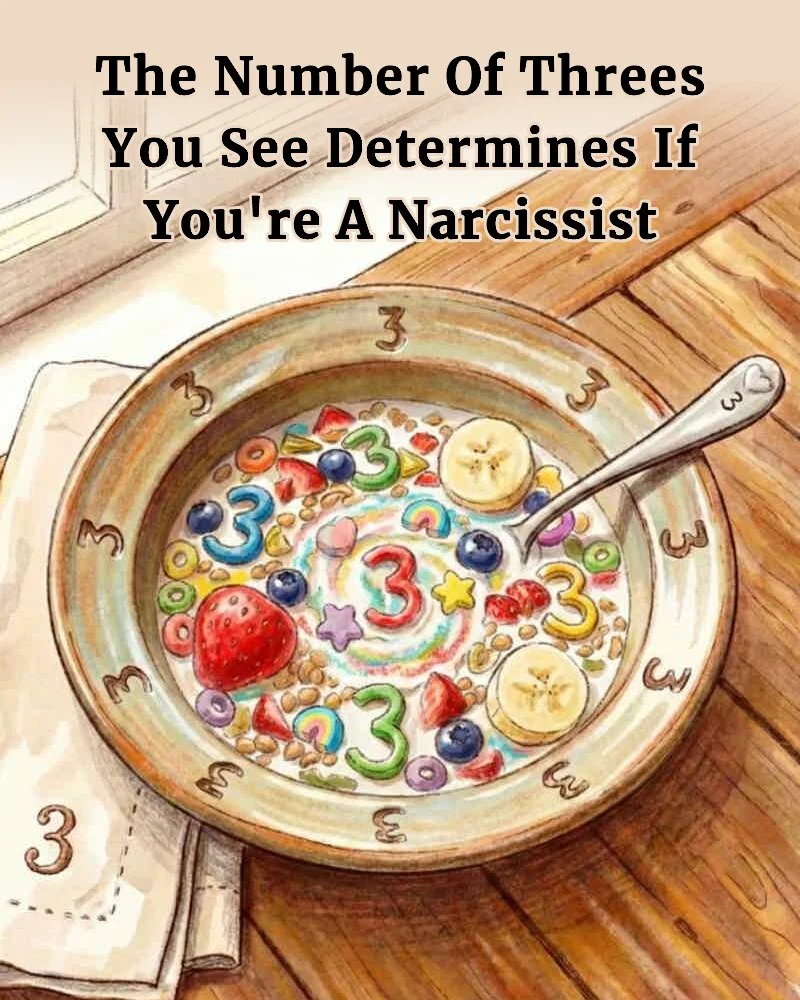
Stop scrolling for a second and look at the picture above. Don’t count too quickly.
How many number 3s can you find?
Most people notice the obvious ones first. Then, once they slow down, they begin spotting numbers hidden around the bowl, inside the cereal, near the spoon, and in places they didn’t notice at first.
But here’s the interesting part: the number of threes you see cannot actually prove that you’re a narcissist. This kind of picture is better understood as a visual-attention puzzle than a psychological test.
So before you read the explanations below, take another look and make your own guess.
Why Your First Answer Can Be So Different From Someone Else’s
When you look at a busy image, your brain doesn’t examine every tiny detail one by one.
Instead, it quickly searches for patterns, familiar shapes, colors, and objects that seem important.
That’s why one person might immediately notice the large 3 in the cereal bowl while another person may focus on the numbers around the plate.
Neither person is necessarily “better” at seeing.
They’re simply directing their attention differently.
And that’s what makes these puzzles surprisingly addictive.
Did You Count Only the Obvious Threes?
Look carefully at the entire image.
Don’t just count the large numbers inside the bowl.
Check:
- Around the edge of the plate
- Near the spoon
- Inside the cereal
- Around the fruit
- On the paper beneath the bowl
- Between other objects
- Along the outer areas of the picture
Some numbers are deliberately placed where your eyes are less likely to search.
That means your first count may not be your final count.
What If You Saw Only a Few?
If you noticed just a handful of threes immediately, it doesn’t mean you’re self-centered or narcissistic.
It may simply mean that your attention was drawn toward the most prominent elements of the picture.
Your brain naturally filters information.
If an object doesn’t seem important, your attention may ignore it—even when it’s sitting right in front of you.
That’s one reason visual puzzles can fool people so easily.


What If You Found Almost All of Them?
Now that’s interesting too—but don’t jump to a personality diagnosis.
Finding many hidden threes could simply mean that you spent more time scanning the image.
You may also naturally enjoy puzzles that require careful observation.
The important difference is this:
Being highly observant is not the same thing as being narcissistic.
Narcissism is a much more complex psychological concept than the result of a picture puzzle.
Why These “Personality Tests” Feel So Accurate
There’s a reason these social-media puzzles get people talking.
They give you a very simple choice:
“I saw X number of objects, so this must mean I have X personality trait.”
That feels satisfying because humans love explanations that connect a small action to something bigger about ourselves.
But real personality assessment doesn’t work that way.
Psychologists use much more comprehensive methods to understand traits and behavior.
A single visual puzzle can’t tell you whether you’re narcissistic, introverted, generous, anxious, intelligent, or anything else with certainty.
The Fun Part Is Still Worth Trying
Even though the picture isn’t a scientific narcissism test, there’s no reason you can’t enjoy it.
In fact, try this with someone else.
Show them the image without explaining anything.
Ask:
“How many threes do you see?”
Write down both answers.
Then look at the picture together and see which ones each person missed.
You might be surprised by how differently two people can look at exactly the same image.


So, How Many Did You See?
Before checking anyone else’s answer, go back to the picture one more time.
Start at the center.
Move outward.
Check the bowl.
Check the plate.
Check the spoon.
Then scan the background.
Did you find a few more?
That’s the trick: once someone tells you that there are hidden threes, your brain suddenly starts looking for them.
And once you know what you’re searching for, things that were practically invisible a moment ago can become obvious.
The Real Takeaway
The number of threes you see doesn’t determine whether you’re a narcissist.
But the puzzle does demonstrate something genuinely interesting about human vision: what we notice depends heavily on where our attention goes.
So if you found 5, 10, 15, or even more, don’t worry about what that supposedly says about your personality.
Instead, ask yourself a more interesting question:
What did your eyes notice first—and what did they completely miss?
That’s where the real puzzle begins.