

You probably don’t think much about the position you end up in when you fall asleep. You simply get comfortable, close your eyes, and let your body settle into whatever feels natural.
But what if that familiar position could tell you something about your habits, comfort preferences, or even the way you approach your day? Before you decide that your favorite sleeping position has nothing to do with you, take a look at the position you naturally return to night after night.


There is an important catch, though. Viral graphics often claim that a particular sleeping position proves you are lazy, confident, anxious, independent, or some other type of person. Science doesn’t support personality conclusions that neatly. Research does suggest relationships between sleep patterns and personality traits, but the evidence is much weaker when it comes to assigning a personality type to a specific sleeping position.
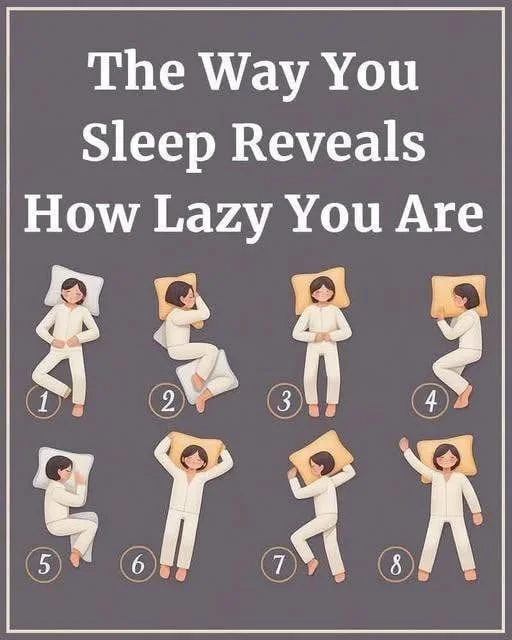
So rather than treating this as a personality test, let’s look at the eight positions in the picture as a fun way to think about comfort, habits, and what your sleeping routine might say about you.
First, Find Your Usual Sleeping Position
Look at the illustration and choose the position that most closely resembles the way you normally fall asleep.
You may not match one perfectly. That’s completely normal.
Most people change positions during the night, and your preferred position can also change because of your mattress, pillows, temperature, physical comfort, or simply what feels good on a particular night.
The useful question isn’t:
“Which position am I supposed to be?”
It’s:
“Which position do I naturally return to when I’m comfortable?”
1. Sleeping on Your Back With Your Legs Relaxed
If you naturally lie on your back with your arms and legs relatively relaxed, you may simply prefer having your body spread out rather than curled into a compact position.
This can be a sign that space and physical comfort matter to you.
You may also appreciate a predictable bedtime routine: a comfortable pillow, a familiar mattress, and enough room to settle without feeling restricted.
But don’t turn that into a personality diagnosis. There isn’t strong evidence that sleeping on your back means you are automatically confident, calm, or independent.
Your body may simply find the position comfortable.
2. Curled Up on Your Side
The curled side position is one of the most recognizable sleeping postures.
If this is your favorite, you may find that feeling physically secure and comfortable helps you relax at bedtime.
Some people naturally curl their knees toward their chest because it feels cozy, while others use the position because they have always slept that way.
The interesting part is that sleeping position isn’t necessarily fixed. Your preferred posture can be influenced by physical characteristics, health conditions, and other factors, which is one reason researchers are cautious about connecting a particular position to personality.
3. Flat on Your Back With Your Arms Down
This position looks almost perfectly symmetrical.
If you sleep this way, you may simply enjoy a straightforward, uncluttered sleeping setup.
You might prefer your pillow in one particular place, your blankets arranged a certain way, and your body relatively still.
Again, that’s more useful as an observation about your comfort habits than a label about your personality.
There’s a big difference between saying:
“I like sleeping this way because it feels comfortable.”
and:
“I sleep this way, therefore I have a certain personality.”
The first is reasonable. The second goes much further than the evidence allows.
4. Side Sleeping With the Knees Bent
This position combines side sleeping with a more pronounced bend in the legs.
For many people, it simply provides a comfortable way to settle the hips and legs while keeping the body supported by the mattress.
If you regularly fall asleep this way, notice whether you also tend to adjust your pillow, blanket, or leg position before you feel completely comfortable.
Sometimes what looks like a “personality trait” in a viral graphic is actually just a person’s preferred way of arranging their body for comfort.
5. Side Sleeping With the Body More Curled
This is another variation of side sleeping, but with a tighter, more compact posture.
Some people naturally prefer this because it creates a feeling of warmth and physical comfort.
If you recognize yourself here, you may notice that you also like having your bedroom environment feel settled before bedtime—perhaps the right temperature, a familiar pillow, and blankets arranged just so.
That doesn’t mean you’re “lazy” or “shy.”
It simply means your body may have developed a familiar sleep routine.
6. Sleeping With Your Arms Behind Your Head
This position looks particularly relaxed.
If you naturally sleep with your arms above or behind your head, you may find that opening up your upper body feels comfortable.
It can also be one of those positions people adopt temporarily before moving somewhere else during the night.
That’s important because the position you start in isn’t necessarily the position you stay in.
Sleep is dynamic. Your body can move repeatedly while you’re asleep without you remembering most of those movements.
So if you identify with this position, don’t assume you spend eight hours frozen exactly like the illustration.
7. Side Sleeping With One Leg Raised
This position may look unusual, but variations of side sleeping are extremely common.
You may raise one knee because it feels natural, because it reduces pressure somewhere, or simply because your body has learned that position over time.
If you sleep this way, the most interesting thing to consider is not whether it supposedly makes you a certain “type” of person.
Instead, ask:
Does this position help you fall asleep quickly and stay comfortable?
If the answer is yes, that’s probably the most meaningful thing it tells you.
8. Sprawled Out on Your Back
This position takes up more space and may look particularly relaxed.
If this resembles you, you might simply prefer not feeling restricted while you’re sleeping.
For people who sleep alone, having plenty of room can make sprawling out feel natural. Someone sharing a bed, however, may discover that this position requires a little negotiation.
And that’s another reminder that sleeping positions aren’t determined by personality alone.
Your mattress, bedroom, partner, temperature, pain, and other physical factors can all influence how you sleep.
What Science Actually Says About Sleep and Personality
Here’s where the viral claims need a reality check.
Researchers have found relationships between personality and sleep, but those relationships aren’t as simple as “sleep this way and you’re this kind of person.”
A 2024 systematic review examining 18 studies and more than 58,000 participants found associations between Big Five personality traits and several aspects of sleep, including sleep quality, duration, timing, insomnia, and daytime sleepiness.
A 2025 meta-analysis of 60 studies involving more than 73,000 people also found relationships between personality traits and sleep quality and duration. For example, higher neuroticism was associated with poorer sleep quality, while conscientiousness showed relationships with some sleep characteristics.
But notice something important:
Those studies looked at broader sleep characteristics—not a simple eight-picture test that tells you what kind of person you are.
That’s a much more complicated relationship.
Your Sleeping Position Can Change
One reason personality claims are difficult to take seriously is that people don’t necessarily maintain one sleeping position throughout the night.
You might fall asleep on your left side, roll onto your back, and wake up on your right side.
Your preferred position can also change over time.
A different mattress may change how you sleep. So can a new pillow, changes in physical comfort, age, pregnancy, an injury, or other health-related factors.
Sleep Foundation notes that there is very little rigorous research directly connecting specific sleeping positions with specific personality traits, and that physical and demographic factors can also influence sleeping position.
That’s why it’s better to treat these viral personality charts as entertainment rather than psychological assessments.
What Your Sleep Position Can Tell You
Even if your sleeping position can’t reliably tell someone whether you’re lazy, outgoing, generous, or stubborn, it can still give you something useful to think about.
Ask yourself:
- Do I sleep better on my side or back?
- Do I need several pillows to feel comfortable?
- Do I tend to curl up when I’m stressed?
- Do I move around a lot during the night?
- Has my preferred position changed recently?
- Does a certain position leave me sore in the morning?
- Am I choosing a position because it’s comfortable—or because I’m trying to avoid discomfort?
Those questions can tell you considerably more about your actual sleep habits than a personality label printed on a social-media graphic.
When Your Sleeping Position Is Worth Paying Attention To
A change in sleeping position isn’t automatically a problem.
But if you suddenly can’t get comfortable, wake frequently, experience persistent pain, or notice other significant changes in your sleep, that’s worth paying attention to.
Likewise, if you’re consistently waking up tired despite getting enough time in bed, the position itself may not be the real issue.
Sleep quality depends on much more than posture.
A 2025 review, for example, found meaningful relationships between personality and sleep quality, but the researchers emphasized that the evidence is complex and that more prospective research is needed.
So don’t judge your sleep by a single picture.
Look at the bigger pattern.
The Most Interesting Part of This Picture
The fun part of the viral graphic isn’t really whether position #2 means you’re shy or position #6 means you’re confident.
It’s that you probably have a sleeping position you return to without consciously choosing it.
Your body has its own habits.
And once you start paying attention, you may notice things you never thought about before: which side you prefer, where your arms naturally go, whether you need a pillow between your knees, or whether you always end up in the same position before falling asleep.
That’s a much more interesting discovery than a generic personality label.
Frequently Asked Questions
Does sleeping position really reveal your personality?
Not reliably. There is some research connecting personality with broader sleep characteristics, but there isn’t strong evidence that one specific sleeping position can accurately identify your personality.
What is the most common sleeping position?
Side sleeping is generally one of the most common broad sleep positions, although people’s exact posture varies considerably.
Can my sleeping position change over time?
Yes. Comfort, physical condition, mattress and pillow setup, environment, and other factors can influence how you sleep.
Should I worry if I change positions during the night?
Not necessarily. Moving between positions during sleep is normal. What matters more is whether you’re consistently comfortable and getting restorative sleep.
Can sleeping position affect comfort?
Yes. Different positions can change pressure on different parts of the body, which is why people often naturally settle into positions that feel comfortable to them.
The Bottom Line
Your favorite sleeping position may tell you something about how your body prefers to get comfortable, but it can’t reliably tell the world whether you’re lazy, confident, shy, generous, or any other personality type.
So choose your number, have some fun with the personality descriptions—and then take them with a grain of salt.
The more useful question isn’t “What kind of person does my sleeping position make me?” It’s “What helps me sleep comfortably and wake up feeling rested?”
That answer is much more valuable.