
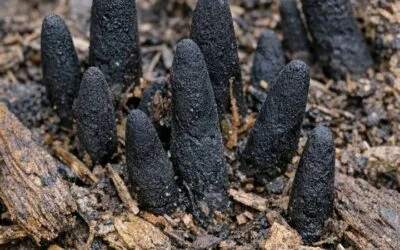
If you’ve ever looked down at your mulch and wondered why something that looks like a cluster of black fingers is pushing through the ground, you’re not alone. The strange growth can look downright creepy, but in many cases it has a much less alarming explanation: a wood-decaying fungus commonly known as Dead Man’s Fingers.
The name sounds dramatic, but these unusual structures are part of the fungus’s natural reproductive process. And if they’re appearing in a bed filled with wood mulch, their presence may simply mean there’s decaying organic material underneath.


What Are Those Black “Fingers”?
The fungus is commonly identified as Xylaria polymorpha, although the name can refer to a group of closely related fungi that can be difficult to distinguish from one another.
Its reproductive structures are usually black, club-shaped, and irregularly finger-like. They may appear alone or in clusters and commonly grow from or near dead wood, old stumps, buried roots, or wood mulch.
Mature growths are typically around 1½ to 4 inches tall, although their shape and size can vary.
The appearance changes as the fungus develops. Younger structures can be pale gray, bluish, or whitish, sometimes with lighter tips. As they mature, they become darker and develop the charcoal-black appearance that gives them their memorable name.
Why Does It Look Like Fingers?
That’s simply the shape of its fruiting bodies.
Several club-like structures can emerge close together, sometimes bending or joining in ways that make them resemble fingers or a hand pushing through the soil.
There’s nothing supernatural about it—and the fungus has nothing to do with decomposing human remains.
The creepy appearance is just one of those amusing coincidences in nature.
Why Is It Growing in My Mulch?
This is probably the most useful clue.
Dead Man’s Fingers feeds on decaying wood and other dead organic material.
Wood chips and bark mulch provide exactly the kind of material that wood-decaying fungi can colonize. The fungus may also be associated with an old buried stump, dead roots, or a piece of decomposing wood beneath the mulch.
Moist, shaded conditions can make the environment even more favorable for fungal growth.
So seeing these structures doesn’t necessarily mean your garden has a problem.
In fact, in a mulch bed, the fungus may simply be doing what decomposers do: breaking down dead organic material and returning nutrients to the ecosystem.
Are They Growing From a Dead Tree or Just the Mulch?
This distinction matters.
If the black structures are scattered through ordinary wood mulch and there’s no sign that a nearby tree or shrub is declining, they may simply be decomposing the mulch.
But if they repeatedly appear right around the base of a living tree or shrub, especially one showing signs of decline, it’s worth taking a closer look. Some fungi in the Xylaria group can be associated with black root rot in susceptible woody plants.
Look for other symptoms such as:
- Declining or thinning foliage
- Branch dieback
- Slow growth
- Basal cankers
- General loss of vigor
The presence of the fungus alone doesn’t prove that a healthy tree is infected.
How Can You Tell If It’s Dead Man’s Fingers?
Several features can point toward this identification.
Look for:
Black or dark brown fingers: Mature structures are usually dark charcoal or black.
Club-like shape: They’re generally thicker than ordinary stems and often look swollen or irregular.
Clusters: Several “fingers” may emerge together.
White interior: When a mature structure is cut open, the inside can be pale or white and tough.
Dead or decaying wood nearby: This is one of the strongest clues.
Still, don’t rely on appearance alone if you’re trying to diagnose a plant disease. University of Wisconsin Extension specifically cautions that plant diseases can be difficult to diagnose by eye.


Are Dead Man’s Fingers Dangerous?
The important distinction is between touching the fungus and eating an unidentified wild fungus.
The growths aren’t something you should treat as food. Penn State Extension advises against eating Xylaria polymorpha.
So don’t let children or pets chew on unidentified mushrooms or fungi in the yard.
And don’t assume that because one particular fungus is harmless to touch, every mysterious mushroom growing nearby is equally safe. Correct identification matters.
If you’re uncertain what you’ve found, take a clear photograph and contact a local extension office or qualified mycologist rather than tasting it.
Will It Hurt My Plants?
Continue Reading For More Helpful Tips →
Continue Reading →
Continue Reading For More Helpful Tips →
Continue Reading →