
Usually, not if it’s simply decomposing mulch or dead wood.
Most of the time, Xylaria polymorpha behaves as a saprobic fungus, meaning it obtains nutrients from dead organic material. Purdue describes it as a wood-rotting fungus living on decaying hardwood stumps and logs, while Penn State describes it as a decomposer of decaying broad-leaved wood.
However, Xylaria species can also be associated with root rot in certain susceptible trees and shrubs.
That’s why the location of the fungus and the condition of nearby plants matter more than the fungus’s creepy appearance.
Should You Remove Them?
If they’re simply growing in your mulch and you don’t like how they look, you can remove the visible fruiting bodies.
University of Wisconsin Extension recommends simply removing and discarding them when they’re growing in wood mulch and aren’t associated with a diseased tree.
But there’s an important catch:
Removing the black fingers doesn’t remove the fungus living in the decaying wood.
The visible structures are reproductive parts of a much larger fungal network. Removing them is mainly a cosmetic measure and may reduce visible spore production; it isn’t a complete eradication method.
What If They’re Growing Beside a Tree?
This is when you should pay more attention.
If you find them directly around the base of an apple, crabapple, pear, cherry, plum, maple, or another susceptible woody plant, inspect the tree for signs of decline.
Don’t automatically cut down a healthy tree just because you found a few black fungal growths.
Instead, look at the whole picture:
- Is the tree losing branches?
- Has growth slowed?
- Are leaves unusually sparse?
- Is there dieback?
- Are there wounds or cankers near the base?
- Is the fungus emerging from an old stump or buried wood?
If the plant appears unhealthy, a local extension plant-disease clinic can help determine whether you’re dealing with simple decomposition or a root-related problem.
Don’t Use Infected Wood as Mulch
If a tree has been confirmed to have a Xylaria-associated root disease, don’t simply turn the infected wood into mulch for another part of the yard.
University of Wisconsin Extension specifically advises against using wood from Xylaria-infected trees as mulch.
That’s a very different situation from finding a few harmless-looking fruiting bodies in ordinary mulch.
What Should You Do Right Now?
If you’ve just discovered these strange black growths, there’s no need to panic.
A practical approach is:
- Take a clear photograph before removing anything.
- Look around the base of nearby trees and shrubs.
- Check whether the growth is emerging from mulch, a stump, or buried wood.
- Inspect nearby plants for signs of decline.
- If everything looks healthy, remove the visible growths if you find them unattractive.
- If a nearby tree is declining or you’re unsure of the identification, contact your local extension service for help.
This approach avoids treating every unusual fungus as a garden emergency.
What About the Spores?
Those black fingers aren’t just strange-looking structures. They’re part of the fungus’s reproductive cycle.
The reproductive structures contain microscopic structures that produce sexual spores. The spores are released through tiny openings in the surface.
That’s why the visible “fingers” can persist for quite a while even after they’ve stopped looking fresh.
They’re essentially the fungus’s way of spreading to new sources of suitable dead wood.
Common Mistakes to Avoid
Assuming the fungus is killing your plant
If it’s growing from mulch or dead wood, it may simply be decomposing that material.
Spraying a fungicide immediately
There’s no reason to reach for a chemical treatment simply because you see a strange fungus in mulch.
First determine what you’re actually dealing with.
Removing the fungus and assuming the problem is solved
Removing the visible fruiting bodies doesn’t remove fungal growth inside decaying wood or roots.
Eating an unidentified fungus
Never use appearance alone to decide whether a wild fungus is edible.
Ignoring a declining tree
If the fungus is appearing around the base of a tree that’s already showing serious symptoms, that’s a reason to investigate further.
Frequently Asked Questions
What are the black fingers growing out of my mulch?
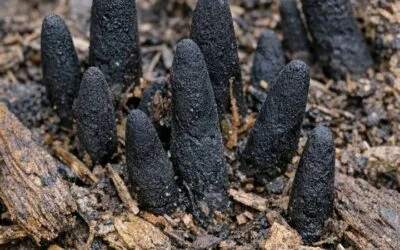
They may be Dead Man’s Fingers, a group of fungi in the genus Xylaria. The best-known species associated with the name is Xylaria polymorpha. They commonly grow from or near decaying wood.
Are Dead Man’s Fingers poisonous?
They should not be eaten. Identification of wild fungi can be difficult, so don’t consume them based on appearance or a photograph alone.
Can I touch them?
The main concern isn’t casual contact. Still, avoid handling unknown fungi unnecessarily and wash your hands afterward. More importantly, don’t allow children or pets to ingest them.
Will they kill my tree?
Not necessarily. Many Xylaria fungi are decomposers of dead wood, but some Xylaria species are associated with root rot in certain trees. If a nearby tree is declining, have the situation evaluated.
Should I pull them out of my garden?
You can remove the visible fruiting bodies if you dislike them. Just understand that this doesn’t eliminate the underlying fungus in the soil or decomposing wood.
Why did they suddenly appear?
Fungal fruiting can become noticeable when environmental conditions are favorable and when enough suitable organic material is available. What looks like a sudden invasion may simply be the stage of the fungus’s life cycle becoming visible.
The Bottom Line
Those creepy black fingers in your mulch may be one of nature’s decomposers rather than a garden disaster.
If they are Dead Man’s Fingers, they’re often associated with decaying wood and may simply be helping break down the mulch beneath your feet.
The one thing worth checking is what’s happening around them. A few fruiting bodies in ordinary mulch are one situation; the same growths appearing around a declining tree are another.
So before reaching for a chemical treatment—or assuming something sinister is growing in your backyard—look at the wood, the mulch, and the health of the plants nearby. That context can tell you far more than the creepy appearance alone.