

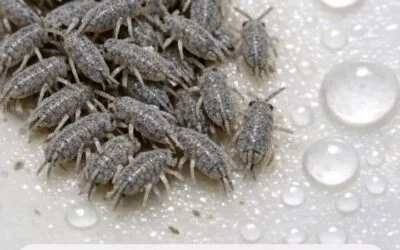
If the bathroom itself seems dry, look beyond it.
Springtails normally live outdoors in soil, leaf litter, mulch, and other moist organic environments. They can move toward buildings when conditions outside become unfavorable.
Look for persistently wet areas near the foundation, excessive mulch, irrigation problems, or water collecting against the house.
Do You Need Bug Spray?
Usually, moisture control is more important than spraying.
University of Maryland Extension specifically says insecticide sprays inside the home are not recommended or necessary for springtails.
That makes sense when you consider the underlying problem: if a damp area remains damp, killing the visible springtails doesn’t remove the conditions attracting them.
You may simply end up seeing more later.
What If They’re Coming From the Drain?
Seeing springtails around a bathtub or sink drain can make it look as though they’re coming up through the plumbing.
But their presence around a drain doesn’t prove that the drain itself is the source.
The surrounding moisture may be what attracts them, and springtails can also enter from nearby areas.
Clean the sink or tub thoroughly, dry the surrounding surfaces, and then watch what happens.
If the numbers continue to return, start looking for moisture around and underneath the fixture rather than automatically reaching for a chemical treatment.
When Should You Take the Moisture Problem Seriously?
A few springtails that disappear after you dry and clean the area aren’t necessarily a major concern.
A persistent or heavy population, however, deserves more attention.
Especially investigate if you also notice:
- A musty odor
- Damp cabinets
- Soft or swollen wood
- Water stains
- Peeling paint
- Persistent condensation
- Mold or mildew
- A floor that stays damp
- A suspected plumbing leak
In that situation, the springtails may simply be the easiest thing to see.
The moisture problem underneath them is what needs attention.
How to Keep Them From Coming Back
Once you’ve dealt with the immediate problem, prevention is fairly straightforward.
Keep bathroom surfaces as dry as practical, use ventilation to reduce humidity, repair leaks promptly, and don’t allow damp organic material to accumulate.
If you have plants near the bathroom, also check their soil and saucers. Overly wet potting soil can provide another suitable environment for springtails.
And if you find gaps or cracks where they may be entering from outside, sealing those openings can help reduce future appearances.
Springtails vs. Fleas: Why the Difference Matters
Tiny jumping creatures can understandably make people think of fleas.
But springtails are different.
Springtails are generally associated with moisture and organic material, while fleas are parasitic insects associated with animals and can bite people.
Springtails are also not flattened in the same way fleas are, and they don’t have wings. Their distinctive jumping mechanism is one of their easiest identifying characteristics.
If you’re uncertain about the identification, a clear close-up photograph can help an extension service or pest professional identify what you’re seeing.
Frequently Asked Questions
Are springtails harmful to people?
No. Springtails do not bite or sting people and are generally considered harmless.
Why do springtails jump?
They have a specialized structure that allows them to propel themselves away when disturbed. That’s why a group of tiny specks can suddenly seem to disappear when you touch the surface.
Why are they suddenly everywhere?
Large numbers can develop when moisture and suitable food sources are available. Outdoor populations can also move indoors when environmental conditions change.
Will springtails eventually go away?
They often decline or disappear when the conditions supporting them—especially excess moisture—are corrected.
Should I call an exterminator?
Not necessarily for a small, temporary appearance. If the insects persist despite drying and cleaning the area, or if you suspect a hidden leak or moisture problem, a plumber or pest professional may be appropriate depending on what you find.
The Bigger Clue Isn’t the Bug
Seeing hundreds of tiny gray specks jumping around your bathtub or sink can certainly be startling.
But if they are springtails, the insects themselves are usually not the thing to worry about.
Think of them as a small warning sign: somewhere nearby, conditions may be staying wetter than they should.
Clean the area, dry it thoroughly, check for leaks and condensation, and investigate the surrounding moisture sources if the problem keeps returning. Once the environment becomes dry and less hospitable, the springtails generally have much less reason to stick around.